Australia's employment surged by 39,500 in August; will the Reserve Bank of Australia raise interest rates next week?
2026-09-24 10:58:13
On Thursday (September 24) during Asian trading hours, the Australian dollar continued its decline against the US dollar from the previous day, hitting a low of 0.7017, its lowest level since August 5. As the exchange rate refreshed its recent lows, the latest Australian employment data became a key reference for the market to assess the Reserve Bank of Australia's policy path. Australian employment growth in August far exceeded expectations, reversing the unexpected decline in July, but the unemployment rate still rose to its highest level since the end of 2021, as the number of people joining the labor force surged faster than the hiring rate. 
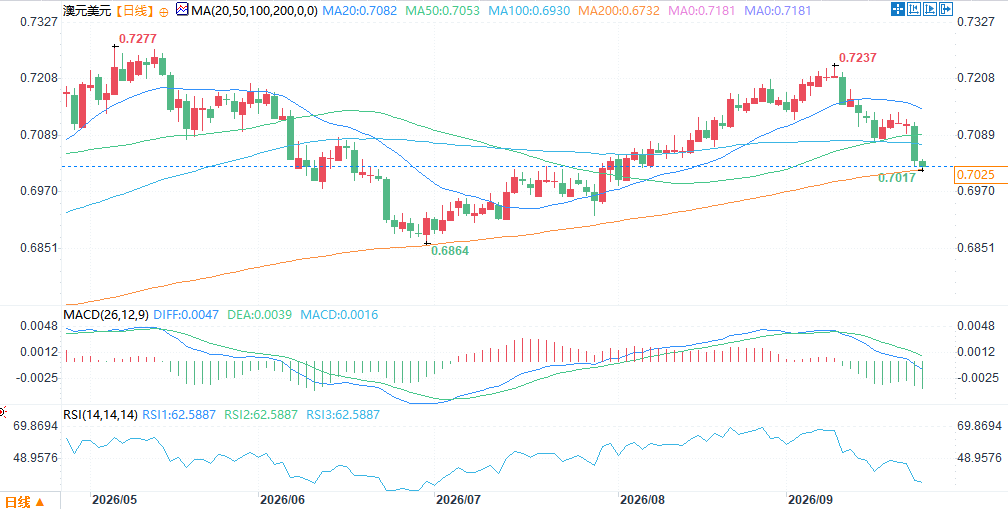 (Australian dollar to US dollar daily chart, source: EasyForex) At 10:56 Beijing time, the Australian dollar to US dollar exchange rate was 0.7035/36.
Job growth doubled, but full-time positions decreased, with part-time jobs contributing all the increase.
Job gains totaled 39,500, roughly double the market expectation of 20,000, following a decrease of 15,800 in July. However, the details were less robust than the overall picture: full-time positions decreased by 6,300, while part-time positions accounted for the entire increase, rising by 45,800. Over the past three months, employment has averaged 34,000 new jobs per month. This structure suggests concerns about the quality of job growth, with the contrast between the decrease in full-time positions and the surge in part-time positions potentially reflecting a greater preference for flexible employment amid uncertainty.The unemployment rate rose to 4.6%, and the participation rate jumped to 67.1%.
The unemployment rate rose to 4.6% from 4.5%, higher than economists' expectations of stability. The increase reflected a jump in the participation rate from 66.9% to 67.1%, as a larger proportion of Australians entered the workforce looking for work. The unrounded unemployment rate was approximately 4.65%, close to 4.7% when rounded. Monthly hours worked increased by 0.7%, and the underemployment rate fell to 6.2%, indicating that the labor market retains some underlying strength despite the overall rise in unemployment. This result contradicts a more optimistic outlook – National Australia Bank had previously favored a drop in the unemployment rate to 4.4%, and considered this forecast close given that the July unemployment rate was slightly below 4.5% before rounding.The National Bureau of Statistics has changed its methodology; it is advised to treat seasonally adjusted data with caution.
The National Bureau of Statistics (NBS) also highlighted a methodological change affecting this release. The NBS introduced a new data collection model for its supplemental survey, designed to eliminate distortions previously observed in the February and August labor force data. The NBS noted that this distortion may have inadvertently captured some seasonal patterns, but testing showed that its impact on monthly variations should be less than normal sampling noise, making the August data suitable for use. The NBS advises users to keep the potential impacts in mind when using the seasonally adjusted August data and reiterates that trend data remains the best indicator of underlying labor market conditions.Reserve Bank of Australia focuses on inflation
Following the data release, the Australian dollar fell slightly against the US dollar, by approximately 0.25%. Analysts believe the data is unlikely to change the Reserve Bank of Australia's (RBA) near-term thinking, given robust job growth and the fact that the rise in the unemployment rate was driven by participation rather than unemployment itself; the case for a rate hike at next week's meeting remains valid. The interest rate market may interpret the rise in the unemployment rate as a supply-side story driven by participation, keeping the focus on inflation and the RBA's decision next week.Summarize
Australia's August employment data presented a mixed picture: better-than-expected employment figures but a rising unemployment rate. Employment increased by 39,500, roughly double the expected figure, but full-time positions decreased by 6,300, with part-time jobs contributing all the gains. The unemployment rate rose to 4.6%, driven by a jump in the participation rate to 67.1%, rather than an increase in unemployment. Changes in the Bureau of Statistics' methodology have increased uncertainty; it is recommended to refer to trend data. Analysts believe the data is unlikely to change the Reserve Bank of Australia's (RBA) recent stance, and the rationale for a rate hike next week remains valid. Going forward, attention should be paid to the RBA's policy decision next week, inflation data, and subsequent revisions to trend labor force data to determine whether the rising unemployment rate is a supply-side phenomenon or the beginning of weakening demand. (Australian dollar to US dollar daily chart, source: EasyForex) At 10:56 Beijing time, the Australian dollar to US dollar exchange rate was 0.7035/36.
- Risk Warning and Disclaimer
- The market involves risk, and trading may not be suitable for all investors. This article is for reference only and does not constitute personal investment advice, nor does it take into account certain users’ specific investment objectives, financial situation, or other needs. Any investment decisions made based on this information are at your own risk.