The 10-year US Treasury yield hit a new high since July 2007. What impact will this have on the US economy?
2026-09-24 10:12:12
On Wednesday (September 23), U.S. Treasury yields rose sharply, and the impact of this bond market turmoil extends far beyond the federal government's massive $40 trillion debt. Higher yields will push up borrowing costs across society, placing greater repayment pressure on everyone from homebuyers to credit card users. While depositors may see a slight increase in interest rates, the gains are very limited. Banks, theoretically, could benefit, but they also face the risks associated with a cooling economy. Inflation data, expectations of a Fed rate hike, weak demand at Treasury auctions, and large-scale bond issuance by cloud service providers all contributed to this round of U.S. Treasury sell-offs. Even Treasury Secretary Scott Bessant's introduction of long-term bond repurchase operations failed to curb the upward trend in yields.
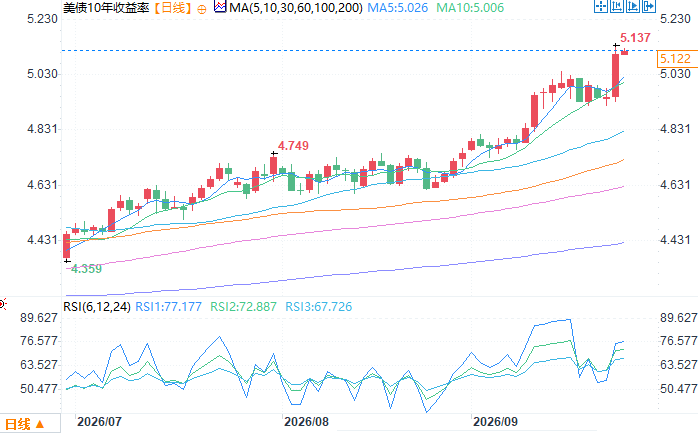 10-year US Treasury yield daily chart. Source: EasyTrade. At 10:11 AM Beijing time on September 24th, the 10-year US Treasury yield was 5.126%.
Multiple negative factors combined to push US Treasury yields to multi-year highs.
U.S. Treasury financing costs surged on Wednesday, driven by a confluence of negative factors. Latest data showed persistent inflationary pressures, with the market betting on another Federal Reserve rate hike in October. Meanwhile, weak demand was evident in the 5-year Treasury auction results, and continued debt issuance by large-scale cloud service providers further exacerbated supply pressures in the bond market. This round of yield increases was the largest in nearly a year and a half; the last time such a dramatic market movement occurred was in April 2025, when Trump first announced retaliatory tariffs on trading partners. U.S. Treasury Secretary Scott Bessenter previously introduced a series of market liquidity support measures, increasing long-term Treasury repurchase operations, but so far, these measures have not stabilized the bond market, and long-term yields continue to rise. As a benchmark for long-term loans such as mortgages, the 10-year Treasury yield reached 5.137%, reaching levels seen before the global financial crisis. The 2-year Treasury yield, which mainly reflects Fed policy expectations and is linked to home equity and auto loan yields, rose by more than 13 basis points, breaking through 4.9%. Traders priced in a significantly increased likelihood of another Fed rate hike in October after last week's rate increase.Household debt pressures are intensifying, and rising deposit interest rates are failing to offset the impact of borrowing costs.
Rising US Treasury yields will ultimately impact the US real economy, affecting ordinary consumers. Household consumption contributes nearly 70% of US economic activity, and total household debt is close to $19 trillion. Higher borrowing rates will directly increase the financial burden on households. Dan North, senior economist at Allianz Trader for North America, stated that while bank deposit rates will rise slightly, the increased returns will be far from offsetting the increased spending on borrowing. He said, "Consumers are the most important component of the economy. The slight increase in deposit returns from a very low level will have limited help for ordinary households. However, high interest rates will severely damage the housing market, and credit cards and various personal consumer loans will also be impacted." Data from the Federal Deposit Insurance Corporation (FDIC) shows that the interest rate for ordinary savings accounts is approximately 0.37%, and has been declining slightly since the Federal Reserve's three rate cuts at the end of 2025. In contrast, mortgage rates are trending in the opposite direction, with the average 30-year mortgage rate reaching 7.26%, an increase of more than 0.25 percentage points in just two weeks, and a cumulative increase of nearly 1 percentage point over the past year. Credit card interest rates have remained relatively stable in recent years, but if the current upward trend continues, credit card interest rates will also rise. The Federal Reserve's rate hikes directly impact the benchmark interest rate, which is also the pricing benchmark for floating-rate credit products. After the Fed's rate hike last week, the benchmark interest rate increased by 25 basis points to 7%. A rise in the federal funds rate will raise interest rates across the entire yield curve, increasing the barriers to obtaining car loans and consumer loans, reducing borrowing willingness, and dragging down aggregate demand. North explains that higher interest rates will reduce demand for cars, leading to a decline in car demand, which in turn affects employment in the auto industry, ultimately slowing the economy—this is the basic logic of interest rate transmission.High interest rates present both advantages and disadvantages, raising concerns about banks' profit expectations, while small and medium-sized enterprises are the hardest hit.
The high-yield environment also presents some localized benefits. Besides depositors receiving a small amount of interest, the banking sector has opportunities for improved profitability. The banking profit model relies on multiple factors; in a rising interest rate environment, banks can increase the interest rates charged to borrowers, widening the deposit-loan interest rate spread, and improving the investment returns on idle funds. However, most bank stocks fell on Wednesday because the sharp rise in yields will suppress loan demand and drag down previously stable economic activity. Data tracked by the Atlanta Federal Reserve shows that the estimated GDP growth rate for the third quarter in the United States reached 5.1%, and this strong economic data itself is a factor pushing up US Treasury yields. However, persistently high yields will disrupt the current economic growth pattern. North points out that small and medium-sized enterprises (SMEs) are the most severely impacted, as these enterprises have fewer financing channels, reduced credit availability, and significantly increased operational difficulties.Conclusion
In summary, the recent surge in US Treasury yields is the result of multiple factors, including inflation, expectations of interest rate hikes, and the supply of Treasury bonds. High yields exacerbate the interest payment pressure on the US federal government's $40 trillion debt, and this pressure is also cascading down to the household level, raising costs across mortgages, consumer loans, and credit cards. While depositors' savings yields have increased only slightly, insufficient to offset household debt pressures, banks may see their interest rate spreads widened. However, shrinking loan demand and a slowing economy will offset some of the positive effects, with small and medium-sized enterprises bearing the brunt. The Fed's expected October rate hike, inflation data, and the outcome of US Treasury auctions will continue to influence long-term bond yields. The duration of the rising interest rates will determine how much downward pressure the US economy can withstand. 10-year US Treasury yield daily chart. Source: EasyTrade. At 10:11 AM Beijing time on September 24th, the 10-year US Treasury yield was 5.126%.
- Risk Warning and Disclaimer
- The market involves risk, and trading may not be suitable for all investors. This article is for reference only and does not constitute personal investment advice, nor does it take into account certain users’ specific investment objectives, financial situation, or other needs. Any investment decisions made based on this information are at your own risk.