Gold prices fell below the key support level of $4,300, but strategists say the downside is limited and gold could potentially reach $5,000 next year.
2026-09-24 11:06:13
International gold prices have been under pressure recently, with spot gold closing below the key support level of $4,300 per ounce on Wednesday (September 23). Ryan McKay, senior commodities strategist at TD Securities, stated in his latest market commentary that although gold prices have experienced a short-term pullback, the downside is relatively limited. Multiple long-term supporting factors are accumulating strength, and gold is expected to launch another upward attack in 2027, challenging the target price of $5,000 per ounce . While the high-interest-rate environment brought about by the Fed's rate hikes continues to exert short-term pressure, the underlying investment demand for gold remains resilient, and the traditional negative correlation between interest rates and gold prices has been broken.
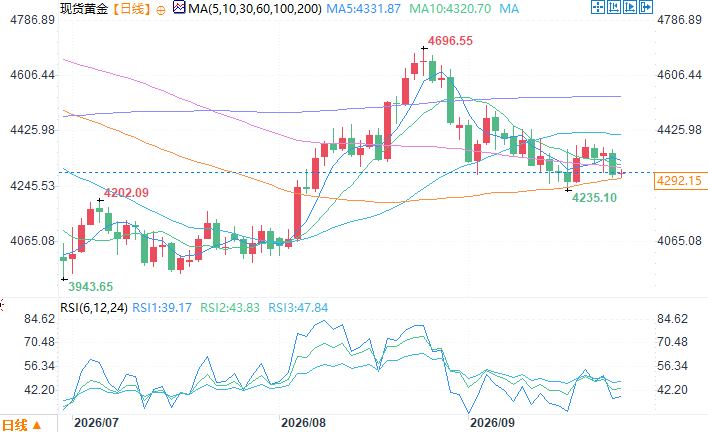 Spot gold daily chart source: FX678. At 11:05 AM Beijing time on September 24, spot gold was trading at $4289.55 per ounce.
Traditional pricing logic is failing, and multiple macroeconomic risks underpin the value of gold as an investment.
Ryan McKay stated that high interest rates and high real yields, according to classic theory, should suppress the price of gold, a non-interest-bearing asset. However, the traditional correlation between gold and interest rates has now failed. Historically, there have been instances where rising real yields coincided with rising gold prices; however , this inverse relationship fails when macroeconomic risks dominate market sentiment. TD Securities believes that persistent geopolitical uncertainty, the trend of de-dollarization, concerns about currency devaluation, deteriorating fiscal conditions, and lingering inflationary anxieties are collectively supporting investment demand for gold . The market has already priced in three more rate hikes by the Federal Reserve, creating an asymmetric trading opportunity for gold. If the Fed ultimately fails to deliver on its expected number of rate hikes, gold prices are likely to experience a rapid upward trend . McKay said, "The timing for a new round of gold price increases is gradually maturing. Even with continued Fed rate hikes, gold prices have shown strong resilience. As investors and central banks' willingness to buy gold heats up again, gold is expected to challenge $5,000/ounce again in 2027. "Fund flows have quietly improved, and there is still ample room for speculative positions to be increased.
Beneath the surface of tightening interest rates, a significant shift is occurring in the internal funding structure of the gold market. Since June, macro-level institutional investors have been continuously rebuilding their net long positions in gold, while speculative long positions have been slowly recovering. This buying power supported gold prices during the summer, and even as market expectations for interest rate hikes intensified, buying remained resilient. Initially, factors driving the influx of funds included escalating geopolitical risks, central bank gold purchases, and market skepticism about the Federal Reserve's ability to control inflation. More recently, market concerns about the US fiscal situation and currency devaluation have led investors to continue allocating to gold despite continued monetary policy tightening. Current speculative positions remain relatively low, and institutional gold positions are still about 30% below their 2022 highs and 50% lower than the historical peak in 2016, indicating significant room for further accumulation. Inflows into gold ETFs in Western markets are also recovering. TD Securities estimates that global gold ETFs have cumulatively increased their holdings by approximately 6.3 million ounces since July, and the momentum of inflows has not slowed despite the Federal Reserve's renewed tightening cycle . McKay stated that although the inflow of funds has improved, this is only the beginning of a new bull market.Central bank gold purchases have created a price floor, with major Asian markets becoming the core pillar of demand.
Central banks worldwide continue to purchase gold, providing solid support for gold prices. Based on customs data, trade flows, and inventory discrepancies, the three-month moving average of global central bank gold purchases is close to 70 tons per month. McKay believes that official institutions will adopt a buy-on-dips strategy, increasing purchases once gold prices fall to current levels or lower. Major Asian countries are among the most important sources of global gold demand. This year, non-monetary gold imports in these countries reached a record high, driven by demand from domestic central banks, institutional investors, individual buyers, and gold ETFs. The country's central bank has increased its gold reserves for 22 consecutive months, and TD Securities believes the actual scale of its purchases is likely higher than the officially reported figures. Domestic gold ETFs continue to receive inflows, and the net gold holdings of large traders on the country's futures exchange are near their highest levels since TD Securities began tracking data in 2017.Conclusion
In summary, the recent pullback in gold prices after breaking below the $4,300 support level is likely a temporary correction rather than a trend reversal. Continued central bank gold purchases, global ETF inflows, low speculative positions, coupled with long-term concerns about inflation, fiscal deterioration, and currency devaluation, collectively form the underlying support for gold. Even if the Federal Reserve maintains a tight monetary policy, the continued inflow of long-term funds can help gold withstand the negative impact of high interest rates, driving a new bull market. Institutions are optimistic that gold prices will break through $5,000 per ounce by 2027. Investors should continue to monitor the Federal Reserve's policy statements, central bank gold purchase data, and global gold ETF fund flows to identify turning points in the gold market. Spot gold daily chart source: FX678. At 11:05 AM Beijing time on September 24, spot gold was trading at $4289.55 per ounce.
- Risk Warning and Disclaimer
- The market involves risk, and trading may not be suitable for all investors. This article is for reference only and does not constitute personal investment advice, nor does it take into account certain users’ specific investment objectives, financial situation, or other needs. Any investment decisions made based on this information are at your own risk.