Hawkish interest rate expectations from the Federal Reserve have pushed the dollar to an eight-week high, and it may accelerate its upward movement in the short term.
2026-09-24 14:34:12
The US dollar continued its strong performance from the previous trading day in Asian trading on Thursday, with the US Dollar Index (DXY) remaining above 101.00. It had risen to around 101.23 in the previous session, hitting a roughly eight-week high. So far this week, the US dollar has generally strengthened against major currencies, rising approximately 1.17% against the Australian dollar, 1.13% against the British pound, and 0.91% against the euro, indicating that the recent strength of the US dollar has a broad market basis.  The core factors driving the dollar's strength are improved US economic data and renewed inflation expectations. The preliminary S&P Global Composite PMI for September rose to 58.4, significantly higher than August's 56.0; the manufacturing PMI rose to 57.0, also significantly higher than the previous 53.9. Although service sector activity slowed, overall business activity remained at a high level, indicating that the US economy continued to maintain strong momentum in the third quarter. Chris Williamson, S&P Global's chief business economist, stated that US business activity continued to expand rapidly, with September's output growth reaching one of the highest levels in over five years. Historically, the latest survey results correspond to an annualized economic growth rate of approximately 5%, with overall third-quarter growth potentially reaching around 4%. If the US economy continues to maintain this resilience, market expectations for rapid easing by the Federal Reserve may further decline. The rebound in oil prices also increased policy support for the dollar. Crude oil prices rebounded after a period of decline, and rising energy costs are likely to be transmitted to broader economic sectors through transportation, production, and consumption prices. With strong demand in the US economy, inflationary pressures from rising oil prices are attracting more market attention and further reinforcing expectations that the Federal Reserve will maintain higher interest rates for a longer period. Recent comments from Fed officials have also reinforced this policy backdrop. Some officials pointed out that rising energy prices and strong demand could hinder the process of inflation falling back. Fed Governor Michael Barr previously stated that further policy adjustments may still be needed to control inflation. The market has therefore renewed its focus on future interest rate hikes, providing some support for the US dollar and US Treasury yields. Looking at the performance of major currencies, the US dollar has seen significant gains against the Australian dollar, British pound, and euro this week. The Australian dollar, influenced by both the strengthening US dollar and changes in risk sentiment, has become one of the weakest major currencies against the US dollar recently; the British pound and euro have been affected by differences in monetary policy expectations between the US and UK, and the US and Europe, respectively. Meanwhile, the Japanese yen, Canadian dollar, and Swiss franc have also weakened to varying degrees against the US dollar. However, the current rise in the US dollar is also beginning to accumulate technical risks. The US dollar index RSI has entered overbought territory, meaning that after continuous gains, the market may experience profit-taking in the short term. If subsequent US economic data fails to exceed expectations, or if Fed officials' speeches become more cautious, the recent gains in the dollar may face some corrective pressure. Therefore, it is necessary to pay attention to the number of initial jobless claims in the US, subsequent speeches by Fed officials, and US inflation-related data. At the same time, crude oil prices cannot be ignored. If oil prices continue to strengthen and push up inflation expectations again, the dollar may receive additional support; if oil prices fall significantly and US economic data cools down, the pressure for a pullback in the dollar from its high level may increase. The daily structure of the dollar index remains significantly strong, and the current price is running above the 20-day EMA, which is about 99.98, and has turned from resistance to important trend support. As long as the dollar index remains above this moving average, the overall bullish structure in the short term has not been broken. The first thing to watch above is the recent high near 101.23. If it breaks through effectively, it may further open up upward space; however, the RSI (14) is about 71.01, which has entered the overbought zone, indicating that the short-term upward trend is relatively concentrated, and the risk of subsequent fluctuations or technical pullbacks is increasing. From a 4-hour chart perspective, the US dollar index has maintained strong momentum after its previous consecutive rise, but the risk of chasing the rally at higher levels has increased significantly. If the price can hold above 101.00 and break through 101.23, the bulls may continue their upward attack; if it encounters resistance and falls below 100.50, the 100.00 psychological level and the 20-day EMA support around 99.98 should be monitored. If the daily chart further breaks below 99.98, the current strong structure may turn into a deeper correction; conversely, as long as the core moving average support remains effective, the dollar's pullback may still be seen as a technical correction within a strong market trend.
 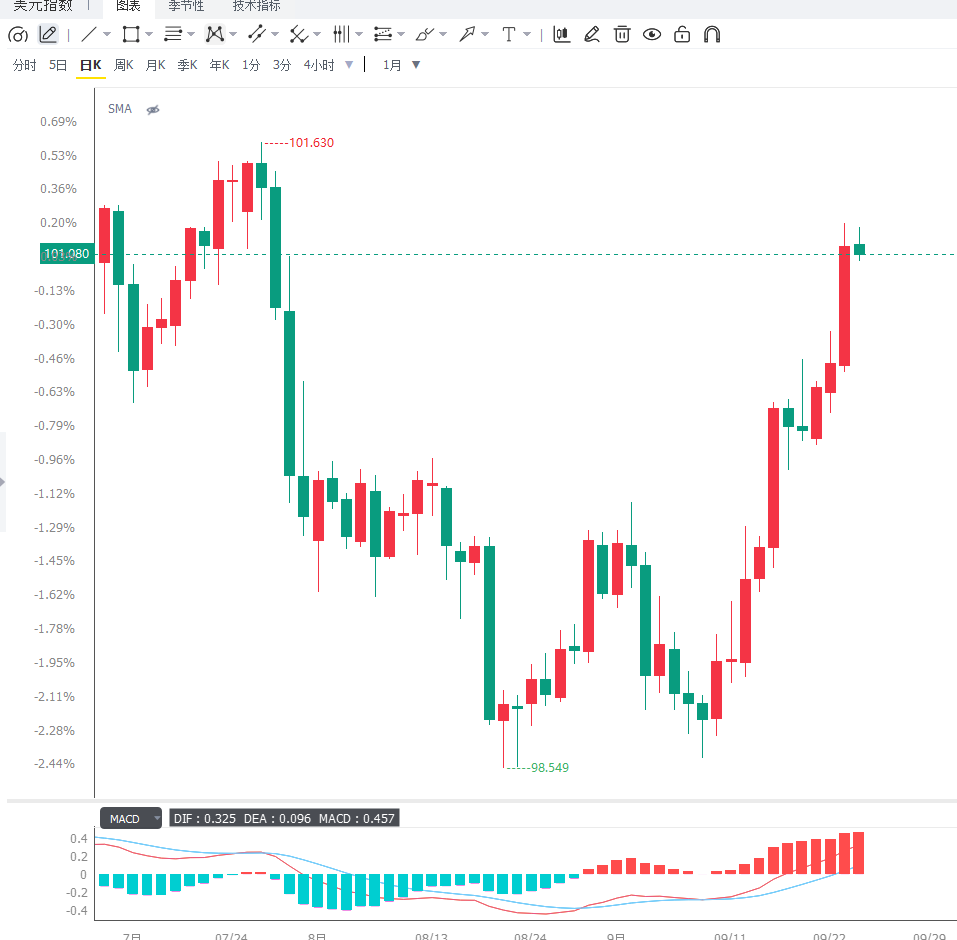 Editor's Summary: The recent strength of the US dollar is mainly driven by the resilience of the US economy, the rebound in energy prices, and expectations of a hawkish Federal Reserve policy. The US dollar index has reached a relatively high level after rising to around 101.23. While the fundamentals remain favorable for the dollar, overbought technical indicators suggest potential increased short-term volatility. Subsequent US economic data, Fed policy signals, and oil price movements will continue to influence the dollar's direction. 101.23 is a key level to watch for a short-term breakout, while 99.98 is a crucial support level for determining whether the current upward structure will hold.
The core factors driving the dollar's strength are improved US economic data and renewed inflation expectations. The preliminary S&P Global Composite PMI for September rose to 58.4, significantly higher than August's 56.0; the manufacturing PMI rose to 57.0, also significantly higher than the previous 53.9. Although service sector activity slowed, overall business activity remained at a high level, indicating that the US economy continued to maintain strong momentum in the third quarter. Chris Williamson, S&P Global's chief business economist, stated that US business activity continued to expand rapidly, with September's output growth reaching one of the highest levels in over five years. Historically, the latest survey results correspond to an annualized economic growth rate of approximately 5%, with overall third-quarter growth potentially reaching around 4%. If the US economy continues to maintain this resilience, market expectations for rapid easing by the Federal Reserve may further decline. The rebound in oil prices also increased policy support for the dollar. Crude oil prices rebounded after a period of decline, and rising energy costs are likely to be transmitted to broader economic sectors through transportation, production, and consumption prices. With strong demand in the US economy, inflationary pressures from rising oil prices are attracting more market attention and further reinforcing expectations that the Federal Reserve will maintain higher interest rates for a longer period. Recent comments from Fed officials have also reinforced this policy backdrop. Some officials pointed out that rising energy prices and strong demand could hinder the process of inflation falling back. Fed Governor Michael Barr previously stated that further policy adjustments may still be needed to control inflation. The market has therefore renewed its focus on future interest rate hikes, providing some support for the US dollar and US Treasury yields. Looking at the performance of major currencies, the US dollar has seen significant gains against the Australian dollar, British pound, and euro this week. The Australian dollar, influenced by both the strengthening US dollar and changes in risk sentiment, has become one of the weakest major currencies against the US dollar recently; the British pound and euro have been affected by differences in monetary policy expectations between the US and UK, and the US and Europe, respectively. Meanwhile, the Japanese yen, Canadian dollar, and Swiss franc have also weakened to varying degrees against the US dollar. However, the current rise in the US dollar is also beginning to accumulate technical risks. The US dollar index RSI has entered overbought territory, meaning that after continuous gains, the market may experience profit-taking in the short term. If subsequent US economic data fails to exceed expectations, or if Fed officials' speeches become more cautious, the recent gains in the dollar may face some corrective pressure. Therefore, it is necessary to pay attention to the number of initial jobless claims in the US, subsequent speeches by Fed officials, and US inflation-related data. At the same time, crude oil prices cannot be ignored. If oil prices continue to strengthen and push up inflation expectations again, the dollar may receive additional support; if oil prices fall significantly and US economic data cools down, the pressure for a pullback in the dollar from its high level may increase. The daily structure of the dollar index remains significantly strong, and the current price is running above the 20-day EMA, which is about 99.98, and has turned from resistance to important trend support. As long as the dollar index remains above this moving average, the overall bullish structure in the short term has not been broken. The first thing to watch above is the recent high near 101.23. If it breaks through effectively, it may further open up upward space; however, the RSI (14) is about 71.01, which has entered the overbought zone, indicating that the short-term upward trend is relatively concentrated, and the risk of subsequent fluctuations or technical pullbacks is increasing. From a 4-hour chart perspective, the US dollar index has maintained strong momentum after its previous consecutive rise, but the risk of chasing the rally at higher levels has increased significantly. If the price can hold above 101.00 and break through 101.23, the bulls may continue their upward attack; if it encounters resistance and falls below 100.50, the 100.00 psychological level and the 20-day EMA support around 99.98 should be monitored. If the daily chart further breaks below 99.98, the current strong structure may turn into a deeper correction; conversely, as long as the core moving average support remains effective, the dollar's pullback may still be seen as a technical correction within a strong market trend. Editor's Summary: The recent strength of the US dollar is mainly driven by the resilience of the US economy, the rebound in energy prices, and expectations of a hawkish Federal Reserve policy. The US dollar index has reached a relatively high level after rising to around 101.23. While the fundamentals remain favorable for the dollar, overbought technical indicators suggest potential increased short-term volatility. Subsequent US economic data, Fed policy signals, and oil price movements will continue to influence the dollar's direction. 101.23 is a key level to watch for a short-term breakout, while 99.98 is a crucial support level for determining whether the current upward structure will hold.
- Risk Warning and Disclaimer
- The market involves risk, and trading may not be suitable for all investors. This article is for reference only and does not constitute personal investment advice, nor does it take into account certain users’ specific investment objectives, financial situation, or other needs. Any investment decisions made based on this information are at your own risk.