Iran's proposal to strike across the entire Gulf region has raised the risk premium for crude oil.
2026-09-24 18:34:16
On Thursday (September 24), during the Asian and European sessions, WTI crude oil futures experienced a sharp rise followed by a fall, influenced by news of Iran expanding its strike area. Currently, it is up 1.15% and trading around 93.26. During the recent UN General Assembly in New York, the US and Iran held multiple rounds of indirect talks mediated by Qatar, becoming a core focus of geopolitical pricing in the oil market. Iranian officials stated that the next phase of action could extend to the Indian Ocean, meaning Iran's strike range could cover the entire Gulf region. The market initially hoped for a phased ceasefire to ease shipping deadlock, reduce geopolitical risks in the Middle East, and alleviate disruptions to oil transportation. However, judging from the latest negotiation progress and statements from both sides, this round of diplomatic consultations has not yielded any substantial breakthroughs. Core differences have become entrenched, and Iran has proactively escalated its geopolitical tactics and amplified geopolitical pressure across the board. Coupled with the continued pressure on Iran's domestic economy caused by the US's extreme sanctions, the risks to the Middle East energy supply chain have increased across the board, solidifying the geopolitical floor for international oil prices and continuously pushing up the risk premium for crude oil. 
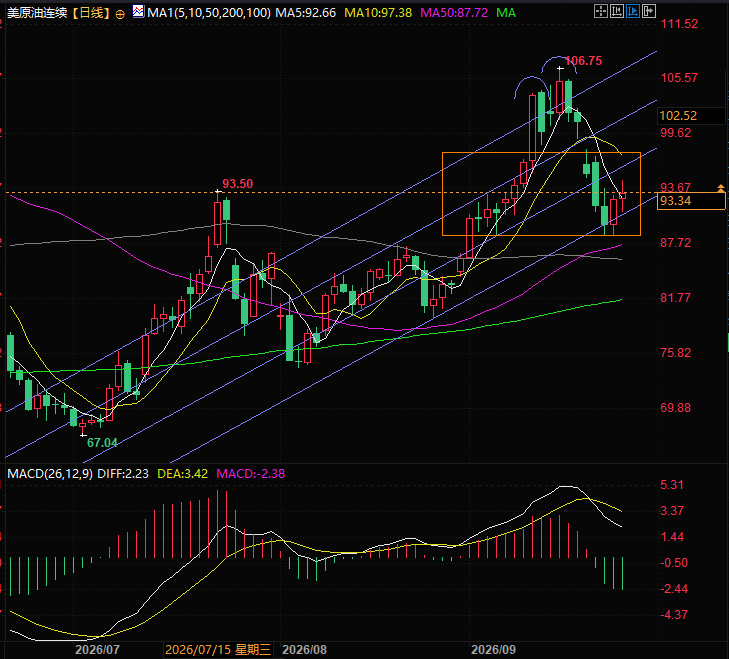 (WTI crude oil futures main contract continuous daily chart, source: EasyTrade) At 18:26 Beijing time, WTI crude oil is currently trading at $93.24 per barrel.
UN General Assembly negotiations have reached a complete deadlock, with the core contradictions irreconcilable.
The recent US-Iran negotiations employed a remote communication model, with US envoys Steve Witkov and Jared Kushner and Iranian Foreign Minister Araghchi in separate rooms, their demands relayed by Qatari personnel. This inherently limited the negotiation mechanism, hindering the achievement of deep consensus. The core issue that led to the breakdown in negotiations centered on control of shipping in the Strait of Hormuz, a crucial energy issue. Iran proactively proposed a phased solution, outlining a roadmap including a 60-day nationwide ceasefire, a phased reopening of the Strait of Hormuz, and a timetable for normalized negotiations, attempting to use the opening of shipping as leverage to secure the lifting of US sanctions and blockades. However, the US directly rejected this proposal, strongly questioning Iran's negotiating rights. The core position was that the Strait of Hormuz is an international public waterway, and Iran has no right to unilaterally control it, nor is it qualified to use it as a bargaining chip. The complete opposition on core interests directly led to the failure of this round of UN General Assembly negotiations, with no clear path for subsequent consultations. Simultaneously, both sides adopted a thoroughly hardline diplomatic stance, completely shattering market expectations of reduced risk aversion. Iranian President Peskov clearly stated during the UN General Assembly debate that Iran is willing to engage in dialogue and cooperation, but will never succumb to US sanctions, military threats, or power pressure. Iran will not sacrifice its national sovereignty and security for reconciliation, and criticized the West's double standards in Middle Eastern affairs, insisting on relying on its own defense capabilities to ensure national security. Meanwhile, the US continues its strategy of maximum pressure, with Trump publicly making extreme statements about "completely destroying Iran," coupled with the US's continued naval blockade. The US-Iran rivalry has entered a "no-buffer, no-compromise" jungle law stage. Security analysts clearly point out that both the US and Iran are currently disregarding international law, and the normalization and escalation of geopolitical conflict in the Middle East is a growing trend.Iran faces escalating pressure both internally and externally, and is proactively intensifying its energy geopolitical pressure.
Faced with the comprehensive and extreme blockade by the United States, Iran's domestic economy and people's livelihoods have suffered severe blows, forcing it to abandon moderate negotiations and instead actively exert pressure on the global market through energy and shipping leverage, forming a positive risk cycle of "the stronger the blockade, the fiercer the countermeasures." The "steel barrier" maritime blockade implemented by the United States has precisely struck at Iran's economic lifeline. Currently, over 80%-90% of Iran's international flights have been forced to close, and overseas personnel exchanges and import and export of goods have almost come to a standstill. The United States has even stated that it cannot guarantee the return journey of the Iranian delegation attending the conference. The maritime blockade has directly cut off Iran's vital oil and gas export channels, while the vast majority of imported goods cannot enter the country, putting immense pressure on domestic industrial supply chains and the supply of essential goods. With maritime transport paralyzed, Iran has been forced to rely entirely on the Gurbulak land port in Turkey for land trade, which has become a vital economic lifeline for Iran. However, land transport capacity is extremely limited and cannot replace the massive volume of maritime oil and gas trade and goods transportation. The port is congested for kilometers year-round, and truck drivers face transport cycles of 40 days to two months, resulting in a sharp decline in people's income and a significant increase in the pressure on people's livelihoods. Faced with dual economic and livelihood difficulties, Iran has completely abandoned any illusions of compromise and launched a comprehensive geopolitical countermeasure. In addition to continuing to strengthen shipping control in the Strait of Hormuz and proposing tolls for passing merchant ships, an advisor to Iran's Supreme Leader has officially released a strong and authoritative signal: if the United States and Israel launch another military strike, Iran will no longer be confined to its traditional combat zones of the Persian Gulf, the Strait of Hormuz, and the Red Sea, but will extend the conflict directly to the entire Indian Ocean and even further afield. This statement has fundamentally rewritten the pricing logic for Middle Eastern oil risk.Risks are spreading across the board, requiring a restructuring of the crude oil market trading logic.
Previously, geopolitical risks in the market were limited to traditional oil shipping routes such as the Strait of Hormuz and the Red Sea, and the impact of these risks was relatively controllable. However, with Iran expanding its strategic scope to the Indian Ocean, the entire global core oil shipping network has been exposed to risk. The Indian Ocean is home to the world's most important oil export, transshipment, and import ports, encompassing key Gulf oil export nodes such as Fujairah in the UAE, Yanbu in Saudi Arabia, and Bandar Abbas in Iran, as well as key Asian and African oil receiving and transshipment hubs such as Mundra in India, Gwadar in Pakistan, Kyaukpyu in Myanmar, and Mombasa in Kenya. This means that even if some ports and shipping routes can bypass the Strait of Hormuz to avoid risks, they cannot escape the entire Indian Ocean shipping system. Once the conflict escalates, the entire global oil export, transshipment, and import chain will be disrupted, and the stability of global oil supply will be significantly reduced. The core trading logic of the current oil market has completely shifted: from the original "pricing based on supply and demand fundamentals" to geopolitical premium pricing driven by the normalization of the US-Iran rivalry and the pervasive nature of shipping risks. With no substantial progress in US-Iran negotiations and both sides' hardline stances solidified, coupled with Iran's domestic economic pressure forcing continued countermeasures, there is no window for easing geopolitical risks in the Middle East. Any further developments will continue to push oil prices higher. Until the US-Iran conflict completely de-escalates and shipping order is restored, international oil prices will continue to be supported by geopolitical risks, maintaining a strong and volatile pattern. Technically, WTI crude oil futures have rebounded back into an upward channel after repeatedly testing the bottom of their trading range. (WTI crude oil futures main contract continuous daily chart, source: EasyTrade) At 18:26 Beijing time, WTI crude oil is currently trading at $93.24 per barrel.
- Risk Warning and Disclaimer
- The market involves risk, and trading may not be suitable for all investors. This article is for reference only and does not constitute personal investment advice, nor does it take into account certain users’ specific investment objectives, financial situation, or other needs. Any investment decisions made based on this information are at your own risk.