Will long-term interest rates continue? Williams' question is rewriting dollar pricing.
2026-09-24 18:36:13
On Thursday, September 24th, New York Fed President John Williams, at a macroeconomic policy forum, brought policy discussions back to a harder constraint: downside risks to employment have diminished, but inflation remains the main obstacle to bringing price stability back to the 2% target. His words were unambiguous: "Traders think another rate hike this year might be appropriate, which I see as a reasonable line of thinking. But we must continue to look at the data and assess information as we did between July and September." Currently, the dollar index is trading around 101, and the yield on the 10-year US Treasury note recently touched approximately 5.12%, near its highest level since 2007, before consolidating at high levels, while the 2-year yield hovers around 4.90%. Market pricing in a further 25 basis point rate hike by the Fed in October has risen to approximately 77%. 
 Following the policy rate hike in mid-September, the US dollar index rose from its consolidation range around 99, consistent with the simultaneous increase in the yields of 2-year and 10-year US Treasury bonds. Williams limited the definition of "reasonable" to another rate hike within the year, while leaving the final decision to subsequent data.
Policy communication shifts from guidance to condition assessment
Last week, the Federal Reserve raised the target range for the federal funds rate by 25 basis points to 3.75% to 4.00%, emphasizing in its statement that this move aimed to push inflation back to 2% more promptly. The dot plot showed that 16 of the 18 officials who submitted forecasts believed at least one more rate hike was needed before the end of 2026, with a median year-end rate of 4.1%. Williams translated this forecast into verifiable language: rate hikes are no longer written as a timetable, but as a conditional response to the data path. He also drew a boundary for communication, clearly stating that the era of forward guidance is over. Fed Chairman Warsh recently emphasized that the committee will not pre-determine the outcome of the next meeting. This means that the information content regarding the interest rate path has shifted from an "officials' verbal calendar" to three sets of observable variables: whether price readings have fallen from their highs, whether employment has shown significant easing again, and whether rising long-term yields have replaced some policy tightening. Williams also mentioned that it is currently unclear whether higher Treasury yields will persist. If yields remain high, financial conditions will tighten on their own; if they fall, the policy rate itself will still bear the responsibility of pushing inflation back to the target.With employment risks taking a backseat, inflation becomes the hard constraint.
Williams articulated the risk balance directly: U.S. economic activity remains resilient, downside risks to achieving full employment have diminished, and the biggest obstacle at present is inflation; the policy objective is to bring inflation back to the target as soon as possible. This statement corroborates the summary of economic projections following the September meeting. The Committee revised its 2026 median PCE inflation forecast upward to 3.7%, core PCE median upward to 3.4%, unemployment rate median downward to 4.1%, and real GDP growth median to approximately 2.3%. August CPI was 3.4% year-on-year, and core CPI was approximately 2.4% year-on-year; based on the consumer and producer price indices, August PCE year-on-year growth was roughly around 3.6%, with core PCE still significantly above 2%. Boston Fed President Collins recently warned that the possibility of inflation "significantly" exceeding the 2% target is increasing. Governor Barr stated that "further policy adjustments" may still be needed to bring prices back to the target. These two statements form the same logical chain as Williams's: as long as employment does not deteriorate to the point requiring a policy shift, the Committee will focus on the persistence of inflation. High energy prices and supply disruptions caused by geopolitical conflicts continue to make the price path more uncertain than in normal cycles. Williams emphasized that the committee wants to see not only inflation eventually return to 2%, but also that this process occurs in a sufficiently timely manner.Treasury yields are currently fulfilling a part of the tightening function.
The interest rate market is reflecting not sentiment, but discounting. The 10-year Treasury yield rose to around 5.12%, near a 19-year high; the 30-year yield rose to around 5.42%; and the 2-year yield, most sensitive to policy, rose to around 4.90%. The yield curve rose simultaneously, pricing in rate hikes at the short end and term premiums and inflation risk premiums at the long end. The September US business activity survey showed faster expansion in manufacturing and services, and higher input costs due to rising energy prices; this data was quickly interpreted by the interest rate market as indicating a higher probability of a policy path. Williams did not present rising yields as a sufficient condition to replace rate hikes. His level of thinking was that higher Treasury yields could tighten financial conditions through financing costs, asset valuations, and the dollar exchange rate, but the policy rate remains a tool that the committee can directly manipulate. Last week's rate hike already demonstrated that when price pressures accumulate to the point of requiring action, the committee will not leave all the work to the bond market. For the dollar index, the repricing of the interest rate path changes the relative position of interest rate differentials and capital flows, not the narrative of a particular currency.The daily chart of the US dollar index shows fluctuations and indicator status.
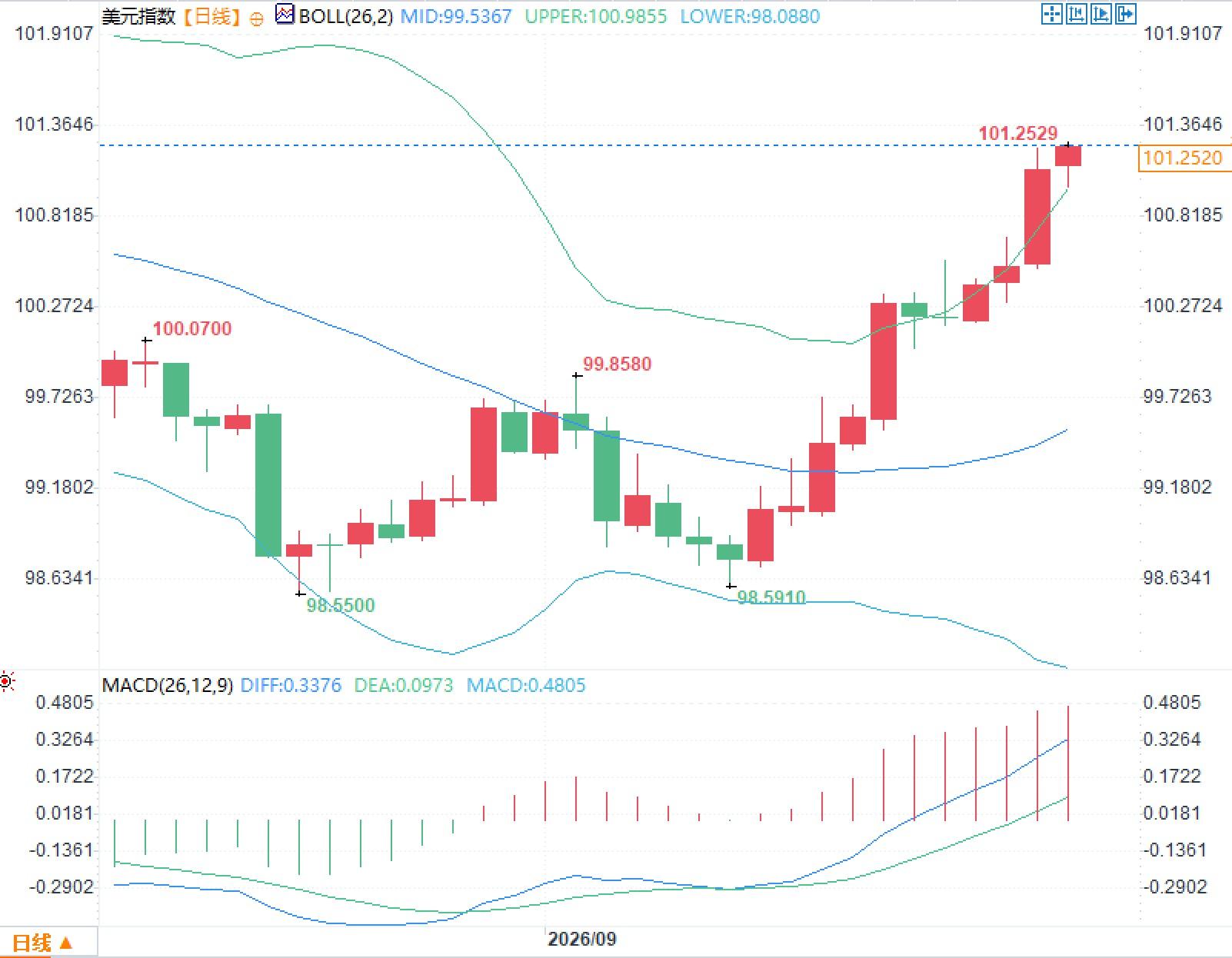
On the daily chart, the US dollar index is trading around 101. The Bollinger Bands have a middle band at approximately 99.54, an upper band at approximately 100.99, and a lower band at approximately 98.09. The price is located outside the upper band, and the band has widened compared to the previous low range. The MACD parameters DIFF and DEA are approximately 0.10, and the MACD histogram is approximately 0.48, with the histogram above the zero line. Following the policy rate hike in mid-September, the US dollar index rose from its consolidation range around 99, consistent with the simultaneous increase in the yields of 2-year and 10-year US Treasury bonds. Williams limited the definition of "reasonable" to another rate hike within the year, while leaving the final decision to subsequent data.
- Risk Warning and Disclaimer
- The market involves risk, and trading may not be suitable for all investors. This article is for reference only and does not constitute personal investment advice, nor does it take into account certain users’ specific investment objectives, financial situation, or other needs. Any investment decisions made based on this information are at your own risk.