It's a policy recalibration, not an interest rate hike cycle.
2026-09-24 18:50:12
If you ask a Federal Reserve chairman how far the policy rate is from the neutral rate, you'll usually get a number, or at least a range. On September 16, when current chairman Kevin Warsh was asked the exact same question, he gave neither. He stated that the comparison "has academic value…it helps us think about policy discussions," but it has no "practical binding force" on the Federal Open Market Committee (FOMC) decision made that day.  Warsh's signal marks a significant shift in how the Federal Reserve describes its policy stance compared to recent practices. Since Janet Yellen served as Fed Chair from 2014 to 2018, the real neutral interest rate has been a core element of FOMC communication. Prior to Yellen, Chairman Ben Bernanke also relied on the same framework: he implicitly attributed the decline in the neutral interest rate following the 2008–2009 global financial crisis to economic trauma and subsequent balance sheet repair, describing it as a "headwind." However, Warsh, after assuming the chair this year, adopted a different logic. At the Jackson Hole Economic Symposium and the September meeting, he stated that he "finds it difficult to describe broad financial conditions as contractionary," and that this view was "widely accepted within the Committee." This new framework for understanding monetary policy stance—more specifically, changes in the Fed's policy rate—looks at how interest rate changes affect a wider range of asset prices and spreads: credit spreads, equity valuations, and overall borrowing costs, rather than the difference between the policy rate and the model-estimated neutral rate. This distinction is crucial and will have implications for short-term Fed policy. Some (but not all) FOMC members believe that this year's policy is between neutral and slightly tightening; theoretically, this stance should at least alleviate temporary inflationary pressures. Meanwhile, despite shocks to the energy market, the broad financial environment in the US has been unusually stable. Rising real interest rates should have dampened economic activity, but US stock returns have remained strong. The S&P 500 has risen about 13% since the beginning of the year, supporting consumer spending through the wealth effect. From this perspective, the Fed's September rate hike may have been aimed at preventing further easing of financial conditions; continued easing could push up demand-side inflationary pressures. Prior to the September meeting, the market had already priced in a high probability of a 25 basis point rate hike. Therefore, if the Fed maintains its current rate, it would be seen as a major surprise. Looking ahead, the market has already priced in further rate hikes. Our baseline scenario is that the FOMC will likely raise rates 1-2 more times this year or early next year, each time by 25 basis points. However, looking at a longer timeframe and relying on a "financial conditions-oriented" framework to predict the appropriate Fed policy has its limitations. Therefore, the neutral interest rate as an anchor still has its value. Overall, our assessment is that the Federal Reserve is recalibrating its policy stance, preparing for the risk that inflation may not subside. However, once the temporary factors driving inflation subside—tariffs, energy, and AI-related computer equipment price adjustments—and the FOMC is more confident in confirming that inflation is not sustainable, then further interest rate hikes will no longer be necessary. Real Neutral Interest Rate: Theory and Reality In the traditional definition, the real neutral interest rate (also known as the natural rate of interest), denoted by economists as r*, is the actual interest rate level that neither stimulates nor inhibits the economy. At this rate, the economy grows at its potential rate, and inflation remains stable at the target level. As a theoretical anchor, it is very useful: it can be used to measure whether monetary policy stimulates or tightens the economy. However, in reality, r* has significant limitations: it fluctuates with structural forces, cannot be directly observed, and the results obtained from different estimation methods are highly uncertain and vary considerably. Besides the Laubach-Williams (2003) and subsequent Holston-Laubach-Williams (HLW) models, several regional Federal Reserve banks within the Federal Reserve System now publish their own r* estimates. Summarizing these estimates, the current real neutral interest rate is roughly estimated at 0.8%–2.6%, with a median of about 1.4% (see Figure 1). This is not significantly different from the approximately 1.2% implied by the median of the FOMC's long-term forecasts. However, the reasonable estimation range spans as much as 1.8 percentage points; the values at the two ends of this range have drastically different practical implications for current monetary policy. Moreover, the various r* estimates are inherently inconsistent, each containing errors that are increasing in magnitude. The 90% confidence interval provided by the model indicates that the actual r* may be about 1.7 percentage points higher or lower than the single-point estimate—a very large range in the interest rate domain. Figure 1: Summary of Nine Different r* Indicators
 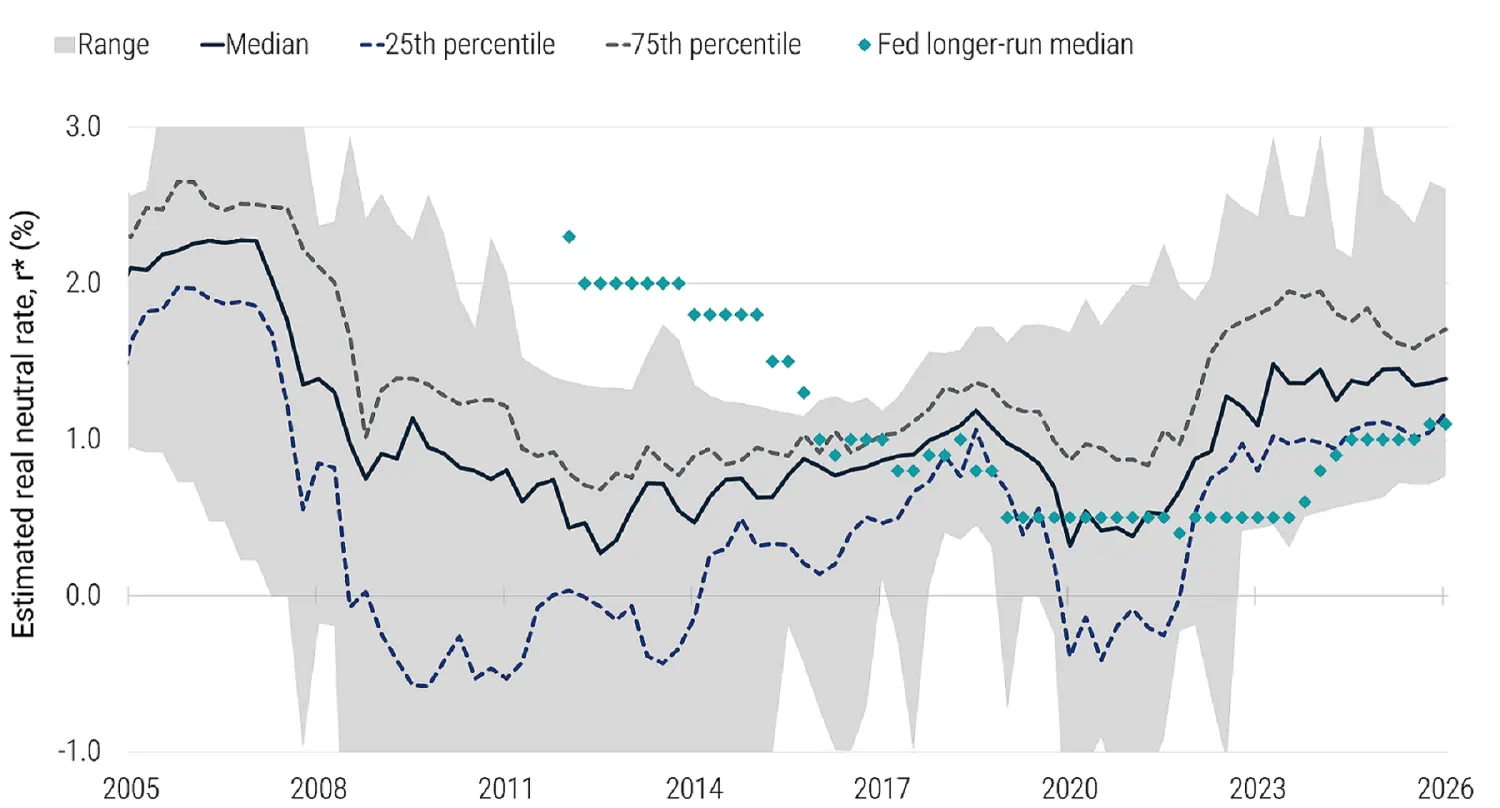 (Data as of June 30, 2026; the nine indicators in the chart are the Davis-Mills model, LW, HLW, LM, HZ/ZH, Fed Research Notes, DGGT, Coutine model, and GO.) Another complexity: the estimated value of r* changes over time due to changes in economic structural factors. After nearly three decades of decline, the post-pandemic model-estimated r* has risen by about 100 basis points, from approximately 0.5% to 1.5%. It is generally believed that the factors driving r* are related to potential growth rate, savings, and investment preferences; however, the most significant recent driver is the rise in potential economic growth, with related models revising the potential growth rate from approximately 1.8% to 2.5% (see Figure 2). Data from the U.S. Department of Commerce shows that the core component of potential growth—labor productivity—had already increased post-pandemic, even before the large-scale implementation of AI and the availability of statistical data. Figure 2: Model-estimated potential growth rate of the U.S. economy.
 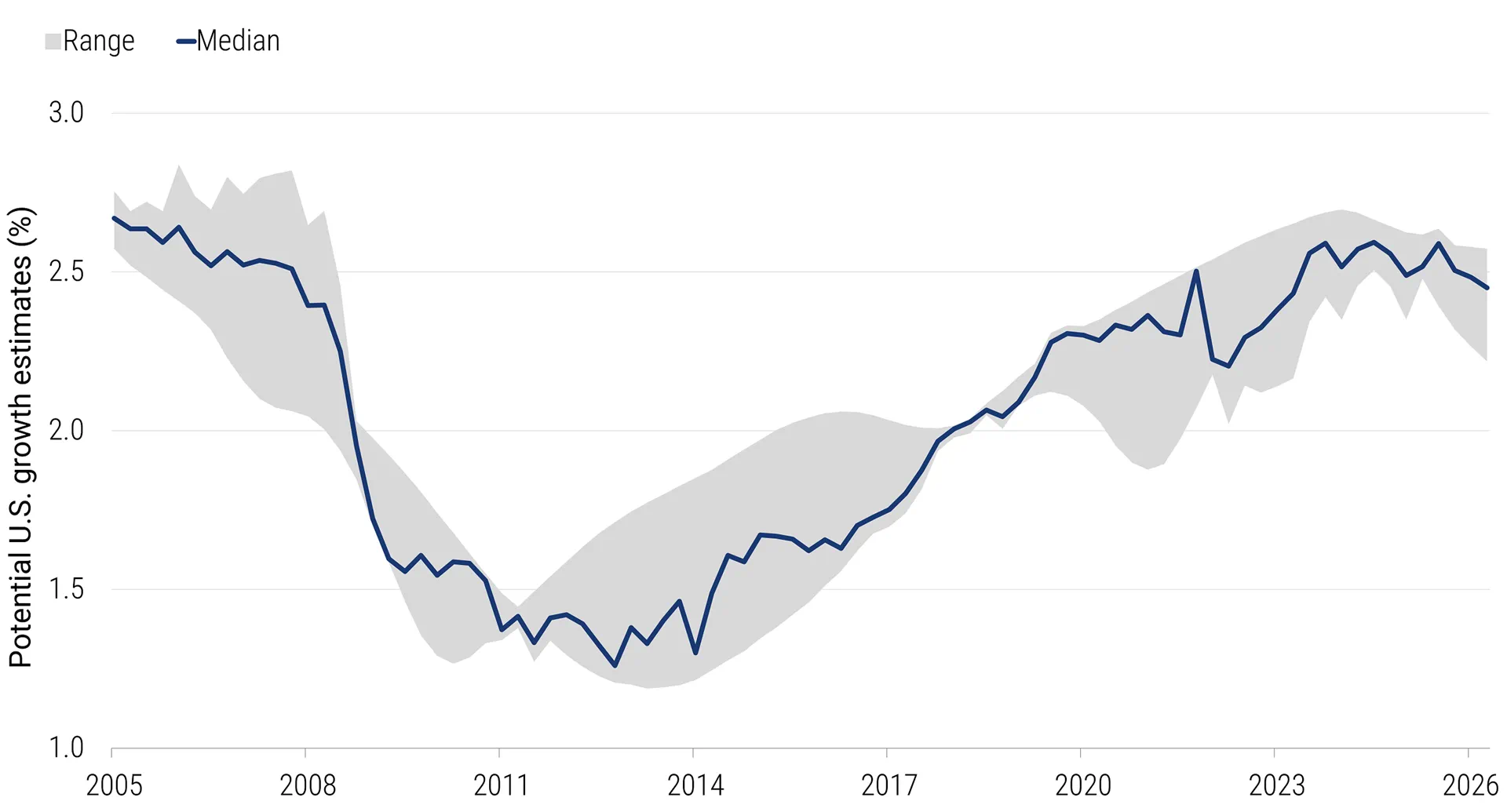 (Data source: HLW, LW, Congressional Budget Office (CBO), HZ model, as of June 30, 2026) The US yield curve has also been repriced: the long-term average of short-term interest rates implied in the 5-year forward rate (term structure estimate) has also risen by approximately 100 basis points during the same period (see Figure 3). Figure 3: Implied US short-term interest rate expectations in the nominal 5-year forward rate
 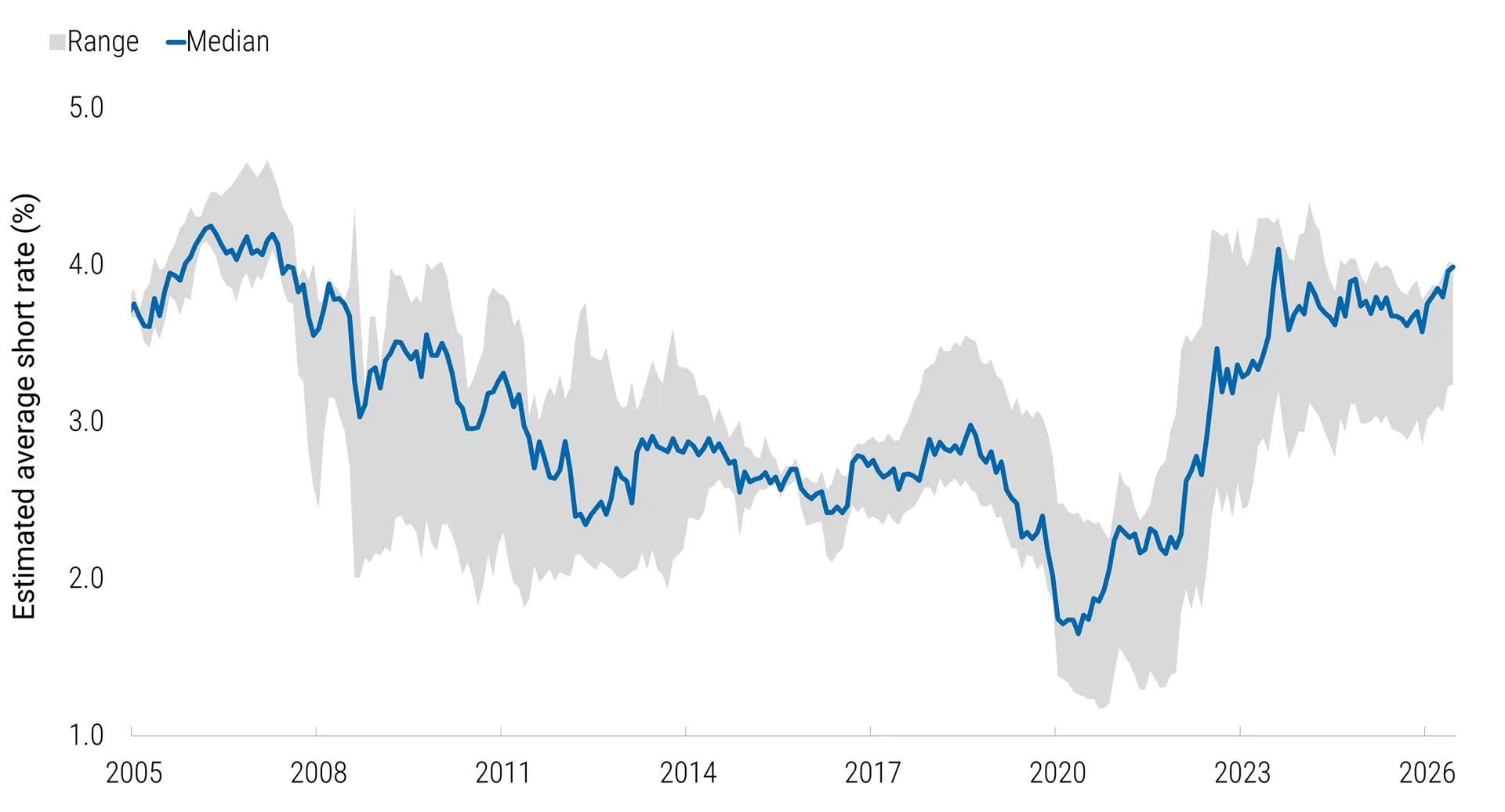 (Data source: DKW, ACM, KW, CR models, as of June 30, 2026) Whether r* will continue to rise is another key question. The structural factors that previously drove r* downward are difficult to reverse easily, but AI may become a powerful force reshaping the economy. A widely cited study by Rachel & Smith (2015) shows that global long-term real interest rates have cumulatively fallen by about 450 basis points over the past thirty years. This trend is observed in both developed and emerging economies, indicating that this is a change in the global neutral interest rate, rather than a single country's factor. It is worth noting that in Rachel and Smith's analysis, trend growth (the core driver in current US growth estimates) has a weak explanatory power for the decline in interest rates before the financial crisis. Global growth was largely stable during those decades; it was the financial crisis itself that triggered a comprehensive reassessment of growth prospects. Most of the impetus for declining interest rates comes from savings and investment preferences: increased life expectancy and rising income inequality push up desirable savings; lower relative prices of capital goods and declining public investment depress desirable investment. Now, if AI continues to drive productivity gains and increase desirable investment, it will push up r*. However, the social uncertainties brought about by AI may also prompt residents to increase precautionary savings. Our previous research found no evidence that the release of AI models has driven market estimates of r* based on the trend of US Treasury yields; however, this does not mean that AI will not affect r* in the future. Using financial conditions as a policy target has inherent limitations. Given the significant uncertainty in r* estimation, and the fact that current policy interest rates are within a reasonable estimation range, coupled with the ongoing technological and structural changes in the global economy, the future path of r* is also fraught with uncertainty. Therefore, at least in the short term, broad financial conditions may indeed be a better reference indicator for central banks—for a simple reason: financial conditions are directly observable, not estimated. Even though the US interest rate market has already priced in a higher policy interest rate path, financial conditions remain stable. Although the factors driving inflation do not appear to be sustainable, the FOMC's choice is: before building stronger confidence in achieving the inflation target, it is unwilling to see market expectations fail to materialize, leading to a de facto easing of financial conditions and thus exacerbating inflationary pressures. Looking at a longer time horizon, over-reliance on financial conditions also has practical drawbacks. Many drivers of financial conditions are beyond the Federal Reserve's control. Geopolitical shocks, growth panics, and unexpected fiscal changes can all instantly alter investors' risk appetite. Current financial conditions are supported by market optimism regarding AI and expectations of productivity growth. However, these expectations could reverse. A bursting AI bubble isn't needed to cool investment growth; a slowdown in the pace of investment acceleration is sufficient. If central banks focus solely on financial conditions when formulating policies, they may be forced to overreact to temporary fluctuations, ultimately causing policy rates to deviate significantly from any reasonable neutral interest rate level due to factors unrelated to the fundamentals of the real economy. Implications Our baseline scenario: The next few Fed meetings will likely see one or two more 25-basis-point rate hikes, largely in line with market pricing. By early 2027, the non-labor cost pressures that drove inflation in 2026—tariffs, energy, and computer equipment prices—are expected to gradually subside, reducing the need for further rate hikes. While the Fed's recent rate hikes are primarily aimed at managing broad financial conditions and preventing escalating inflationary pressures, the "monitoring financial conditions" framework has practical limitations. Financial conditions can remain stable for a long time, or they can suddenly change. Even with uncertainties surrounding data and prospects, understanding the underlying fundamentals and their evolution remains a crucial anchor for monetary policy.
Warsh's signal marks a significant shift in how the Federal Reserve describes its policy stance compared to recent practices. Since Janet Yellen served as Fed Chair from 2014 to 2018, the real neutral interest rate has been a core element of FOMC communication. Prior to Yellen, Chairman Ben Bernanke also relied on the same framework: he implicitly attributed the decline in the neutral interest rate following the 2008–2009 global financial crisis to economic trauma and subsequent balance sheet repair, describing it as a "headwind." However, Warsh, after assuming the chair this year, adopted a different logic. At the Jackson Hole Economic Symposium and the September meeting, he stated that he "finds it difficult to describe broad financial conditions as contractionary," and that this view was "widely accepted within the Committee." This new framework for understanding monetary policy stance—more specifically, changes in the Fed's policy rate—looks at how interest rate changes affect a wider range of asset prices and spreads: credit spreads, equity valuations, and overall borrowing costs, rather than the difference between the policy rate and the model-estimated neutral rate. This distinction is crucial and will have implications for short-term Fed policy. Some (but not all) FOMC members believe that this year's policy is between neutral and slightly tightening; theoretically, this stance should at least alleviate temporary inflationary pressures. Meanwhile, despite shocks to the energy market, the broad financial environment in the US has been unusually stable. Rising real interest rates should have dampened economic activity, but US stock returns have remained strong. The S&P 500 has risen about 13% since the beginning of the year, supporting consumer spending through the wealth effect. From this perspective, the Fed's September rate hike may have been aimed at preventing further easing of financial conditions; continued easing could push up demand-side inflationary pressures. Prior to the September meeting, the market had already priced in a high probability of a 25 basis point rate hike. Therefore, if the Fed maintains its current rate, it would be seen as a major surprise. Looking ahead, the market has already priced in further rate hikes. Our baseline scenario is that the FOMC will likely raise rates 1-2 more times this year or early next year, each time by 25 basis points. However, looking at a longer timeframe and relying on a "financial conditions-oriented" framework to predict the appropriate Fed policy has its limitations. Therefore, the neutral interest rate as an anchor still has its value. Overall, our assessment is that the Federal Reserve is recalibrating its policy stance, preparing for the risk that inflation may not subside. However, once the temporary factors driving inflation subside—tariffs, energy, and AI-related computer equipment price adjustments—and the FOMC is more confident in confirming that inflation is not sustainable, then further interest rate hikes will no longer be necessary. Real Neutral Interest Rate: Theory and Reality In the traditional definition, the real neutral interest rate (also known as the natural rate of interest), denoted by economists as r*, is the actual interest rate level that neither stimulates nor inhibits the economy. At this rate, the economy grows at its potential rate, and inflation remains stable at the target level. As a theoretical anchor, it is very useful: it can be used to measure whether monetary policy stimulates or tightens the economy. However, in reality, r* has significant limitations: it fluctuates with structural forces, cannot be directly observed, and the results obtained from different estimation methods are highly uncertain and vary considerably. Besides the Laubach-Williams (2003) and subsequent Holston-Laubach-Williams (HLW) models, several regional Federal Reserve banks within the Federal Reserve System now publish their own r* estimates. Summarizing these estimates, the current real neutral interest rate is roughly estimated at 0.8%–2.6%, with a median of about 1.4% (see Figure 1). This is not significantly different from the approximately 1.2% implied by the median of the FOMC's long-term forecasts. However, the reasonable estimation range spans as much as 1.8 percentage points; the values at the two ends of this range have drastically different practical implications for current monetary policy. Moreover, the various r* estimates are inherently inconsistent, each containing errors that are increasing in magnitude. The 90% confidence interval provided by the model indicates that the actual r* may be about 1.7 percentage points higher or lower than the single-point estimate—a very large range in the interest rate domain. Figure 1: Summary of Nine Different r* Indicators (Data as of June 30, 2026; the nine indicators in the chart are the Davis-Mills model, LW, HLW, LM, HZ/ZH, Fed Research Notes, DGGT, Coutine model, and GO.) Another complexity: the estimated value of r* changes over time due to changes in economic structural factors. After nearly three decades of decline, the post-pandemic model-estimated r* has risen by about 100 basis points, from approximately 0.5% to 1.5%. It is generally believed that the factors driving r* are related to potential growth rate, savings, and investment preferences; however, the most significant recent driver is the rise in potential economic growth, with related models revising the potential growth rate from approximately 1.8% to 2.5% (see Figure 2). Data from the U.S. Department of Commerce shows that the core component of potential growth—labor productivity—had already increased post-pandemic, even before the large-scale implementation of AI and the availability of statistical data. Figure 2: Model-estimated potential growth rate of the U.S. economy. (Data source: HLW, LW, Congressional Budget Office (CBO), HZ model, as of June 30, 2026) The US yield curve has also been repriced: the long-term average of short-term interest rates implied in the 5-year forward rate (term structure estimate) has also risen by approximately 100 basis points during the same period (see Figure 3). Figure 3: Implied US short-term interest rate expectations in the nominal 5-year forward rate (Data source: DKW, ACM, KW, CR models, as of June 30, 2026) Whether r* will continue to rise is another key question. The structural factors that previously drove r* downward are difficult to reverse easily, but AI may become a powerful force reshaping the economy. A widely cited study by Rachel & Smith (2015) shows that global long-term real interest rates have cumulatively fallen by about 450 basis points over the past thirty years. This trend is observed in both developed and emerging economies, indicating that this is a change in the global neutral interest rate, rather than a single country's factor. It is worth noting that in Rachel and Smith's analysis, trend growth (the core driver in current US growth estimates) has a weak explanatory power for the decline in interest rates before the financial crisis. Global growth was largely stable during those decades; it was the financial crisis itself that triggered a comprehensive reassessment of growth prospects. Most of the impetus for declining interest rates comes from savings and investment preferences: increased life expectancy and rising income inequality push up desirable savings; lower relative prices of capital goods and declining public investment depress desirable investment. Now, if AI continues to drive productivity gains and increase desirable investment, it will push up r*. However, the social uncertainties brought about by AI may also prompt residents to increase precautionary savings. Our previous research found no evidence that the release of AI models has driven market estimates of r* based on the trend of US Treasury yields; however, this does not mean that AI will not affect r* in the future. Using financial conditions as a policy target has inherent limitations. Given the significant uncertainty in r* estimation, and the fact that current policy interest rates are within a reasonable estimation range, coupled with the ongoing technological and structural changes in the global economy, the future path of r* is also fraught with uncertainty. Therefore, at least in the short term, broad financial conditions may indeed be a better reference indicator for central banks—for a simple reason: financial conditions are directly observable, not estimated. Even though the US interest rate market has already priced in a higher policy interest rate path, financial conditions remain stable. Although the factors driving inflation do not appear to be sustainable, the FOMC's choice is: before building stronger confidence in achieving the inflation target, it is unwilling to see market expectations fail to materialize, leading to a de facto easing of financial conditions and thus exacerbating inflationary pressures. Looking at a longer time horizon, over-reliance on financial conditions also has practical drawbacks. Many drivers of financial conditions are beyond the Federal Reserve's control. Geopolitical shocks, growth panics, and unexpected fiscal changes can all instantly alter investors' risk appetite. Current financial conditions are supported by market optimism regarding AI and expectations of productivity growth. However, these expectations could reverse. A bursting AI bubble isn't needed to cool investment growth; a slowdown in the pace of investment acceleration is sufficient. If central banks focus solely on financial conditions when formulating policies, they may be forced to overreact to temporary fluctuations, ultimately causing policy rates to deviate significantly from any reasonable neutral interest rate level due to factors unrelated to the fundamentals of the real economy. Implications Our baseline scenario: The next few Fed meetings will likely see one or two more 25-basis-point rate hikes, largely in line with market pricing. By early 2027, the non-labor cost pressures that drove inflation in 2026—tariffs, energy, and computer equipment prices—are expected to gradually subside, reducing the need for further rate hikes. While the Fed's recent rate hikes are primarily aimed at managing broad financial conditions and preventing escalating inflationary pressures, the "monitoring financial conditions" framework has practical limitations. Financial conditions can remain stable for a long time, or they can suddenly change. Even with uncertainties surrounding data and prospects, understanding the underlying fundamentals and their evolution remains a crucial anchor for monetary policy.- Risk Warning and Disclaimer
- The market involves risk, and trading may not be suitable for all investors. This article is for reference only and does not constitute personal investment advice, nor does it take into account certain users’ specific investment objectives, financial situation, or other needs. Any investment decisions made based on this information are at your own risk.