Will the United States impose a ban on diesel exports?
2026-09-24 23:48:12
Global markets suffered a sharp decline yesterday. Long-term US Treasury yields surged. Strong US economic data reinforced market concerns that the Federal Reserve's actions were lagging and that a more aggressive tightening of monetary policy was necessary. Meanwhile, global energy markets experienced significant volatility. The near-month futures price of Brent crude, the international benchmark, continued to rise; Saudi oil pipelines were about to resume operations, Persian Gulf oil exports increased rapidly, and Iran's influence in the Strait of Hormuz declined. The rise in Brent crude prices exacerbated global concerns about high gasoline and diesel prices. Meanwhile, with the US midterm elections approaching, domestic anxiety was particularly pronounced. 
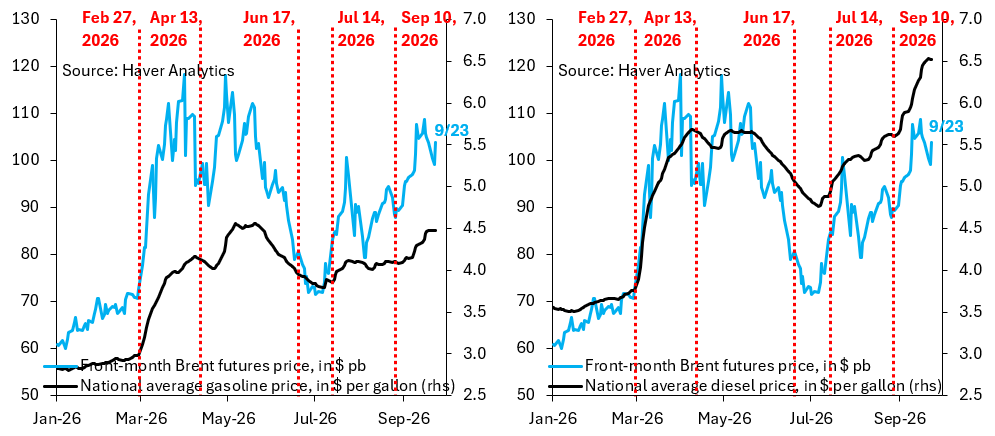 The two charts above show the price increases of gasoline (left) and diesel (right) in the United States. The blue lines in both charts represent the near-month Brent crude oil futures price, with values referenced to the left axis. The black line in the left chart represents the average price per gallon of gasoline nationwide; the black line in the right chart represents the average price per gallon of diesel. Diesel prices have already broken through the highs reached earlier this year, which is why the market has been discussing a diesel export ban recently. This article uses a question-and-answer format to address the core issues surrounding this ban. Will the ban be implemented? Such policies involve numerous unknown risks and unforeseen consequences and cannot be implemented arbitrarily. Once the export ban is implemented, domestic diesel prices in the United States will fall, but refinery storage tanks will quickly fill up. Refineries will then reduce diesel production. Gasoline is often produced simultaneously with diesel, which could result in higher gasoline prices. With the midterm elections approaching, this is the scenario the United States least wants to see. There are many such thorny details, requiring a careful consideration of the demands for a ban raised by the American agricultural community. Ultimately, everything depends on how much pressure the White House feels before the midterm elections. My judgment: Unless diesel prices continue to surge significantly, the likelihood of an export ban being implemented is low.
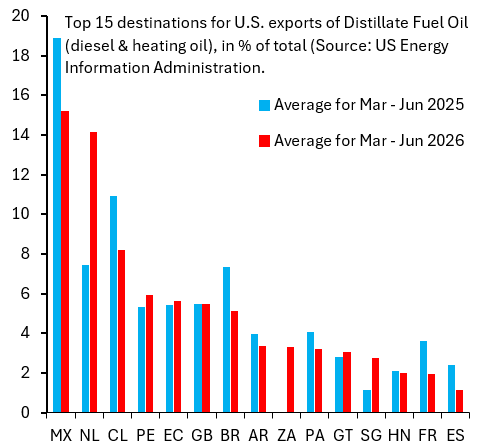
 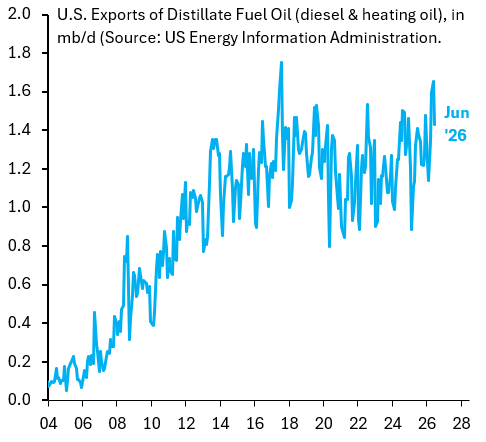 Who will be impacted by the ban? The chart above shows monthly export data for US distillate fuel oil (primarily diesel). From March to June 2026 (since the outbreak of the Iran conflict), the US exported an average of 1.4 million barrels per day. Global demand for distillate fuel oil is 28 million barrels per day, with US exports accounting for 5% of global demand. The next chart marks the main export destinations. If the ban is implemented, Latin America will be severely affected: Mexico, Chile, Peru, Ecuador, and Brazil are all highly dependent on US diesel. The Netherlands, a European energy logistics hub, and the UK will also be significantly impacted. In fact, a diesel export ban could even push Europe into recession, and the risk of recession would then backfire on the US. Precisely because of these chain reactions, the probability of a rapid implementation of a ban in the short term is very low.
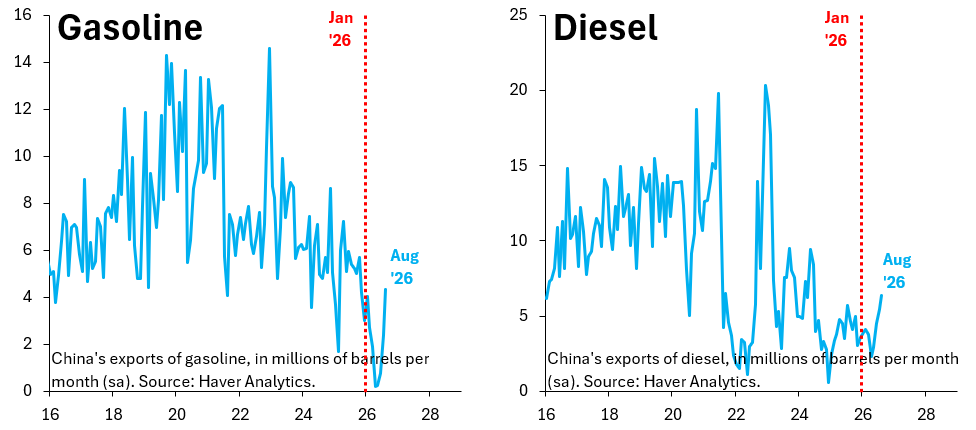
  Can China fill the gap? President Trump met with Chinese leaders today. China has a massive refining capacity, theoretically capable of rapidly expanding refined oil exports. The data in the right-hand chart shows that China's gasoline exports have been low recently, and diesel exports are similarly low. There is speculation in the market that the two sides may reach an agreement: China increases refined oil exports; in exchange, the US will give way on Pacific-related issues. I am not optimistic about this speculation, for a simple reason: China will not trust such an agreement. After all, after the midterm elections, who can guarantee that the US will continue to fulfill its obligations? China will not step in to help the US out of its predicament.
  My core conclusion is that, given current oil price levels, the likelihood of a diesel export ban is low. The baseline scenario is that Brent crude prices resume their downward trend, thereby stabilizing diesel prices.
The two charts above show the price increases of gasoline (left) and diesel (right) in the United States. The blue lines in both charts represent the near-month Brent crude oil futures price, with values referenced to the left axis. The black line in the left chart represents the average price per gallon of gasoline nationwide; the black line in the right chart represents the average price per gallon of diesel. Diesel prices have already broken through the highs reached earlier this year, which is why the market has been discussing a diesel export ban recently. This article uses a question-and-answer format to address the core issues surrounding this ban. Will the ban be implemented? Such policies involve numerous unknown risks and unforeseen consequences and cannot be implemented arbitrarily. Once the export ban is implemented, domestic diesel prices in the United States will fall, but refinery storage tanks will quickly fill up. Refineries will then reduce diesel production. Gasoline is often produced simultaneously with diesel, which could result in higher gasoline prices. With the midterm elections approaching, this is the scenario the United States least wants to see. There are many such thorny details, requiring a careful consideration of the demands for a ban raised by the American agricultural community. Ultimately, everything depends on how much pressure the White House feels before the midterm elections. My judgment: Unless diesel prices continue to surge significantly, the likelihood of an export ban being implemented is low. Who will be impacted by the ban? The chart above shows monthly export data for US distillate fuel oil (primarily diesel). From March to June 2026 (since the outbreak of the Iran conflict), the US exported an average of 1.4 million barrels per day. Global demand for distillate fuel oil is 28 million barrels per day, with US exports accounting for 5% of global demand. The next chart marks the main export destinations. If the ban is implemented, Latin America will be severely affected: Mexico, Chile, Peru, Ecuador, and Brazil are all highly dependent on US diesel. The Netherlands, a European energy logistics hub, and the UK will also be significantly impacted. In fact, a diesel export ban could even push Europe into recession, and the risk of recession would then backfire on the US. Precisely because of these chain reactions, the probability of a rapid implementation of a ban in the short term is very low. Can China fill the gap? President Trump met with Chinese leaders today. China has a massive refining capacity, theoretically capable of rapidly expanding refined oil exports. The data in the right-hand chart shows that China's gasoline exports have been low recently, and diesel exports are similarly low. There is speculation in the market that the two sides may reach an agreement: China increases refined oil exports; in exchange, the US will give way on Pacific-related issues. I am not optimistic about this speculation, for a simple reason: China will not trust such an agreement. After all, after the midterm elections, who can guarantee that the US will continue to fulfill its obligations? China will not step in to help the US out of its predicament. My core conclusion is that, given current oil price levels, the likelihood of a diesel export ban is low. The baseline scenario is that Brent crude prices resume their downward trend, thereby stabilizing diesel prices.
- Risk Warning and Disclaimer
- The market involves risk, and trading may not be suitable for all investors. This article is for reference only and does not constitute personal investment advice, nor does it take into account certain users’ specific investment objectives, financial situation, or other needs. Any investment decisions made based on this information are at your own risk.