With the Fed's rate hike just implemented, Hammark has already shifted the risk focus towards inflation.
2026-09-24 22:00:15
On Thursday, September 24, Cleveland Federal Reserve Bank President Beth Hammark delivered the opening remarks at the annual conference on inflation drivers and dynamics co-hosted by the Cleveland Fed and the European Central Bank. She defined price stability as an inalienable responsibility of central banks, noting that output and demand remain supported, inflation risks are skewed to the upside, and supply shocks are a prominent challenge for current policy. She also emphasized that the longer inflation remains above the target, the more difficult it will be to pull it back to 2%. Her remarks fell within a clear policy window. The Fed had already raised the target range for the federal funds rate by 25 basis points to 3.75% to 4.00% on September 16, ending approximately three years of holding steady. The Summary of Economic Projections revised the median PCE inflation forecast for 2026 upward to 3.7%, core PCE upward to 3.4%, and the median year-end interest rate to 4.1%. The vast majority of participants judged that overall PCE inflation risks were skewed to the upside. The US dollar index traded around 101 that day, near a two-month high. What the market needs to verify is how the committee will handle the combination of demand not cooling significantly and supply disruptions continuing after the interest rate hike. 
Harmack Framework: Stable Prices, Cannot Be Outsourced
Hammark is an official who consistently emphasizes the inflation side, having advocated a 25 basis point rate hike at the July meeting. Her logic this time is three-tiered. The first tier is responsibility: price stability is the central bank's responsibility; it cannot expect inflation to automatically fall after supply recovers. The second tier is the current situation: output and demand remain supported, inflation remains high, and the risk distribution is skewed to the upside. The third tier is time cost: the longer the deviation from the target, the easier it is for expectations, pricing, and contracts to solidify high inflation, and the greater the cost of subsequent correction. Her stance is consistent with previous statements. In August, she stated that inflation might end this year around 3%, and at most return to the middle of the 2% range next year, believing that interest rates at that time did not provide sufficient constraint. She also repeatedly mentioned that if action is taken only after inflation is embedded in the economy, the required adjustments might be greater. This speech did not explicitly state that a rate hike is necessary at the next meeting, but the risk function is clear: she is focusing on the cost of keeping inflation high for too long, rather than considering the employment gap as a more pressing constraint.Data cross-section: Slower decline than employment buffer
The official data and the dot plot show a slight upward revision in the same direction, not a trend reversal. The US July PCE rose 3.7% year-on-year, and core PCE rose 3.3%. August CPI rose 3.4% year-on-year, and core CPI rose 2.4%, with an overall month-on-month increase of 0.4% and a core month-on-month increase of 0.3%. The Cleveland Fed's immediate estimates as of September 23 showed August PCE at approximately 3.8% year-on-year and core at approximately 3.4%, and September PCE at approximately 4.0% year-on-year and core at approximately 3.5%. The official August PCE figures will be released on September 30, and the market will use them to check whether the immediate estimates are too high. Employment provides a buffer, not evidence that inflation is under control. The US unemployment rate remained stable at 4.1% in August, non-farm payrolls increased by 162,000, and the labor force participation rate rebounded to 61.6%. The dot plot lowered the median unemployment rate for 2026 from 4.3% in June to 4.1%, and revised the median real GDP growth rate upward from 2.2% to 2.3%. Most members simultaneously revised upwards on growth, downwards on unemployment, and upwards on the paths to inflation and interest rates. Within the policy function, the weight of a shift forced by deteriorating employment is decreasing, while the weight of prolonged inflation is increasing. St. Louis Fed President Musaleem recently pointed out that persistent demand and recurring supply forces continue to raise inflation risks, and without further constraints, the likelihood of inflation significantly exceeding 2% in 18 months is greater than the possibility of it returning to the target.Why supply shocks pose a policy challenge
Hammark singled out supply shocks because of tool mismatch. Interest rates can suppress demand, but cannot directly repair disruptions in oil, transportation, or intermediate inputs. In the case of a one-off shock, the committee can observe the decay at the expected anchoring point. If shocks recur, or demand spreads relative price increases into a broader price index, then choosing to "see through" will confirm high inflation. Chicago Fed President Goolsby also emphasized this week that in the face of persistent rather than one-off supply shocks, central banks cannot fulfill their price stabilization responsibilities through inaction; ultimately, they still need to narrow the supply-demand gap by suppressing demand. The difficulty is not identifying the source, but determining whether the shock has altered the pricing rhythm. Demand remains supported, and businesses can more easily pass on costs. The longer the shock persists, the more likely wage contracts, rental terms, and factory gate prices are to be reset at a higher benchmark. Hammark's time cost argument addresses this path dependence: policy can refrain from committing to specific actions at the next meeting, but it cannot assume time is on the side of the 2% target.US Dollar Index Daily Chart Structure
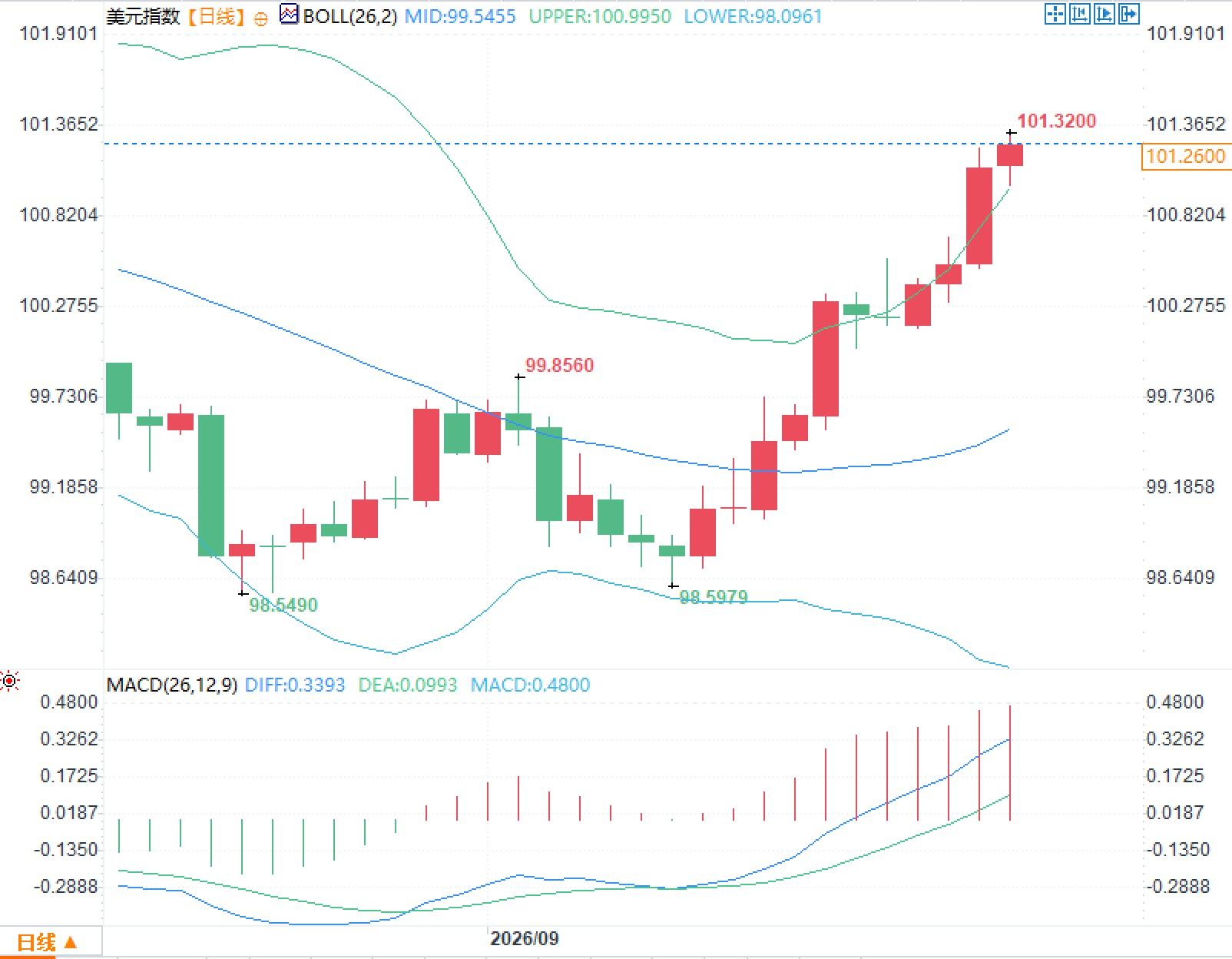
On the daily chart, the US dollar index has been trading around 101 recently after rebounding from its lows in late August. The Bollinger Band middle band is above 99, the upper band is around 101, and the lower band is above 98. The price is outside the upper band, and the bandwidth has reopened after a period of contraction. The MACD shows the DIFF line is above the DEA line, and the histogram is above the zero line.Frequently Asked Questions
Question 1: Does Harmark's speech foreshadow the next interest rate hike? Answer: The speech clarified the distribution of risks and the boundaries of responsibility, but did not explicitly state that the next meeting must raise interest rates. She emphasized that inflation risks are skewed to the upside, supply shocks are difficult to resolve, and prolonged inflation would increase the cost of correction. This is comparable to the median of 4.1% in the dot plot, but personal statements should not be incorporated into the committee's agenda. Question 2: How do interest rate tools affect inflation when supply shocks exist? Answer: Interest rates cannot repair supply disruptions, but they can limit the spread of relative price increases into sustained inflation. The committee needs to assess the rate of shock decay and whether pricing behavior has changed, rather than making a simple trade-off between demand and supply. This mismatch in tools explains why officials repeatedly emphasize the time cost. Question 3: Why does inflation remain a dominant issue even when employment data is stable? Answer: The unemployment rate in August was 4.1%, and non-farm payrolls increased by 162,000. The dot plot simultaneously lowered unemployment and revised growth upwards. The employment side has not yet met the conditions for a forced shift, while the PCE remains significantly above 2%. Under this combination, officials are more concerned about the erosion of expectations and contract pricing caused by prolonged inflation.- Risk Warning and Disclaimer
- The market involves risk, and trading may not be suitable for all investors. This article is for reference only and does not constitute personal investment advice, nor does it take into account certain users’ specific investment objectives, financial situation, or other needs. Any investment decisions made based on this information are at your own risk.