One chart: Freight rates across all sectors strengthened, with the Baltic Dry Index continuing to rise.
2026-09-25 00:24:12
Latest data shows that on September 24, 2026, the Baltic Dry Index (BDI) closed at 3399 points, a three-day low, down 0.90% week-on-week (compared to the previous value), marking the largest drop since September 16, 2026, and the second consecutive day of decline (including zero growth). Looking at the short-term charts, the recent 11 BDI data points show: 4 positive increases, 7 negative increases, and 0 zero increases. Specifically, the Panamax Freight Index (BPI) closed at 2382 points, up 2.10% from the previous value; the Capesize Freight Index (BCI) closed at 5939 points, up 1.33%; and the Supramax Freight Index (BSI) closed at 1782 points, up 0.22%. For detailed 720-day and 10-year trend charts of the Baltic Dry Index and its three sub-indices, please refer to the charts specially created by FX678. 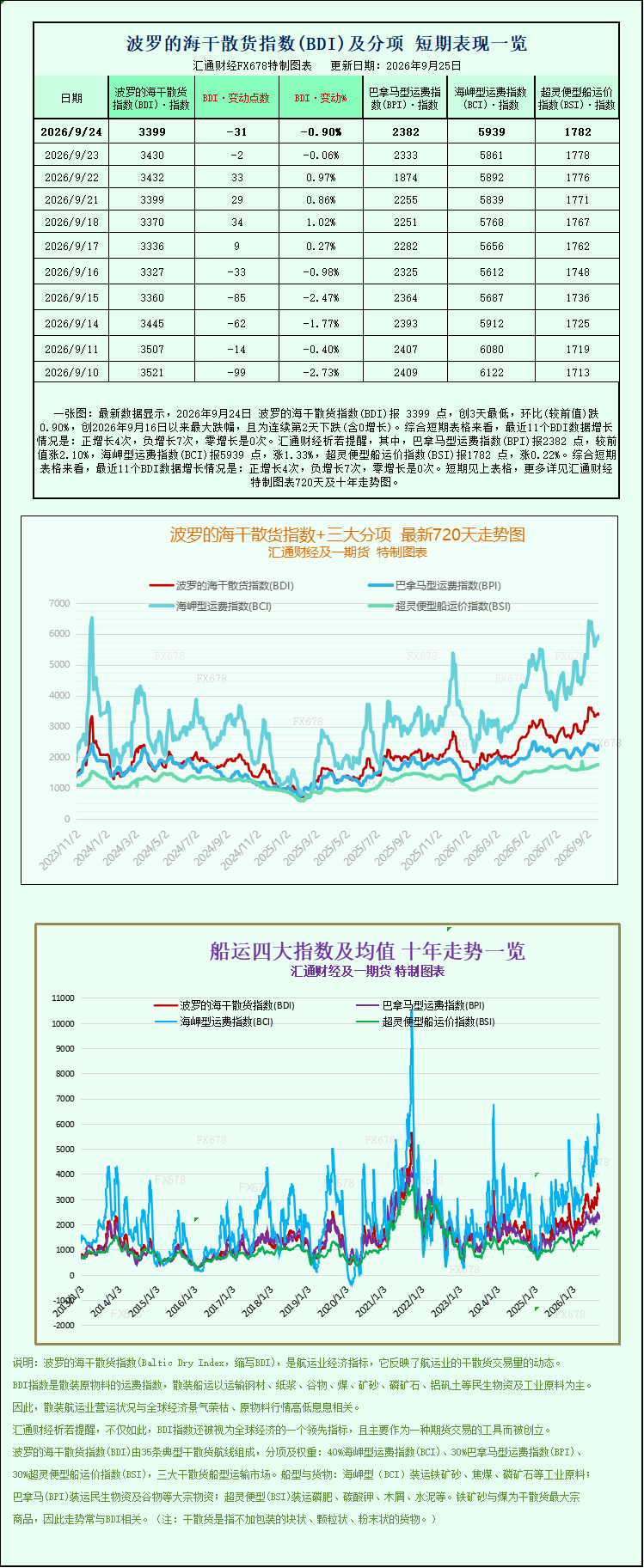 On Thursday, the international dry bulk shipping market saw a broad-based price increase, with the Baltic Dry Index (BDI) rising across the board, covering all types of bulk carriers from large to small. Freight rates across all sub-segments strengthened simultaneously, driving the overall index steadily higher and highlighting the current global dry bulk shipping market's recovery in demand and tight capacity. This index increase, characterized by a broad-based rise without segment differentiation, is an important signal of the continued recovery in the shipping market recently. Data shows that the Baltic Dry Index (BDI), which tracks freight rates for Capesize, Panamax, and Supramax vessels, rose 43 points, or 1.2%, to close at 3399 points, continuing its recent upward trend and approaching its year-to-date high. Looking at the sub-ship type indices, freight rates for all tonnage vessels increased to varying degrees, with medium and large vessels showing the most significant gains, becoming the core driver of the index's rise. The market for Very Large Capesize vessels (VLS) performed exceptionally well, with the Capesize index surging 78 points, or 1.3%, to close at 5939. Profitability on key routes for this vessel type also improved. The Capesize shipping route index, primarily engaged in the transport of 150,000-tonnage ultra-large bulk cargo, including iron ore and coal, saw its average daily revenue increase by $709, reaching $50,361 and firmly establishing itself above the $50,000 mark. As a core vessel type for industrial raw material shipping, Capesize vessel performance is directly linked to the pace of global industrial production and commodity trade. The current iron ore market exhibits a tug-of-war between bulls and bears, providing structural support and constraints for Capesize freight rates. As the world's largest importer of iron ore, China's market fundamentals are a key variable influencing freight rates. Rising domestic steel mill inventories and increasing industry losses have suppressed iron ore procurement demand to some extent, offsetting some of the positive support. However, at the same time, the expected reduction in shipments from Brazil's main mining areas and the contraction in global seaborne iron ore supply provided a floor for Capesize vessel freight rates, ultimately driving up rates for this vessel type against the trend. Medium-sized Panamax vessels led the gains across all sectors, with a strong market recovery. The Panamax index rose 49 points, a significant increase of 2.1%, closing at 2382 points, far exceeding the average increase of the broader market. This vessel type primarily operates on 60,000 to 70,000-ton freight routes, mainly transporting bulk commodities such as thermal coal and grains. Its main routes saw an average daily revenue increase of $438, reaching $21,434. The approaching peak season for global food transportation in the fourth quarter, the steady release of demand for North American coal exports, coupled with the continued restrictions on passage through the Panama Canal leading to a contraction in effective transport capacity and decreased route turnover efficiency, further pushed up freight rates for medium-sized vessels. The small vessel market maintained a steady upward trend, with a relatively stable performance. The Supramax index rose slightly by 4 points, an increase of 0.2%, closing at 1782 points. Although the increase was relatively moderate, it achieved a steady upward trend without any sector correction, confirming the comprehensive nature of this round of dry bulk market activity. Smaller vessels offer greater flexibility and cover a wider range of routes, primarily handling regional and small-to-medium-sized bulk cargo transportation. The stable upward trend reflects a comprehensive recovery in global segmented freight demand. Overall, the Baltic Dry Index's across-the-board rise is the result of multiple factors on both the supply and demand sides. On the demand side, the traditional peak shipping season at the end of the year has begun early, with a concentrated release of demand for industrial raw materials, grains, and energy commodities. On the supply side, regional weather conditions and limited capacity on key shipping routes have led to a tight supply of effective shipping capacity. Market analysts believe that with the full commencement of the global trade peak season in the fourth quarter, coupled with a rebound in shipments from overseas mining and grain regions, dry bulk shipping demand is expected to continue to expand, and the Baltic Dry Index is likely to maintain a strong, high-level fluctuation pattern in the future.
On Thursday, the international dry bulk shipping market saw a broad-based price increase, with the Baltic Dry Index (BDI) rising across the board, covering all types of bulk carriers from large to small. Freight rates across all sub-segments strengthened simultaneously, driving the overall index steadily higher and highlighting the current global dry bulk shipping market's recovery in demand and tight capacity. This index increase, characterized by a broad-based rise without segment differentiation, is an important signal of the continued recovery in the shipping market recently. Data shows that the Baltic Dry Index (BDI), which tracks freight rates for Capesize, Panamax, and Supramax vessels, rose 43 points, or 1.2%, to close at 3399 points, continuing its recent upward trend and approaching its year-to-date high. Looking at the sub-ship type indices, freight rates for all tonnage vessels increased to varying degrees, with medium and large vessels showing the most significant gains, becoming the core driver of the index's rise. The market for Very Large Capesize vessels (VLS) performed exceptionally well, with the Capesize index surging 78 points, or 1.3%, to close at 5939. Profitability on key routes for this vessel type also improved. The Capesize shipping route index, primarily engaged in the transport of 150,000-tonnage ultra-large bulk cargo, including iron ore and coal, saw its average daily revenue increase by $709, reaching $50,361 and firmly establishing itself above the $50,000 mark. As a core vessel type for industrial raw material shipping, Capesize vessel performance is directly linked to the pace of global industrial production and commodity trade. The current iron ore market exhibits a tug-of-war between bulls and bears, providing structural support and constraints for Capesize freight rates. As the world's largest importer of iron ore, China's market fundamentals are a key variable influencing freight rates. Rising domestic steel mill inventories and increasing industry losses have suppressed iron ore procurement demand to some extent, offsetting some of the positive support. However, at the same time, the expected reduction in shipments from Brazil's main mining areas and the contraction in global seaborne iron ore supply provided a floor for Capesize vessel freight rates, ultimately driving up rates for this vessel type against the trend. Medium-sized Panamax vessels led the gains across all sectors, with a strong market recovery. The Panamax index rose 49 points, a significant increase of 2.1%, closing at 2382 points, far exceeding the average increase of the broader market. This vessel type primarily operates on 60,000 to 70,000-ton freight routes, mainly transporting bulk commodities such as thermal coal and grains. Its main routes saw an average daily revenue increase of $438, reaching $21,434. The approaching peak season for global food transportation in the fourth quarter, the steady release of demand for North American coal exports, coupled with the continued restrictions on passage through the Panama Canal leading to a contraction in effective transport capacity and decreased route turnover efficiency, further pushed up freight rates for medium-sized vessels. The small vessel market maintained a steady upward trend, with a relatively stable performance. The Supramax index rose slightly by 4 points, an increase of 0.2%, closing at 1782 points. Although the increase was relatively moderate, it achieved a steady upward trend without any sector correction, confirming the comprehensive nature of this round of dry bulk market activity. Smaller vessels offer greater flexibility and cover a wider range of routes, primarily handling regional and small-to-medium-sized bulk cargo transportation. The stable upward trend reflects a comprehensive recovery in global segmented freight demand. Overall, the Baltic Dry Index's across-the-board rise is the result of multiple factors on both the supply and demand sides. On the demand side, the traditional peak shipping season at the end of the year has begun early, with a concentrated release of demand for industrial raw materials, grains, and energy commodities. On the supply side, regional weather conditions and limited capacity on key shipping routes have led to a tight supply of effective shipping capacity. Market analysts believe that with the full commencement of the global trade peak season in the fourth quarter, coupled with a rebound in shipments from overseas mining and grain regions, dry bulk shipping demand is expected to continue to expand, and the Baltic Dry Index is likely to maintain a strong, high-level fluctuation pattern in the future. - Risk Warning and Disclaimer
- The market involves risk, and trading may not be suitable for all investors. This article is for reference only and does not constitute personal investment advice, nor does it take into account certain users’ specific investment objectives, financial situation, or other needs. Any investment decisions made based on this information are at your own risk.