September 25th Financial Breakfast: Gold prices hit a one-week low, Houthi attacks on Saudi Arabia reignited supply concerns, and oil prices rose to a one-week high.
2026-09-25 07:02:13
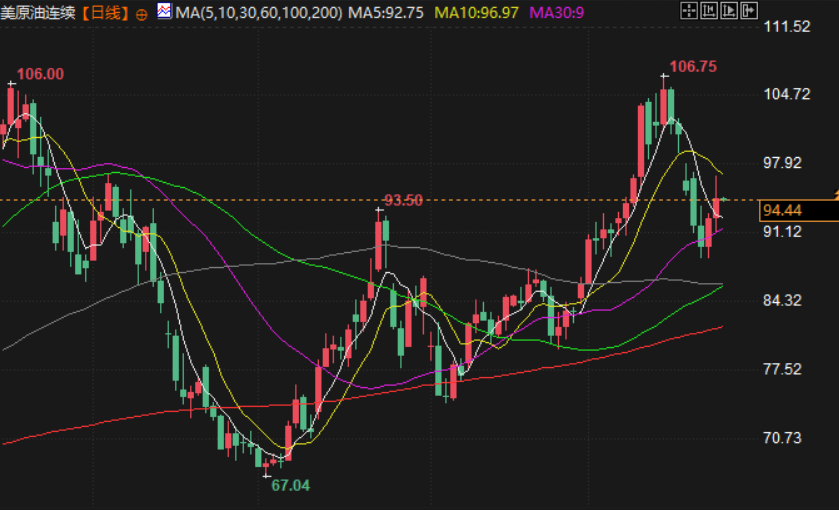
On Friday (September 25, Beijing time) in early Asian trading, spot gold was trading at $4,271.36 per ounce. Gold prices hit a one-week low on Thursday, influenced by rising oil prices and a more hawkish stance from the Federal Reserve, which strengthened market expectations for further interest rate hikes. US crude oil was trading around $94.40 per barrel. Oil prices rose to a one-week high on Thursday after Houthi missile strikes on Saudi Arabia reignited concerns about supply disruptions. However, gains in oil prices narrowed after reports that the US and Iran were discussing reopening the Strait of Hormuz. 
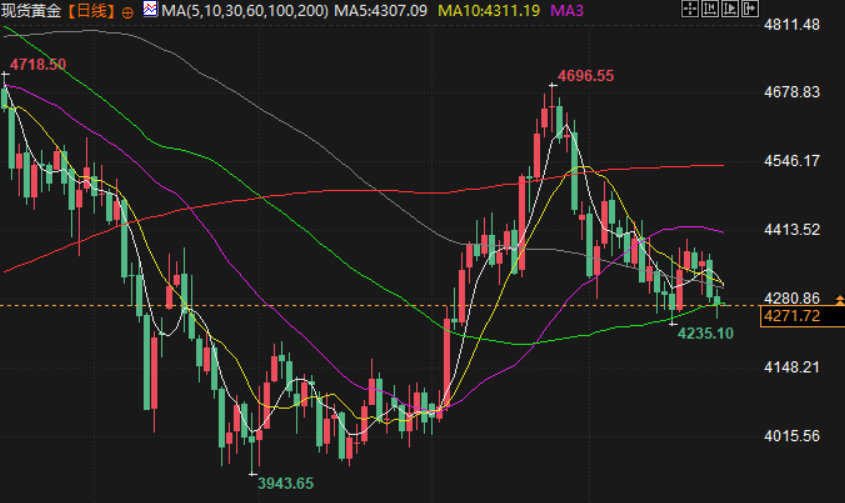 David Meger, director of precious metals trading at High Ridge Futures, said rising energy prices and interest rates continue to put pressure on gold. As energy prices rise, inflation concerns intensify, increasing the likelihood of further interest rate hikes by the Federal Reserve. The Houthi missile attack on Saudi Arabia on Thursday reignited concerns about supply disruptions, pushing up oil prices. As producers pass on increased costs to consumers, rising energy prices could push up overall inflation, forcing central banks to adopt tighter policies to curb price increases. The Federal Reserve raised interest rates last week for the first time in three years and hinted at further rate hikes this year. Several Fed officials reiterated the need for further rate increases, with Fed Governor Barr being the latest to emphasize the need for tighter monetary policy. The CME Group's FedWatch tool shows that traders currently expect a 69% probability of a Fed rate hike in October. While gold is traditionally seen as an inflation hedge, rising interest rates will diminish its appeal. The dollar's rise to a two-month high also put pressure on gold prices, making dollar-denominated gold more expensive for overseas buyers; meanwhile, the yield on the 10-year US Treasury bond hovered near a 20-year high, increasing the opportunity cost of holding non-interest-bearing gold. Ole Hansen, head of commodity strategy at Saxo Bank, said in a report that the recent support level for gold around $4,235 per ounce is the first level to watch. A break below this level could lead to further price corrections, and market focus could shift back to the $4,000 area seen in June and July. Spot silver fell 0.9% to $63.85 per ounce; platinum dipped 0.1% to $1,748.46 per ounce; and palladium rose 0.7% to $1,268.24 per ounce.
 The Saudi-led coalition said Saudi Arabia intercepted six ballistic missiles fired by Houthi rebels in Yemen, thwarting attacks on the southern Taif province and the Yanbu region on the Red Sea coast. Neighboring countries, including the UAE and Oman, banned Iranian airlines from entering the country in response to new US sanctions, the first major impact of the US expanding sanctions to include third-country companies doing business with Iran. The war with Iran has been deadlocked on the battlefield for months, and Washington announced expanded financial sanctions targeting third-country companies doing business with Iranian enterprises—a move known as "secondary sanctions." Iran threatened on Wednesday to retaliate against neighboring countries that complied with the US ban on Iranian flights, rendering their airports "unusable." Furthermore, industry sources, satellite imagery, and shipping data show that Saudi Arabia is increasing crude oil shipments to the Red Sea export hub of Yanbu via the East-West Pipeline, although oil tanker loading operations have not yet resumed. Sources close to the negotiations said US and Iranian negotiators are in New York discussing a phased end to the war, including Tehran reopening the Strait of Hormuz and Washington lifting its economic blockade of Iran, but neither side is willing to relinquish their negotiating leverage.
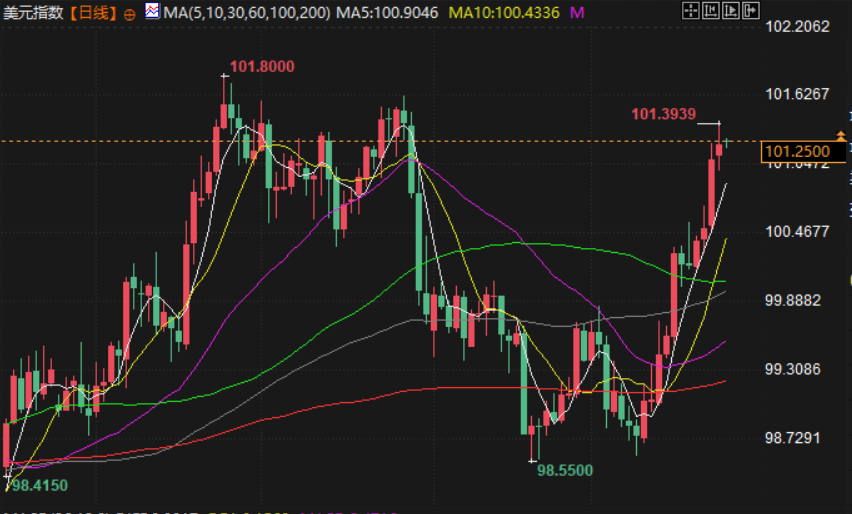 Following sharp fluctuations in the previous trading day, U.S. Treasury yields continued to climb, with the 30-year yield rising to its highest level since June 2004 and the benchmark 10-year yield reaching its highest level in nearly 20 years. Data released on Thursday showed that initial jobless claims fell by 1,000 to 197,000 last week, lower than economists' expectations of 201,000, indicating a stabilizing labor market. Adding to inflation concerns was the Houthi missile attack on Saudi Arabia, which reignited fears of supply disruptions, causing oil prices to surge initially. However, the gains were somewhat mitigated after reports surfaced that the U.S. and Iran were discussing reopening the Strait of Hormuz. Since the Federal Reserve raised its target range for interest rates by 25 basis points to 3.75%-4.00% last week, several Fed officials have warned that further rate hikes may be necessary if inflation fails to ease. New York Fed President Williams and Philadelphia Fed President Paulson both indicated that further rate increases might be needed. According to CME Group's FedWatch data, market expectations for a Federal Reserve rate hike of at least 25 basis points at its October meeting rose to 68.6%, up from 55.4% a week ago. The euro fell 0.04% against the dollar to $1.1379, having earlier fallen to $1.1358, its lowest level since July 28. European Central Bank Executive Board member Schnabel resigned on Thursday to take a senior position at the International Monetary Fund. The Norwegian central bank raised interest rates on Thursday, and the Swedish central bank hinted at a possible follow-up move before the end of the year. The dollar rose 0.34% against the Swiss franc to 0.828, having earlier risen to 0.8296, a new high since May 2025. The Swiss National Bank kept interest rates unchanged and stated that rising inflation triggered by the Middle East wars would not threaten price stability in Switzerland. The dollar rose 0.34% against the yen to 158.85. Japanese Finance Minister Satsuki Katayama said that the principles upon which Japan and the US coordinated intervention in the foreign exchange market in July remained valid, indicating that Tokyo was prepared to take joint action again if necessary. However, the Bank of Japan's interest rate hike last week failed to convince investors that a faster tightening cycle was coming, and market sentiment remained fragile.
Key Focus Today
stock market
U.S. stocks closed mixed on Thursday. The S&P 500 fell 0.02% to close at 7704.13, the Nasdaq Composite rose slightly by 0.01% to close at 26939.37, and the Dow Jones Industrial Average fell 0.31% to close at 51349.98. Uncertainty in the Middle East pushed up oil prices and U.S. Treasury yields. Negotiators from the U.S. and Iran are exploring ways to end the war in stages, including Tehran reopening the Strait of Hormuz and Washington lifting its economic blockade against Iran. However, Houthi missile attacks on Saudi Arabia reignited concerns about supply disruptions, causing Brent crude to rise more than 3% to nearly $107 a barrel. Bill Northey, senior investment director at Bank of America Wealth Management, said the market was primarily driven by oil prices, inflation, and their impact on interest rates. In individual stocks, Microsoft fell 0.5%, Broadcom fell 1.3%, and AMD rose 2.4%; Meta Platforms rose 4.5% after releasing a small handheld device the previous day that can be used with its AI assistant; Oracle fell 3.5% after reports that it had issued a "force majeure" notice regarding its New Mexico data center project. U.S. Treasury yields rose, with the 30-year yield hitting its highest level since 2004, making safe-haven assets like Treasuries more attractive than stocks. Eight of the 11 S&P sectors fell, with materials leading the decline at 1.18%, followed by consumer staples at 0.96%. Strong business activity data on Wednesday increased expectations of another Federal Reserve rate hike, with CME Group's FedWatch showing traders expecting a near 70% probability of another rate hike next month; New York Fed President Williams said on Thursday that it was reasonable for the Fed to need to raise rates again before the end of the year.Gold Market
Spot gold fell slightly on Thursday, hitting a one-week low of $4,244.16 per ounce, as rising oil prices and a more hawkish stance from the Federal Reserve strengthened market expectations for further interest rate hikes. David Meger, director of precious metals trading at High Ridge Futures, said rising energy prices and interest rates continue to put pressure on gold. As energy prices rise, inflation concerns intensify, increasing the likelihood of further interest rate hikes by the Federal Reserve. The Houthi missile attack on Saudi Arabia on Thursday reignited concerns about supply disruptions, pushing up oil prices. As producers pass on increased costs to consumers, rising energy prices could push up overall inflation, forcing central banks to adopt tighter policies to curb price increases. The Federal Reserve raised interest rates last week for the first time in three years and hinted at further rate hikes this year. Several Fed officials reiterated the need for further rate increases, with Fed Governor Barr being the latest to emphasize the need for tighter monetary policy. The CME Group's FedWatch tool shows that traders currently expect a 69% probability of a Fed rate hike in October. While gold is traditionally seen as an inflation hedge, rising interest rates will diminish its appeal. The dollar's rise to a two-month high also put pressure on gold prices, making dollar-denominated gold more expensive for overseas buyers; meanwhile, the yield on the 10-year US Treasury bond hovered near a 20-year high, increasing the opportunity cost of holding non-interest-bearing gold. Ole Hansen, head of commodity strategy at Saxo Bank, said in a report that the recent support level for gold around $4,235 per ounce is the first level to watch. A break below this level could lead to further price corrections, and market focus could shift back to the $4,000 area seen in June and July. Spot silver fell 0.9% to $63.85 per ounce; platinum dipped 0.1% to $1,748.46 per ounce; and palladium rose 0.7% to $1,268.24 per ounce.oil market
Oil prices rose on Thursday to a one-week high, with WTI crude up 2.21% to settle at $94.76 a barrel and Brent crude up 3.7% to settle at $107.24 a barrel, after Houthi rebels launched missiles at Saudi Arabia, reigniting concerns about supply disruptions. However, prices retreated from their intraday highs after reports that the U.S. and Iran were discussing reopening the Strait of Hormuz. The Saudi-led coalition said Saudi Arabia intercepted six ballistic missiles fired by Houthi rebels in Yemen, thwarting attacks on the southern Taif province and the Yanbu region on the Red Sea coast. Neighboring countries, including the UAE and Oman, banned Iranian airlines from entering the country in response to new US sanctions, the first major impact of the US expanding sanctions to include third-country companies doing business with Iran. The war with Iran has been deadlocked on the battlefield for months, and Washington announced expanded financial sanctions targeting third-country companies doing business with Iranian enterprises—a move known as "secondary sanctions." Iran threatened on Wednesday to retaliate against neighboring countries that complied with the US ban on Iranian flights, rendering their airports "unusable." Furthermore, industry sources, satellite imagery, and shipping data show that Saudi Arabia is increasing crude oil shipments to the Red Sea export hub of Yanbu via the East-West Pipeline, although oil tanker loading operations have not yet resumed. Sources close to the negotiations said US and Iranian negotiators are in New York discussing a phased end to the war, including Tehran reopening the Strait of Hormuz and Washington lifting its economic blockade of Iran, but neither side is willing to relinquish their negotiating leverage.Foreign exchange market
The dollar index rose 0.12% to 101.25 on Thursday, reaching a two-month high of 101.39 during the session, as rising Treasury yields, hawkish comments from several Federal Reserve officials, and strong economic data strengthened market expectations for further interest rate hikes by the Fed. Following sharp fluctuations in the previous trading day, U.S. Treasury yields continued to climb, with the 30-year yield rising to its highest level since June 2004 and the benchmark 10-year yield reaching its highest level in nearly 20 years. Data released on Thursday showed that initial jobless claims fell by 1,000 to 197,000 last week, lower than economists' expectations of 201,000, indicating a stabilizing labor market. Adding to inflation concerns was the Houthi missile attack on Saudi Arabia, which reignited fears of supply disruptions, causing oil prices to surge initially. However, the gains were somewhat mitigated after reports surfaced that the U.S. and Iran were discussing reopening the Strait of Hormuz. Since the Federal Reserve raised its target range for interest rates by 25 basis points to 3.75%-4.00% last week, several Fed officials have warned that further rate hikes may be necessary if inflation fails to ease. New York Fed President Williams and Philadelphia Fed President Paulson both indicated that further rate increases might be needed. According to CME Group's FedWatch data, market expectations for a Federal Reserve rate hike of at least 25 basis points at its October meeting rose to 68.6%, up from 55.4% a week ago. The euro fell 0.04% against the dollar to $1.1379, having earlier fallen to $1.1358, its lowest level since July 28. European Central Bank Executive Board member Schnabel resigned on Thursday to take a senior position at the International Monetary Fund. The Norwegian central bank raised interest rates on Thursday, and the Swedish central bank hinted at a possible follow-up move before the end of the year. The dollar rose 0.34% against the Swiss franc to 0.828, having earlier risen to 0.8296, a new high since May 2025. The Swiss National Bank kept interest rates unchanged and stated that rising inflation triggered by the Middle East wars would not threaten price stability in Switzerland. The dollar rose 0.34% against the yen to 158.85. Japanese Finance Minister Satsuki Katayama said that the principles upon which Japan and the US coordinated intervention in the foreign exchange market in July remained valid, indicating that Tokyo was prepared to take joint action again if necessary. However, the Bank of Japan's interest rate hike last week failed to convince investors that a faster tightening cycle was coming, and market sentiment remained fragile.International News
The probability of a Fed rate hike in October is 67.5%, according to CME's "FedWatch". The probability of the Fed maintaining interest rates at 3.75%-4.00% at its October meeting is 32.5%, while the probability of a 25 basis point hike is 67.5%. The probability of the Fed maintaining interest rates at 3.75%-4.00% by December is 5.2%, the probability of a cumulative 25 basis point hike is 38%, and the probability of a cumulative 50 basis point hike is 56.8%. France plans to convene a G7 meeting to discuss releasing strategic oil reserves . French President Macron said in a joint interview with two French television stations on the evening of the 24th that France plans to convene a meeting of G7 members to discuss releasing strategic oil reserves to stabilize international oil prices. Recently, diesel prices in the US and many European countries have reached new highs. Macron said that G7 members could study how to release strategic oil reserves to the market through coordinated efforts to lower oil prices. Macron said the situation in Iran is the main reason for the surge in global oil prices, and France will work to promote regional stability. Furthermore, the Russia-Ukraine conflict has also impacted oil prices, prompting France to call on both sides to cease attacks on each other's energy targets. (Xinhua) Israeli Official: Resuming Strikes Against Iran is Only a Matter of Time According to Al Hadath, Israeli officials believe that resuming strikes against Iran is only a matter of time. The official revealed to the media that Israeli intelligence has detected Iran attempting to revive and restart its nuclear program in preparation for a potential attack. Previously, Israeli sources reported that Iran had moved its remaining nuclear program to "Gazelle Hill," near the Natanz nuclear facility. The report also quoted the official as saying that Israel is "prepared on both defensive and offensive fronts, ready to respond to the possibility of renewed war with Iran and on other fronts." The official added, "If Tehran crosses any red line, regardless of whether the United States participates, we will again strike its nuclear facilities and all related targets." Iran: Has Informed Pakistan of the Latest Developments in the Strait of Hormuz Passage Agreement The Iranian Foreign Ministry stated that the Foreign Minister of the Islamic Republic of Iran met with the Foreign Minister of Pakistan. The Iranian Foreign Minister praised Pakistan's constructive efforts as a mediator in negotiations with the United States, while noting that repeated US violations have undermined its mediator role. He emphasized that the US violation of the Islamabad Agreement has led to increased insecurity and tension in the region, and the US bears continued responsibility for these consequences. The Iranian Foreign Minister briefed his Pakistani counterpart on the latest developments in bilateral talks and agreements between Iran and Oman regarding determining appropriate routes for safe passage of ships in the Strait of Hormuz, as well as interactions with the United States through Qatar. The US Department of Energy will invest nearly $2 billion to upgrade the power grid. The US Department of Energy will announce a nearly $2 billion investment plan on Thursday aimed at unlocking the power supply potential of the aging and increasingly strained US power grid. The funds will cover 31 projects in 26 states and are expected to add more than 23 gigawatts of power transmission capacity, equivalent to meeting the electricity needs of 16 million homes. Saudi Arabia's oil exports hit a new low in July Data released by the Saudi General Authority for Statistics on July 24 showed that both Saudi Arabia's oil exports and total exports continued to decline in July, reaching their lowest levels since May 2025 and June 2021, respectively. According to data cited by the Russian news agency RIA Novosti, Saudi Arabia's oil exports in July totaled 59.888 billion riyals (approximately US$15.9 billion), a 12.8% decrease compared to the same period last year, the lowest since May 2025. Saudi Arabia's total merchandise exports in July totaled 84.379 billion riyals ($22.4 billion), a 17.2% year-on-year decrease, the lowest since June 2021. The share of oil exports in Saudi Arabia's total exports fell from 71.7% in June to 71% in July. Saudi Arabia's imports also fell to 70.015 billion riyals ($18.6 billion) in July, a 15.4% year-on-year decrease. Industry analysts say the decline in Saudi oil exports is mainly due to the US-Iran military conflict. Since the US and Israel launched military strikes against Iran in late February, navigation through the Strait of Hormuz has been continuously disrupted, severely impacting Saudi Arabia's crude oil exports. In response, Saudi Arabia has intensified its "east-to-west oil transfer" strategy, transporting crude oil from its eastern oil fields via pipeline to Yanbu port on the west coast, from where it exits through the Bab el-Mandeb Strait connecting the Red Sea and the Gulf of Aden. However, on July 20, the Houthi rebels in Yemen announced a "maritime blockade" of Saudi Arabia, threatening Saudi Arabia's crude oil export routes from the Red Sea. (CCTV News) The US rejects Iran's proposal to reopen the Strait of Hormuz, questioning its legitimacy . According to Israel's Channel 12, US negotiators, in an indirect meeting during the UN General Assembly in New York, rejected Iran's proposal to reopen the Strait of Hormuz. The US informed Tehran that Iran does not control the waterway and questioned its legitimacy in making such a proposal. Channel 12 revealed details, stating that US envoys Steve Witkov and Jared Kushner were in one room, while Iranian Foreign Minister Abbas Araghchi was in another, with messages exchanged between the two sides through Qatari mediators. According to sources, more indirect talks may be held before the UN General Assembly closes, but mediators are awaiting Trump's decision on whether to continue the process or take other approaches.Domestic News
The robot rental market is booming, with the industry predicting its size will increase by over 900% . With the Mid-Autumn Festival and National Day holidays approaching, the use of robots in cultural tourism performances, commercial activities, and other scenarios has increased significantly. At a robot 6S store in Longgang District, Shenzhen, staff are conducting final checks on humanoid robots and quadrupedal robot dogs that are about to be shipped out that day. The store manager told reporters that rental orders have risen significantly since September. Data shows that in the first half of this year, China's humanoid robot shipments exceeded 40,000 units, accounting for 97% of the global market. The industry predicts that the domestic robot rental market size is expected to exceed 10 billion yuan in 2026, an increase of over 900% compared to 2025. (CCTV Finance) Ministry of Commerce: China's total outbound direct investment reached US$113.39 billion from January to August, a 3.9% increase. According to statistics from the Ministry of Commerce and the State Administration of Foreign Exchange, from January to August 2026, China's total outbound direct investment reached 778.47 billion yuan, a year-on-year decrease of 0.6% (US$113.39 billion, an increase of 3.9%). Among them, Chinese investors made non-financial direct investments in 8,424 overseas enterprises in 148 countries and regions worldwide, totaling RMB 595.06 billion, a decrease of 14.4% (USD 86.68 billion, a decrease of 10.6%). Ministry of Commerce: The Eighth Round of China-US Trade Consultations Reached Multiple Consensus Points He Yadong introduced that recently, the China-US trade teams held the eighth round of trade consultations in the United States. Guided by the important consensus reached by the two heads of state, and adhering to the principles of mutual respect, peaceful coexistence, and win-win cooperation, both sides conducted frank, in-depth, and constructive exchanges on trade and economic issues of common concern, including implementing existing trade consultation consensus, reciprocal tariff reduction arrangements, establishing a trade council and an investment council, and extending the joint arrangements for the Kuala Lumpur trade consultations, reaching multiple consensus points. Vice Premier He Lifeng and Finance Secretary Bessenter, as the respective lead negotiators for China and the US, held their first dialogue on artificial intelligence under the China-US trade consultation mechanism. Next, China will maintain close communication with the US side on follow-up work under the China-US trade consultation mechanism. (CCTV News) On September 24, 2026, the government continued to implement price controls, appropriately adjusting refined oil prices. Since the domestic refined oil price adjustment on September 11, the complex and volatile geopolitical situation in the Middle East has led to a rapid rise and fall in international crude oil prices, followed by a recent surge. To mitigate the impact of rising international oil prices on the domestic market, the government continues to implement price control measures for refined oil. Based on the current pricing mechanism, starting from 24:00 on September 24, the prices of gasoline and diesel (standard grades) should have increased by 830 yuan and 800 yuan per ton respectively. After the adjustment, the actual increase is 395 yuan and 385 yuan per ton respectively. (National Development and Reform Commission)- Risk Warning and Disclaimer
- The market involves risk, and trading may not be suitable for all investors. This article is for reference only and does not constitute personal investment advice, nor does it take into account certain users’ specific investment objectives, financial situation, or other needs. Any investment decisions made based on this information are at your own risk.