Gold Trading Alert: Soaring oil prices coupled with hawkish Fed pronouncements send gold prices hitting a one-week low. Can the $4235 level hold?
2026-09-25 07:46:12
Global gold markets faced renewed pressure on Thursday. Spot gold fell slightly by 0.3%, closing at $4,274.58 per ounce, after hitting a low of $4,244.16, its lowest level since September 16, a one-week low, barely holding above the nearly one-and-a-half-month low of $4,235 reached on September 16. December gold futures closed down 0.5% at $4,298. This was the result of the combined effects of energy prices, interest rate expectations, and the dollar's performance. Gold, traditionally a safe-haven and inflation hedge, was temporarily sidelined by the market due to higher holding costs and a stronger dollar. In early Asian trading on Friday (September 25), spot gold traded in a narrow range, currently hovering around $4,273 per ounce. 
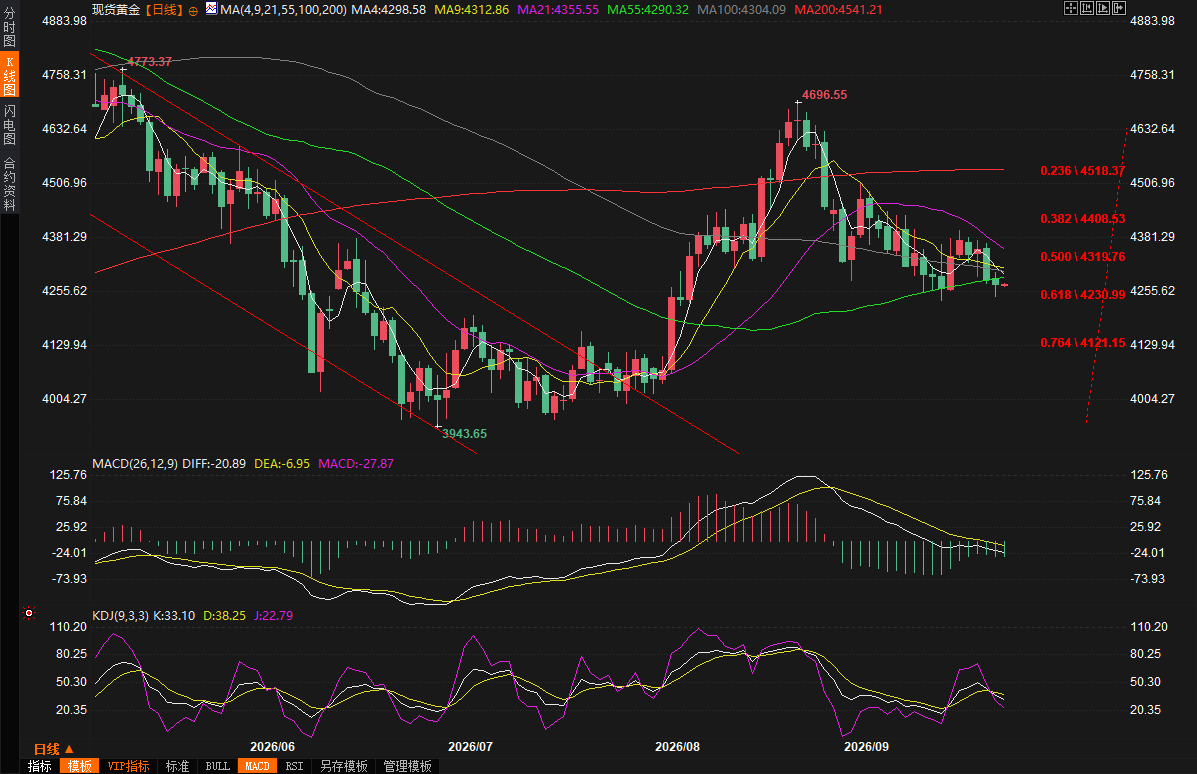 (Spot gold daily chart, source: FX678) At 07:44 Beijing time, spot gold is currently trading at $4273.86 per ounce.
The surge in oil prices has exacerbated inflation concerns, weakening the hedging logic of gold.
The immediate trigger for the decline in gold prices came from the oil market. On Thursday, the Houthi rebels launched a missile attack on Saudi Arabia. Although Saudi Arabia successfully intercepted the ballistic missiles, concerns about supply disruptions in the Middle East quickly intensified. Brent crude futures rose 3.4% to $106.60 a barrel, the highest closing price since September 15; U.S. crude also rose 2.7% to $94.61. Both contracts rose nearly 5% at one point during the session. This rebound in oil prices directly brought energy costs back into focus. Rising energy prices often pass on to overall prices through production costs. When producers pass on higher fuel and raw material costs to downstream users, inflationary expectations are reignited. While gold theoretically has the function of hedging against inflation, in actual trading, the market is more concerned about the possible responses from central banks. Once inflationary pressures reappear, the probability of rising policy interest rates increases, and rising interest rates precisely raise the opportunity cost of holding gold. David Meger, Director of Precious Metals Trading at High Ridge Futures, points out that the simultaneous rise in energy prices and interest rates is continuing to put pressure on gold. Increased energy costs and inflation concerns, coupled with the growing likelihood of further tightening by the Federal Reserve, are diminishing gold's appeal.Federal Reserve officials adopted a hawkish stance, and interest rate expectations were revised upwards rapidly.
Resonating with rising oil prices is the recent flurry of hawkish statements from Federal Reserve officials. Last week, the Fed raised interest rates for the first time in three years, increasing the target range by 25 basis points to 3.75%-4.00%. Since then, several officials have repeatedly emphasized that further action would be necessary if inflation fails to decline significantly. On Thursday, Philadelphia Fed President Paulson and New York Fed President Williams both stated that the Fed may need to raise rates again to curb "unacceptably high" inflation. Fed Governor Barr had also previously stated clearly that further tightening of monetary policy was necessary. The market reacted extremely quickly to this signal. The CME Group's FedWatch tool shows that traders now expect a 69% probability of a rate hike at the Fed's October meeting, significantly higher than a week ago. Meanwhile, the US Treasury market also experienced a sharp correction. The yield on 30-year Treasury bonds rose as high as 5.5016%, the highest since June 2004, before closing at 5.472%, up 7 basis points. The yield on 10-year Treasury bonds rose to 5.185%, having touched a near 19-year high of 5.2251% during the session. The yield on 2-year Treasury bonds also climbed to 4.914%. The steepening and overall upward trend of the yield curve directly increased the opportunity cost of holding non-interest-bearing gold, causing some funds to shift towards dollar assets that offer positive returns.A stronger dollar coupled with geopolitical disturbances makes the path of downward pressure on gold prices clearer.
The dollar index rose to a two-month high on Thursday, touching 101.39 during the session before settling near 101.28. Strong jobs data further reinforced this trend – initial jobless claims fell to 197,000 last week, below market expectations of 201,000, indicating a still robust labor market. A stronger dollar means that dollar-denominated gold becomes more expensive for overseas buyers, naturally suppressing demand. Meanwhile, continued uncertainty in the Middle East also provided some safe-haven support for the dollar. The Houthi attacks and rumors of negotiations between the US and Iran regarding the Strait of Hormuz intertwined, pushing up oil prices and causing the market to repeatedly weigh risk assets against safe-haven assets. The end result was that rising oil prices exacerbated inflation and interest rate hike expectations, thus supporting the dollar, while gold was placed at a relatively unfavorable position. Ole Hansen, head of commodity strategy at Saxo Bank, cautioned that the recent support level around $4,235 per ounce for gold is the first key level to watch. A decisive break below this area could shift market focus back to the $4,000 level seen in June and July. Although gold prices are still at a relatively high level, both upward resistance and downward risks exist simultaneously.Market Outlook
In summary, this round of gold price correction is not driven by a single factor, but rather by a confluence of factors: a surge in oil prices, hawkish comments from the Federal Reserve, soaring US Treasury yields, and a strengthening US dollar. Gold's traditional safe-haven and inflation-hedging attributes remain, but its relative attractiveness has been temporarily suppressed in a high-interest-rate and strong-dollar environment. In the short term, the market will continue to closely monitor developments in the Middle East, oil price fluctuations, and further statements from Federal Reserve officials. If the rise in oil prices is curbed, inflation expectations decline, or the US dollar and US Treasury yields experience a significant correction, gold may be able to hold support around 4235. Conversely, if interest rate hike expectations continue to rise and the US dollar remains strong, gold prices may still face further downward pressure. While paying attention to geopolitical risks, investors need to place interest rate paths and the US dollar's trajectory at the core to more accurately grasp the next stage of gold's direction. Today's trading session also requires attention to the preliminary reading of the US August durable goods orders month-on-month rate and the speech by Kansas City Fed President Schmid, as well as news related to the meeting between Chinese and US leaders. (Spot gold daily chart, source: FX678) At 07:44 Beijing time, spot gold is currently trading at $4273.86 per ounce.
- Risk Warning and Disclaimer
- The market involves risk, and trading may not be suitable for all investors. This article is for reference only and does not constitute personal investment advice, nor does it take into account certain users’ specific investment objectives, financial situation, or other needs. Any investment decisions made based on this information are at your own risk.