Crude Oil Trading Alert: US-Iran Talks Signal Easing of Tensions, WTI Crude Oil Rises and Then Falls Back
2026-09-25 09:45:12
International oil prices retreated during Asian trading hours, with WTI crude futures trading around $93.30 per barrel, down about 1%, ending a two-day winning streak. Brent crude also weakened, trading around $99.20 per barrel. The main reason for the price decline was news of progress in US-Iran negotiations. US and Iranian negotiators are in New York discussing a phased path to ending the conflict, which may include reopening the Strait of Hormuz and Washington lifting its economic blockade of Iranian ports. These negotiations, brokered by Qatari officials, are taking place during the UN General Assembly.  The Strait of Hormuz is a crucial global energy transport route, handling approximately 20% of the world's seaborne crude oil shipments. Since the outbreak of the conflict, shipping through the strait has been severely restricted, becoming a key factor driving the continued rise in international oil prices. Iran has stated that the most likely way to break the deadlock is through a phased arrangement: Iran would allow ships to pass through the Strait of Hormuz in exchange for the US lifting its economic blockade, with Tehran potentially gaining access to its frozen assets. However, negotiations still face significant obstacles. Iran insists on retaining control of the Strait of Hormuz and rejects any agreement unless the US eases its military pressure and lifts the port blockade. White House officials have stated that President Trump is open to discussions but emphasized that given the US's dominant position following sanctions, there is little negotiating pressure. While news of the negotiations has eased supply concerns, tensions in the Middle East remain high. The Houthi rebels in Yemen recently launched missiles at the Saudi cities of Yanbu and Taif, and the Saudi-led coalition confirmed intercepting six ballistic missiles. The Houthis also claimed responsibility for a large-scale attack on multiple military targets in Saudi Arabia's Jizan region, resulting in hundreds of deaths and injuries. Yanbu is a key port for Saudi Arabia to export crude oil around the Strait of Hormuz, and the ongoing conflict in the region continues to threaten energy supplies. From a fundamental perspective, US energy inventory data is putting some downward pressure on oil prices. The latest data from the US Energy Information Administration (EIA) shows that for the week ending September 18, US commercial crude oil inventories increased by approximately 3 million barrels to 426.4 million barrels, far exceeding market expectations of a decrease of 641,000 barrels. However, gasoline inventories decreased by 1.7 million barrels, and distillate fuel inventories decreased by 428,000 barrels, indicating that demand remains somewhat supported. ING analysts warned that shipping restrictions in the Strait of Hormuz have raised concerns among global manufacturers about energy shortages, rising prices, and potential production disruptions. However, they believe that the US is "better equipped than its European and Asian competitors" to handle these challenges because the US "produces more energy than it consumes," providing a meaningful buffer against supply disruptions and soaring prices. From a technical perspective, the WTI crude oil daily chart shows a high-level consolidation structure. Since its rise from around $83 in early September, prices have formed a clear upward trend, reaching a high of $96.78 this week before pulling back. The MACD indicator is running above the zero line, but the red bars are showing signs of contraction, indicating weakening upward momentum. Regarding the moving average system, the 5-day, 10-day, and 20-day moving averages are still in a bullish alignment, with the price currently trading near the 5-day moving average, suggesting a short-term trend correction. Key support lies near the $92 psychological level, a significant psychological barrier previously broken; resistance is seen in the $96-$97 range, the resistance area formed by this week's high. Looking at the 4-hour chart, the short-term trend shows signs of weakening. After reaching a high of $96.78, prices quickly retreated, with the RSI indicator falling from overbought territory above 70 to around 55, indicating waning bullish momentum. The Bollinger Bands are narrowing, with prices falling from near the upper band to near the middle band, suggesting the one-sided upward trend may have ended, and a consolidation phase may be imminent. If the price can hold the $92 support level, it is expected to fluctuate within the $92 to $97 range; if it falls below $92, it may further decline to the $90 level.
 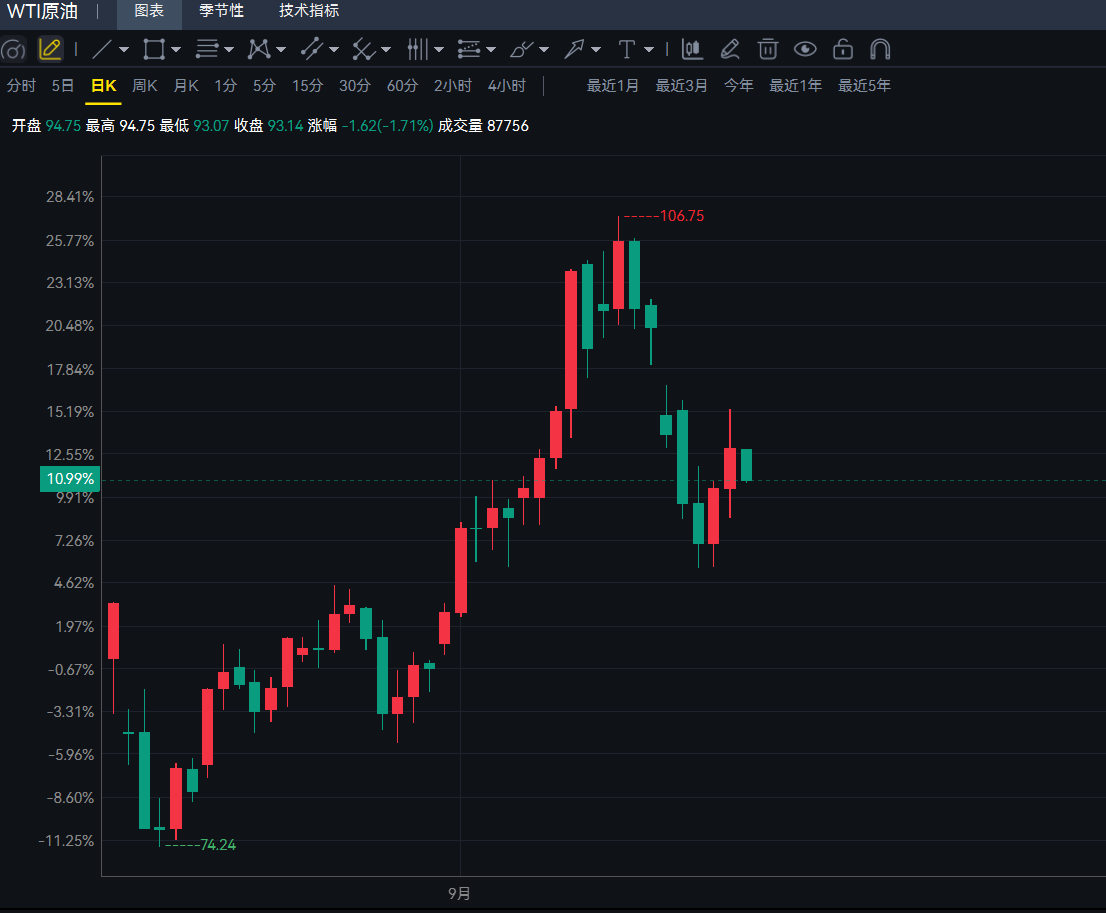 Editor's Summary: The easing signals from the US-Iran negotiations were the core reason for the recent decline in oil prices, as market expectations of the reopening of the Strait of Hormuz eased supply concerns. However, the ongoing Houthi attacks on Saudi oil facilities indicate that the situation in the Middle East remains complex, and geopolitical risks have not been completely eliminated. From a fundamental perspective, the unexpected increase in US crude oil inventories put downward pressure on oil prices, but the decline in refined product inventories reflects continued support on the demand side. Looking ahead, oil price movements will be highly dependent on the actual progress of the US-Iran negotiations. If the two sides can reach a substantial agreement, the reopening of the Strait of Hormuz will significantly increase global crude oil supply, and oil prices may face significant downward pressure; if the negotiations break down or progress slowly, the geopolitical risk premium will continue to support high oil prices. Close attention should be paid to the developments in the negotiations and the Middle East situation, while also being wary of short-term volatility risks arising from changes in US inventory data.
The Strait of Hormuz is a crucial global energy transport route, handling approximately 20% of the world's seaborne crude oil shipments. Since the outbreak of the conflict, shipping through the strait has been severely restricted, becoming a key factor driving the continued rise in international oil prices. Iran has stated that the most likely way to break the deadlock is through a phased arrangement: Iran would allow ships to pass through the Strait of Hormuz in exchange for the US lifting its economic blockade, with Tehran potentially gaining access to its frozen assets. However, negotiations still face significant obstacles. Iran insists on retaining control of the Strait of Hormuz and rejects any agreement unless the US eases its military pressure and lifts the port blockade. White House officials have stated that President Trump is open to discussions but emphasized that given the US's dominant position following sanctions, there is little negotiating pressure. While news of the negotiations has eased supply concerns, tensions in the Middle East remain high. The Houthi rebels in Yemen recently launched missiles at the Saudi cities of Yanbu and Taif, and the Saudi-led coalition confirmed intercepting six ballistic missiles. The Houthis also claimed responsibility for a large-scale attack on multiple military targets in Saudi Arabia's Jizan region, resulting in hundreds of deaths and injuries. Yanbu is a key port for Saudi Arabia to export crude oil around the Strait of Hormuz, and the ongoing conflict in the region continues to threaten energy supplies. From a fundamental perspective, US energy inventory data is putting some downward pressure on oil prices. The latest data from the US Energy Information Administration (EIA) shows that for the week ending September 18, US commercial crude oil inventories increased by approximately 3 million barrels to 426.4 million barrels, far exceeding market expectations of a decrease of 641,000 barrels. However, gasoline inventories decreased by 1.7 million barrels, and distillate fuel inventories decreased by 428,000 barrels, indicating that demand remains somewhat supported. ING analysts warned that shipping restrictions in the Strait of Hormuz have raised concerns among global manufacturers about energy shortages, rising prices, and potential production disruptions. However, they believe that the US is "better equipped than its European and Asian competitors" to handle these challenges because the US "produces more energy than it consumes," providing a meaningful buffer against supply disruptions and soaring prices. From a technical perspective, the WTI crude oil daily chart shows a high-level consolidation structure. Since its rise from around $83 in early September, prices have formed a clear upward trend, reaching a high of $96.78 this week before pulling back. The MACD indicator is running above the zero line, but the red bars are showing signs of contraction, indicating weakening upward momentum. Regarding the moving average system, the 5-day, 10-day, and 20-day moving averages are still in a bullish alignment, with the price currently trading near the 5-day moving average, suggesting a short-term trend correction. Key support lies near the $92 psychological level, a significant psychological barrier previously broken; resistance is seen in the $96-$97 range, the resistance area formed by this week's high. Looking at the 4-hour chart, the short-term trend shows signs of weakening. After reaching a high of $96.78, prices quickly retreated, with the RSI indicator falling from overbought territory above 70 to around 55, indicating waning bullish momentum. The Bollinger Bands are narrowing, with prices falling from near the upper band to near the middle band, suggesting the one-sided upward trend may have ended, and a consolidation phase may be imminent. If the price can hold the $92 support level, it is expected to fluctuate within the $92 to $97 range; if it falls below $92, it may further decline to the $90 level. Editor's Summary: The easing signals from the US-Iran negotiations were the core reason for the recent decline in oil prices, as market expectations of the reopening of the Strait of Hormuz eased supply concerns. However, the ongoing Houthi attacks on Saudi oil facilities indicate that the situation in the Middle East remains complex, and geopolitical risks have not been completely eliminated. From a fundamental perspective, the unexpected increase in US crude oil inventories put downward pressure on oil prices, but the decline in refined product inventories reflects continued support on the demand side. Looking ahead, oil price movements will be highly dependent on the actual progress of the US-Iran negotiations. If the two sides can reach a substantial agreement, the reopening of the Strait of Hormuz will significantly increase global crude oil supply, and oil prices may face significant downward pressure; if the negotiations break down or progress slowly, the geopolitical risk premium will continue to support high oil prices. Close attention should be paid to the developments in the negotiations and the Middle East situation, while also being wary of short-term volatility risks arising from changes in US inventory data.- Risk Warning and Disclaimer
- The market involves risk, and trading may not be suitable for all investors. This article is for reference only and does not constitute personal investment advice, nor does it take into account certain users’ specific investment objectives, financial situation, or other needs. Any investment decisions made based on this information are at your own risk.