With rising expectations of a hawkish stance from the Federal Reserve and the dollar remaining strong, spot gold is consolidating around $4,300, awaiting a directional move.
2026-09-25 10:20:13
Spot gold prices continued their decline in Asian trading on Friday, with London spot gold trading around $4,290 per ounce. Previously, gold prices had fallen below the $4,300 mark, hitting a low of around $4,254. The main reason for the downward pressure on gold prices was the continued rise in expectations of a Federal Reserve interest rate hike. New York Fed President John Williams and Cleveland Fed President Beth Hammark are expected to speak later in the day, and market bets on further Fed rate hikes this year are increasing. According to the CME FedWatch Tool, the market is pricing in a 25 basis point rate hike by the Fed in October at approximately 67.5%, a significant increase from 55.4% a week ago.  Philadelphia Fed President Anna Paulson delivered a distinctly hawkish speech this week, earning an 8.1/10 rating on the FXS speech tracker, above the benchmark of 7/10. Paulson emphasized that inflationary pressures remain high, and the Fed "may need to raise rates again," stating that the September rate hike only put policy in a "better anti-inflationary stance." She also noted that underlying inflation "remains stubbornly high," partly driven by the AI construction boom. The FXS Fed Sentiment Index remained high at 148.18, indicating that the Fed's overall communication tone remains deeply hawkish. Meanwhile, yields on the longest-term U.S. Treasury bonds climbed to their highest levels in over two decades, with the 30-year yield hitting 5.47% and the 10-year yield reaching 5.058%, a new high since July 2007. The dollar index rose for the fifth consecutive trading day, reaching around 101.30, nearing a three-month peak. A high-interest-rate environment directly weighs on gold because it doesn't generate interest income. When bond returns are attractive, market funds naturally prioritize other asset classes. This is the main reason for the recent weakness and repeated adjustments in gold prices. The rebound in oil prices has also put additional pressure on gold. News of minimal progress in US-Iran negotiations has triggered market concerns about oil-driven inflation, causing WTI crude oil prices to rise above $92. Rising oil prices have reinforced market expectations that the Federal Reserve needs to continue raising interest rates to curb inflation above its target level, further suppressing gold's safe-haven appeal. From a technical perspective, the daily chart for spot gold shows a clear weakness. Prices continue to trade below the 100-day moving average, currently around $4310, forming initial resistance. The Bollinger Band middle line is around $4360, and the upper line is close to $4480, forming stronger upward resistance. The Relative Strength Index (RSI) is hovering around 44, neither entering oversold territory nor showing a reversal signal, indicating that downward momentum continues. Prices found initial support above the lower Bollinger Band at $4240. A daily close below this level could lead to further declines towards $4200 or even lower, potentially falling back to the previous consolidation zone. The 4-hour chart also shows a bearish short-term trend. The C-wave decline from the $4371 high is approaching the 100% retracement level of $4262, which almost coincides with today's intraday low, making it a crucial battleground for bulls and bears in the short term. If the $4262 support holds, gold prices may form a minor support level, triggering a technical rebound, with the first resistance level at the $4304-$4316 range. If this support is breached, the decline will accelerate, targeting the $4235-$4200 area, indicating significant potential for further weakness. The MACD indicator remains negative, indicating that bullish momentum has largely dissipated, and a short-term rebound will require time to develop.
 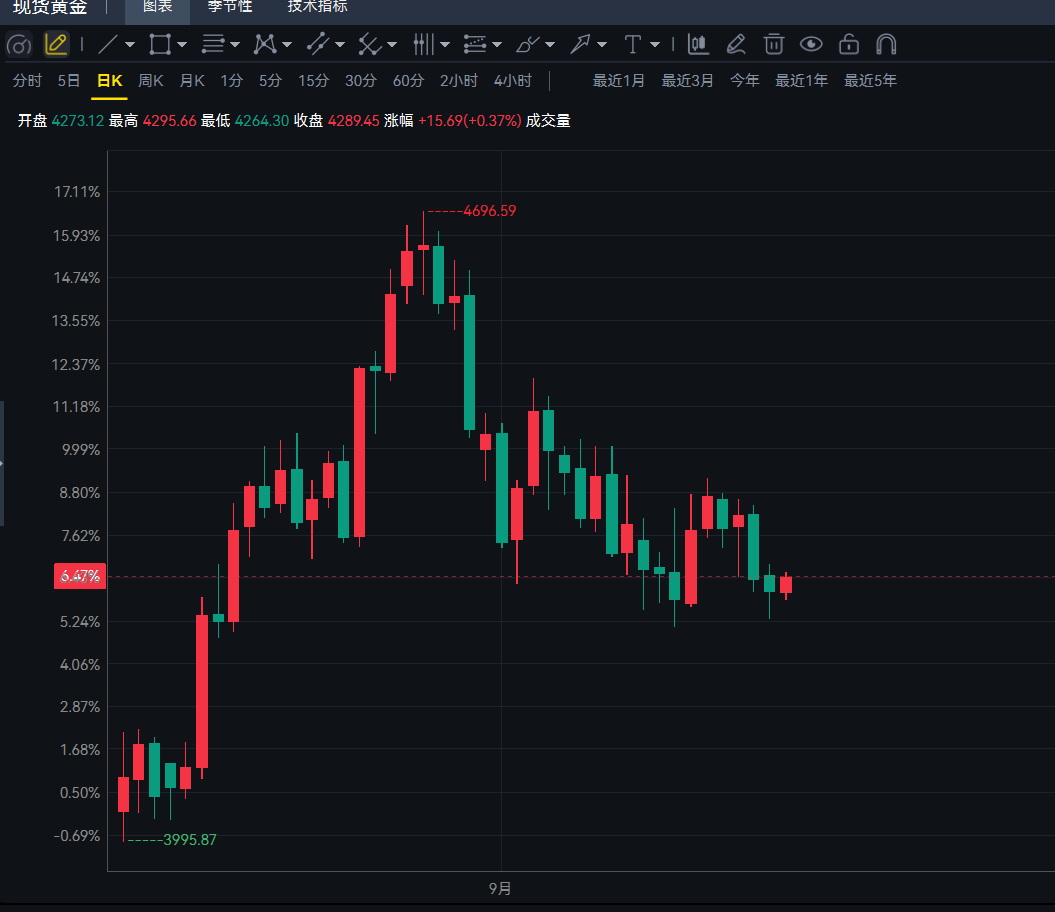 Editor's Summary: The core reason for the recent decline in gold prices is the continued rise in hawkish expectations from the Federal Reserve. Multiple officials have signaled further interest rate hikes, and the market has priced in a 67.5% probability of an October rate hike. Rising US Treasury yields to multi-decade highs and a stronger US dollar have exerted sustained downward pressure on gold, which does not generate interest. Inflation concerns triggered by the rebound in oil prices have also strengthened tightening expectations, further weakening gold's safe-haven appeal. From a fundamental perspective, strong gold imports from major Asian countries and central bank gold purchases provide medium- to long-term support for gold prices. However, until the Fed's tightening expectations subside substantially, the upside potential for gold will remain limited, and it is likely to maintain a range-bound trading pattern. If subsequent inflation data rebounds more than expected and the Fed raises rates in October, gold prices may further decline to $4200 or even lower. If economic data weakens or officials soften their stance, and rate hike expectations cool, gold prices may rebound to test the $4300-$4360 resistance zone. Close attention should be paid to the trend of US Treasury yields, changes in the US dollar index, and speeches by Fed officials, while also being wary of short-term volatility risks caused by repeated geopolitical tensions.
Philadelphia Fed President Anna Paulson delivered a distinctly hawkish speech this week, earning an 8.1/10 rating on the FXS speech tracker, above the benchmark of 7/10. Paulson emphasized that inflationary pressures remain high, and the Fed "may need to raise rates again," stating that the September rate hike only put policy in a "better anti-inflationary stance." She also noted that underlying inflation "remains stubbornly high," partly driven by the AI construction boom. The FXS Fed Sentiment Index remained high at 148.18, indicating that the Fed's overall communication tone remains deeply hawkish. Meanwhile, yields on the longest-term U.S. Treasury bonds climbed to their highest levels in over two decades, with the 30-year yield hitting 5.47% and the 10-year yield reaching 5.058%, a new high since July 2007. The dollar index rose for the fifth consecutive trading day, reaching around 101.30, nearing a three-month peak. A high-interest-rate environment directly weighs on gold because it doesn't generate interest income. When bond returns are attractive, market funds naturally prioritize other asset classes. This is the main reason for the recent weakness and repeated adjustments in gold prices. The rebound in oil prices has also put additional pressure on gold. News of minimal progress in US-Iran negotiations has triggered market concerns about oil-driven inflation, causing WTI crude oil prices to rise above $92. Rising oil prices have reinforced market expectations that the Federal Reserve needs to continue raising interest rates to curb inflation above its target level, further suppressing gold's safe-haven appeal. From a technical perspective, the daily chart for spot gold shows a clear weakness. Prices continue to trade below the 100-day moving average, currently around $4310, forming initial resistance. The Bollinger Band middle line is around $4360, and the upper line is close to $4480, forming stronger upward resistance. The Relative Strength Index (RSI) is hovering around 44, neither entering oversold territory nor showing a reversal signal, indicating that downward momentum continues. Prices found initial support above the lower Bollinger Band at $4240. A daily close below this level could lead to further declines towards $4200 or even lower, potentially falling back to the previous consolidation zone. The 4-hour chart also shows a bearish short-term trend. The C-wave decline from the $4371 high is approaching the 100% retracement level of $4262, which almost coincides with today's intraday low, making it a crucial battleground for bulls and bears in the short term. If the $4262 support holds, gold prices may form a minor support level, triggering a technical rebound, with the first resistance level at the $4304-$4316 range. If this support is breached, the decline will accelerate, targeting the $4235-$4200 area, indicating significant potential for further weakness. The MACD indicator remains negative, indicating that bullish momentum has largely dissipated, and a short-term rebound will require time to develop. Editor's Summary: The core reason for the recent decline in gold prices is the continued rise in hawkish expectations from the Federal Reserve. Multiple officials have signaled further interest rate hikes, and the market has priced in a 67.5% probability of an October rate hike. Rising US Treasury yields to multi-decade highs and a stronger US dollar have exerted sustained downward pressure on gold, which does not generate interest. Inflation concerns triggered by the rebound in oil prices have also strengthened tightening expectations, further weakening gold's safe-haven appeal. From a fundamental perspective, strong gold imports from major Asian countries and central bank gold purchases provide medium- to long-term support for gold prices. However, until the Fed's tightening expectations subside substantially, the upside potential for gold will remain limited, and it is likely to maintain a range-bound trading pattern. If subsequent inflation data rebounds more than expected and the Fed raises rates in October, gold prices may further decline to $4200 or even lower. If economic data weakens or officials soften their stance, and rate hike expectations cool, gold prices may rebound to test the $4300-$4360 resistance zone. Close attention should be paid to the trend of US Treasury yields, changes in the US dollar index, and speeches by Fed officials, while also being wary of short-term volatility risks caused by repeated geopolitical tensions.- Risk Warning and Disclaimer
- The market involves risk, and trading may not be suitable for all investors. This article is for reference only and does not constitute personal investment advice, nor does it take into account certain users’ specific investment objectives, financial situation, or other needs. Any investment decisions made based on this information are at your own risk.