Goldman Sachs has comprehensively lowered its USD/JPY forecast, reducing its 12-month target from 165 to 150.
2026-09-25 11:26:12
On Friday (September 25) during Asian trading hours, the USD/JPY pair saw a slight pullback after five consecutive days of gains, currently trading around 158.40. However, the exchange rate remains near its highest level since September 3. Goldman Sachs has comprehensively lowered its USD/JPY exchange rate forecasts, reducing its 3-month, 6-month, and 12-month targets from 162, 163, and 165 to 158, 155, and 150, respectively, citing the Bank of Japan's accelerated tightening pace, increased likelihood of capital outflows from Japan, and persistent intervention risks. 
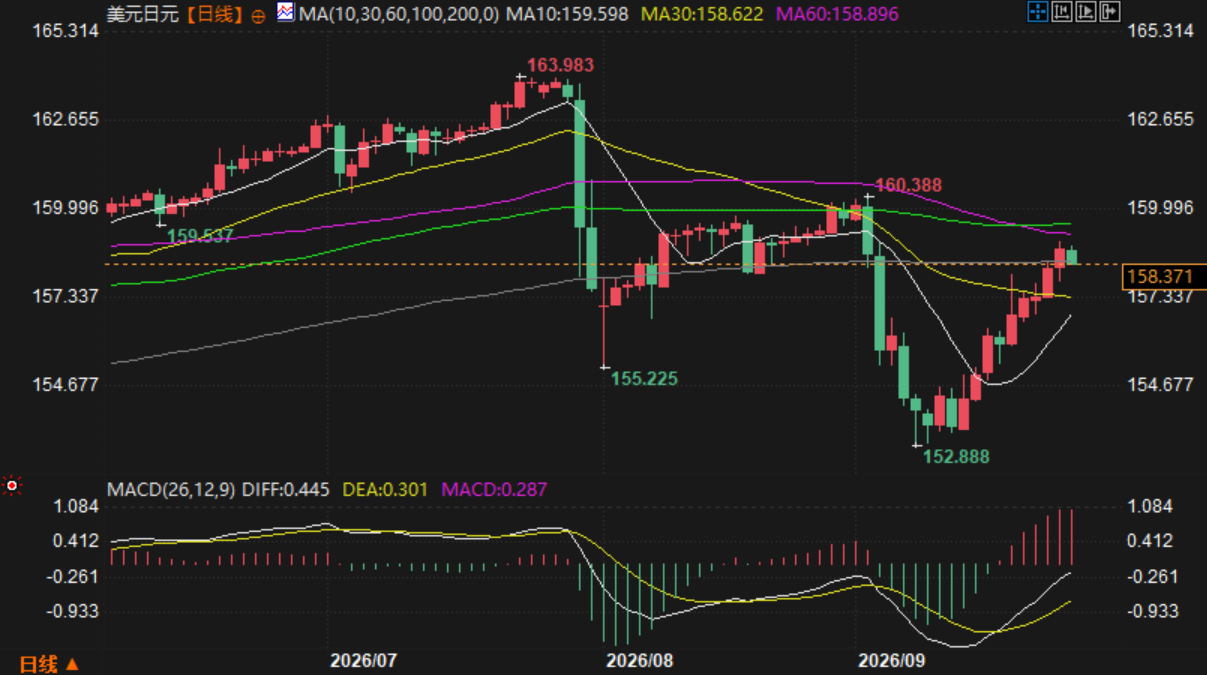 (USD/JPY daily chart, source: EasyForex) At 11:24 Beijing time, USD/JPY was trading at 158.42/43.
Predicting the magnitude and background of the correction: From the most pessimistic to a clearly bullish outlook
Goldman Sachs has significantly lowered its 12-month target from 165 to 150, a move that comes from one of its most influential research teams, carrying considerable market weight. This provides significant support for yen bulls, as the USD/JPY pair approaches the 160 mark. This adjustment contrasts sharply with Goldman Sachs' previous stance. In July, Goldman Sachs raised its USD/JPY forecast, citing persistently high US yields, low US recession risk, concerns about Japan's fiscal situation, and the Bank of Japan's (BOJ) gradual tightening policy. The bank explicitly stated at the time that unless there was a US growth shock or more aggressive tightening by the BOJ, the USD/JPY rally would be difficult to halt. Now, the latter condition has come into play. The BOJ raised its policy rate to 1.25% this month, and Governor Kazuo Ueda announced a shift in policy focus, with the current priority being to stabilize inflation at 2%, rather than further pushing it up. Goldman Sachs strategist Fishman believes that faster rate hikes by the BOJ will help offset the inflationary pull from expansionary fiscal policy, while also increasing the likelihood that Japanese investors will shift their portfolios back to domestic assets.Core logic: Bank of Japan tightening, capital repatriation, and recession hedging.
Goldman Sachs' bullish view on the yen is built on three pillars. First, the Bank of Japan's (BOJ) tightening pace has accelerated. The BOJ raised interest rates to 1.25% this month, and Kazuo Ueda's policy stance signals a shift from "pushing inflation upwards" to "maintaining inflation stability." Goldman Sachs believes that a faster pace of rate hikes will partially offset the inflationary effects of expansionary fiscal policy and narrow the interest rate differential between Japan and other economies. Second, capital repatriation from Japan. Goldman Sachs acknowledges that this "capital repatriation" narrative remains largely speculative, but believes its probability is rising, posing a downside risk to USD/JPY. Fishman writes that, taken together, these developments make long yen positions more attractive, particularly as a hedge against recession risk. Third, intervention risks limit dollar upside. Goldman Sachs expects the threat of further intervention by Japanese authorities to limit the dollar's rise against the yen. Japan has intervened in the market multiple times this year, and the US Treasury itself has also bought yen to curb rising borrowing costs.Tactical choice: Sell EUR/JPY instead of directly shorting USD/JPY
Despite a bullish outlook on the yen in the medium term, Goldman Sachs maintains a cautious tactical stance in the short term. Its preferred trade is not a direct short position on USD/JPY, but rather a short position on EUR/JPY. This position can benefit from a stronger yen without relying on a shift in US yields. This choice reflects Goldman Sachs' continued respect for the short-term support the dollar provides from high US yields. With the US 10-year Treasury yield currently above 5.2%, providing a significant interest rate advantage for the dollar, a direct short position on USD/JPY is not ideal in the short term. In contrast, EUR/JPY benefits from a stronger yen while avoiding the interference of short-term dollar resilience.Market Background: The USD/JPY exchange rate is approaching 160, creating tension with Goldman Sachs' forecast.
Goldman Sachs' new forecast contrasts sharply with recent market movements. The USD/JPY pair has been climbing steadily, nearing the 160 level, supported by the US 10-year yield above 5.2%. Even Goldman Sachs' 3-month target of 158 only implies a modest pullback from current levels. The real shift will occur over the 6-month and 12-month timeframes, when Goldman Sachs expects the effects of the Bank of Japan's tightening and capital flows to gradually accumulate. For Australian dollar traders, the AUD/JPY pair faces a double headwind: a stronger yen and a narrowing interest rate differential between the Bank of Japan and the Reserve Bank of Australia. Any new intervention from Tokyo would be the fastest path to Goldman Sachs' lower target.Institutional Disagreements and Policy Signals
It's worth noting that other institutions in the market have differing opinions on the Bank of Japan's policy path. Daiwa Securities believes the next interest rate hike by the Bank of Japan will be in December, while Kazuo Ueda's recent statements have signaled a shift in policy direction. This divergence means that the key variable in the yen's exchange rate movement lies in whether the Bank of Japan's actual rate hike pace meets market expectations. If the Bank of Japan raises rates again in December, Goldman Sachs' forecast will be strongly validated; if the pace of rate hikes is slower than expected, the USD/JPY exchange rate may remain high for a longer period.Summarize
Goldman Sachs' comprehensive downward revision of its USD/JPY forecast marks a significant reversal in its stance on the yen. From its "most pessimistic" view in July to its current clear bullishness, the core logic lies in the Bank of Japan's accelerated tightening pace, the increased probability of capital outflows from Japan, and the persistent risk of intervention. The 12-month target of 150 implies that Goldman Sachs expects the yen to appreciate significantly from current levels. Tactically, Goldman Sachs' choice to sell EUR/JPY rather than directly shorting USD/JPY reflects its respect for the short-term support of high US yields for the dollar. For market participants, Goldman Sachs' forecast provides a medium-term directional reference, but short-term movements still depend on US yields, the actual pace of the Bank of Japan's rate hikes, and the triggering conditions for intervention. Whether USD/JPY can fall from 160 to 150 depends not on Goldman Sachs' forecast itself, but on whether the Bank of Japan will deliver on its policy shift commitment through concrete actions. (USD/JPY daily chart, source: EasyForex) At 11:24 Beijing time, USD/JPY was trading at 158.42/43.
- Risk Warning and Disclaimer
- The market involves risk, and trading may not be suitable for all investors. This article is for reference only and does not constitute personal investment advice, nor does it take into account certain users’ specific investment objectives, financial situation, or other needs. Any investment decisions made based on this information are at your own risk.