The growing divergence between US and UK policies has hampered the pound's short-term rebound against the dollar.
2026-09-25 10:52:13
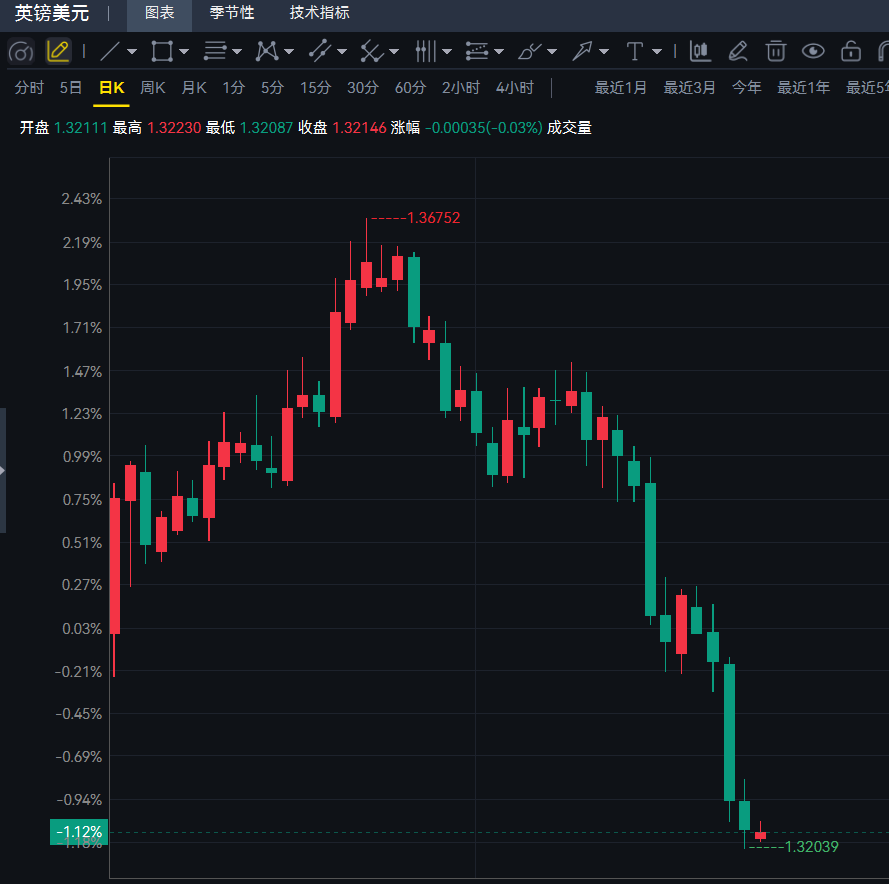
The pound rose slightly against the dollar in Asian trading on Friday, trading around 1.3210, up about 0.03% on the day, but still below the previous day's low of around 1.3206, indicating an overall weak trend. The dollar index remained stable at around 101.24 after rising for five consecutive trading days, and is on track for a 1% weekly gain.  The core support for the strong US dollar comes from the hawkish signals continuously released by the Federal Reserve. Philadelphia Fed President Anna Paulson and Cleveland Fed President Beth Hammark have both recently emphasized that inflationary pressures remain stubborn, and the Fed may need to raise interest rates further. According to the CME FedWatch Tool, the market's pricing in a 25 basis point rate hike in October has risen to approximately 67.5%, a significant increase from a week ago. US economic data shows that the preliminary S&P Global Composite PMI for September rose to 58.4, significantly higher than August's 56.0, while the manufacturing PMI further rose to 57.0, indicating that US business activity continues to maintain strong expansionary momentum. The continued rise in US Treasury yields has further strengthened the attractiveness of the dollar. The 10-year US Treasury yield climbed to around 5.2%, a record high since 2007; the 30-year Treasury yield touched above 5.5%, the highest level since June 2004. The high-yield environment has further widened the relative yield advantage of dollar assets, prompting funds to reallocate to dollar assets. The British pound, on the other hand, faces multiple pressures. There is a clear division within the Bank of England regarding the timing of interest rate hikes: Deputy Governor Sarah Briden stated on Thursday that raising interest rates to address the growing risks of inflation would be "increasingly appropriate," and policymakers should not wait too long to notice the second-round effects of high energy prices; however, the OECD believes that the UK's current monetary policy is already tight enough, and there is no need to further raise interest rates. This policy uncertainty complicates market judgments on the magnitude of future rate hikes. The UK's economic fundamentals are also not optimistic. The Office for Budget Responsibility lowered its 2026 GDP growth forecast from 1.9% to 1.4%, while the International Monetary Fund lowered its 2026 economic growth forecast for the UK to 0.8%. The service sector remains robust, but manufacturing is weak, consumer confidence is low, and the economy exhibits characteristics of a weak recovery and stagflation. From a technical perspective, the GBP/USD daily chart shows a clear bearish pattern. The exchange rate continues to trade below the 200-day simple moving average, currently around 1.3452, which constitutes a major resistance level. The lower Bollinger Band is around 1.3315, and the price has broken below this level, indicating that bearish momentum continues. The Relative Strength Index (RSI) reading is around 25, entering deeply oversold territory. While this suggests a short-term technical correction is possible, it's not yet a clear trend reversal signal. The 4-hour chart also shows a bearish short-term structure. The middle Bollinger Band is around 1.3310, forming a key level between bullish and bearish forces; the lower band at 1.3190 provides short-term dynamic support. Currently, the price is trading below the middle Bollinger Band, and the band is widening, reflecting increased short-term volatility and mounting pressure. If the price fails to break through the short-term resistance around 1.3260, the bears may retest the 1.3190 support; if this support breaks, the decline will accelerate, targeting 1.3140 and even the 1.3038 area.
  Editor's Summary: The British pound is currently in a bearish state due to a confluence of fundamental and technical factors. The core contradiction lies in the renewed divergence in monetary policy expectations between the US and the UK: strong US economic data and hawkish statements from the Federal Reserve continue to support the dollar, while the Bank of England, despite facing energy inflation pressures, faces significant market disagreement regarding the extent of future interest rate hikes, and the UK's weak economic recovery also limits the pound's upside potential. The pound's movement against the dollar will be highly dependent on changes in the US-UK interest rate differential. If the US economy continues to significantly outperform the UK economy, and the Federal Reserve maintains a hawkish stance, the pound may continue to be suppressed; conversely, if UK inflation rebounds and forces the Bank of England to accelerate policy tightening, while US economic data shows a significant slowdown, narrowing the policy divergence between the US and the UK, it could provide the pound with a temporary rebound. Close attention should be paid to speeches by Bank of England Governor Andrew Bailey, US durable goods orders data, and statements from Federal Reserve officials, as these will provide new directional guidance for the exchange rate.
The core support for the strong US dollar comes from the hawkish signals continuously released by the Federal Reserve. Philadelphia Fed President Anna Paulson and Cleveland Fed President Beth Hammark have both recently emphasized that inflationary pressures remain stubborn, and the Fed may need to raise interest rates further. According to the CME FedWatch Tool, the market's pricing in a 25 basis point rate hike in October has risen to approximately 67.5%, a significant increase from a week ago. US economic data shows that the preliminary S&P Global Composite PMI for September rose to 58.4, significantly higher than August's 56.0, while the manufacturing PMI further rose to 57.0, indicating that US business activity continues to maintain strong expansionary momentum. The continued rise in US Treasury yields has further strengthened the attractiveness of the dollar. The 10-year US Treasury yield climbed to around 5.2%, a record high since 2007; the 30-year Treasury yield touched above 5.5%, the highest level since June 2004. The high-yield environment has further widened the relative yield advantage of dollar assets, prompting funds to reallocate to dollar assets. The British pound, on the other hand, faces multiple pressures. There is a clear division within the Bank of England regarding the timing of interest rate hikes: Deputy Governor Sarah Briden stated on Thursday that raising interest rates to address the growing risks of inflation would be "increasingly appropriate," and policymakers should not wait too long to notice the second-round effects of high energy prices; however, the OECD believes that the UK's current monetary policy is already tight enough, and there is no need to further raise interest rates. This policy uncertainty complicates market judgments on the magnitude of future rate hikes. The UK's economic fundamentals are also not optimistic. The Office for Budget Responsibility lowered its 2026 GDP growth forecast from 1.9% to 1.4%, while the International Monetary Fund lowered its 2026 economic growth forecast for the UK to 0.8%. The service sector remains robust, but manufacturing is weak, consumer confidence is low, and the economy exhibits characteristics of a weak recovery and stagflation. From a technical perspective, the GBP/USD daily chart shows a clear bearish pattern. The exchange rate continues to trade below the 200-day simple moving average, currently around 1.3452, which constitutes a major resistance level. The lower Bollinger Band is around 1.3315, and the price has broken below this level, indicating that bearish momentum continues. The Relative Strength Index (RSI) reading is around 25, entering deeply oversold territory. While this suggests a short-term technical correction is possible, it's not yet a clear trend reversal signal. The 4-hour chart also shows a bearish short-term structure. The middle Bollinger Band is around 1.3310, forming a key level between bullish and bearish forces; the lower band at 1.3190 provides short-term dynamic support. Currently, the price is trading below the middle Bollinger Band, and the band is widening, reflecting increased short-term volatility and mounting pressure. If the price fails to break through the short-term resistance around 1.3260, the bears may retest the 1.3190 support; if this support breaks, the decline will accelerate, targeting 1.3140 and even the 1.3038 area. Editor's Summary: The British pound is currently in a bearish state due to a confluence of fundamental and technical factors. The core contradiction lies in the renewed divergence in monetary policy expectations between the US and the UK: strong US economic data and hawkish statements from the Federal Reserve continue to support the dollar, while the Bank of England, despite facing energy inflation pressures, faces significant market disagreement regarding the extent of future interest rate hikes, and the UK's weak economic recovery also limits the pound's upside potential. The pound's movement against the dollar will be highly dependent on changes in the US-UK interest rate differential. If the US economy continues to significantly outperform the UK economy, and the Federal Reserve maintains a hawkish stance, the pound may continue to be suppressed; conversely, if UK inflation rebounds and forces the Bank of England to accelerate policy tightening, while US economic data shows a significant slowdown, narrowing the policy divergence between the US and the UK, it could provide the pound with a temporary rebound. Close attention should be paid to speeches by Bank of England Governor Andrew Bailey, US durable goods orders data, and statements from Federal Reserve officials, as these will provide new directional guidance for the exchange rate.
- Risk Warning and Disclaimer
- The market involves risk, and trading may not be suitable for all investors. This article is for reference only and does not constitute personal investment advice, nor does it take into account certain users’ specific investment objectives, financial situation, or other needs. Any investment decisions made based on this information are at your own risk.