Gold prices fell more than 2% this week, dropping below $4,300, but institutions remain optimistic about the medium- to long-term outlook.
2026-09-25 14:46:13
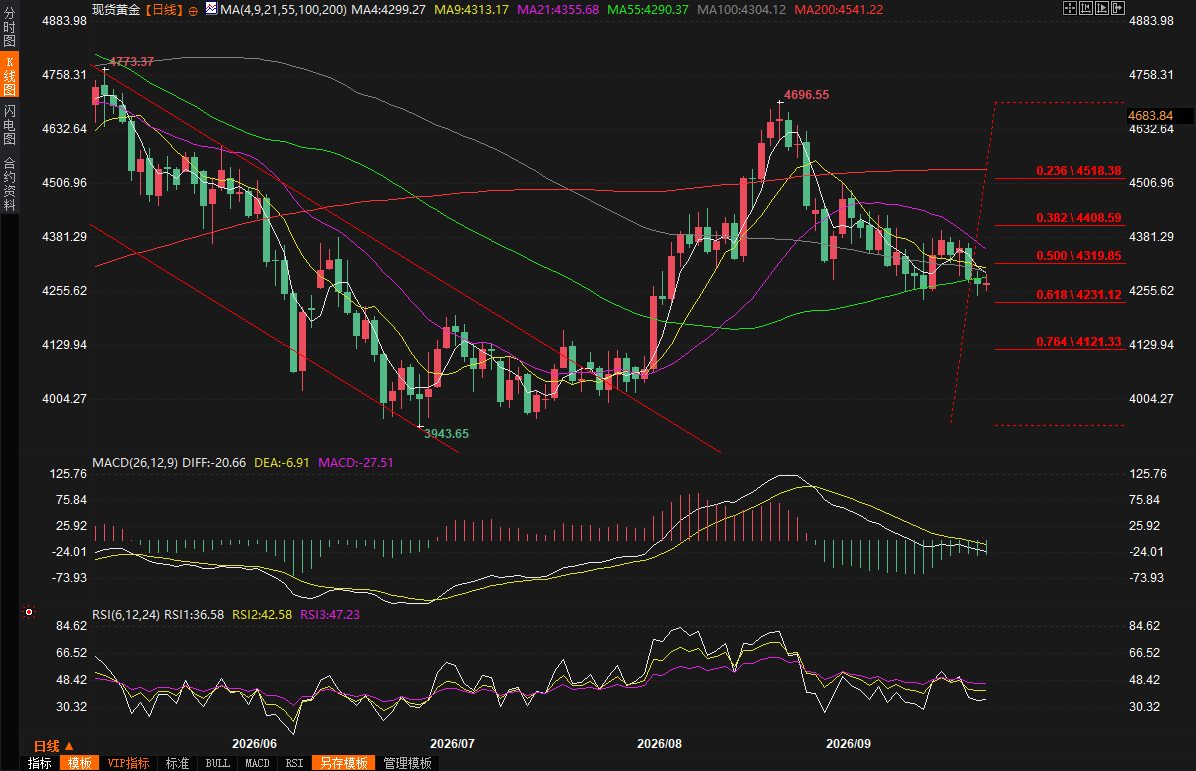
International spot gold prices came under significant pressure this week, influenced by rising US real yields, a stronger US dollar, and hawkish expectations for major central bank policies, causing prices to briefly fall below the $4,300 per ounce mark. On Friday (September 25) in Asian trading, spot gold fluctuated below $4,300, currently trading at $4,275 per ounce, with a weekly decline of approximately 2.5%. Market focus is concentrated on the Fed's subsequent interest rate hike path, high-level interactions between the US and China, and evolving geopolitical risks. While short-term volatility has intensified, long-term structural supporting factors are still being emphasized by many institutions. 
Short-term pressure: Double squeeze from yields and the US dollar
This week, gold prices were highly correlated with the macroeconomic interest rate environment. The yield on the 10-year US Treasury note rose to near 5.11%-5.21%, a recent high, reinforcing the opportunity cost of holding gold. The US dollar index simultaneously climbed above 101, reaching a near two-month high. Stronger-than-expected private sector data further increased market pricing in another Fed rate hike in October, raising the probability from approximately 55% to around 70%. Ashish Rajodiya, head of commodities at PL Capital, pointed out that the Iranian president's remarks at the UN General Assembly injected additional geopolitical uncertainty into the market, even though interest rate expectations themselves had already put downward pressure on gold prices. Meanwhile, the meeting between the leaders of China and the US and the news of the extension of the trade truce eased some risk aversion, but failed to completely offset the drag from interest rates and exchange rates. Jateen Trivedi, vice president of commodities and currency research at LKP Securities, stated that rising yields and a stronger dollar have led to a decline of approximately 1,000 rupees in Indian domestic gold prices, with short-term fluctuations likely between 148,000 and 152,500 rupees per 10 grams. After a significant pullback in the previous trading day, spot gold remains below $4,300. With both technical and fundamental factors at play, the future direction will depend on the upcoming US employment and inflation data. If the data continues to be strong, gold prices may further test the $4,200 support level; conversely, if the labor market shows signs of cooling or the situation in the Middle East deteriorates again, buying interest is expected to return quickly.Institutional perspective: Range-bound trading and long-term upward trend coexist.
Despite near-term pressure, several institutions remain relatively optimistic about the medium- to long-term outlook for gold. Elara Securities predicts that gold prices will fluctuate between $4,200 and $4,700 per ounce for the remainder of 2026. With central bank tightening slowing, prices are expected to rise further to $5,000-$5,200 by the end of 2027. The report notes that after falling approximately 26% from its 2026 high, gold prices have rebounded about 8.4% from their year-to-date lows. Structural factors, including rising US fiscal risks, a relatively weakened safe-haven appeal of US Treasuries, changes in the sanctions environment, and continued demand from Chinese retail and central banks, all support this long-term logic. Central bank gold purchases are still considered strategic reserve allocations, rather than short-term tactical operations. So far this year, global central banks have reported gold purchases of approximately 130 tons, lower than the 160 tons in the same period last year. However, as of the second quarter, 45% of central banks increased their gold reserves year-on-year, significantly higher than the 32% at the end of 2021. The price decline is expected to further stimulate official demand. Elara's model shows that for every 100 basis point increase in the US dollar index year-on-year, the gold price falls by approximately 130 basis points. Meanwhile, the correlation between Brent crude oil and gold has shifted from positive 10% between 2010 and 2019 to negative 31% recently. If the situation in the Middle East eases, a decline in oil prices would help lower real interest rates, thus supporting gold prices; however, monetary policy may still limit upside potential. In the next two to three quarters, gold prices are likely to exhibit range-bound trading. Chief Research Officer Renisha Chainani provides a relatively clear trading range, believing that spot gold will trade between $4250 and $4450, with an overall bullish trend. She suggests buying on dips near support levels and reducing positions moderately near resistance levels.Key Drivers and Risk Balance
In summary, short-term gold prices are driven by real interest rates and the US dollar, and volatility may continue to increase. The Federal Reserve's policy path, US data performance, and the situation in the Gulf region will be key points to watch in the coming weeks. In the long term, central bank reserve diversification, concerns about fiscal sustainability, and geopolitical uncertainties form important price support. Investors need to distinguish between tactical adjustments and strategic allocations, avoiding excessive chasing of highs and lows during periods dominated by a single macroeconomic variable.Editor's Summary
The current gold market exhibits a typical pattern of "near-term pressure and long-term support." The strengthening of US real yields and the dollar directly increase holding costs, driving a significant weekly pullback. Meanwhile, central bank gold purchases, reserve diversification, and fiscal and sanctions-related risks continue to provide a structural foundation for medium- to long-term prices. Institutions generally expect range-bound trading over the next two to three quarters, with further upward movement possible around 2027 against a backdrop of easing monetary policy. Market participants should closely monitor changes in interest rate pricing and geopolitical events, managing their allocation strategy amidst volatility rather than solely relying on short-term directional judgments.Frequently Asked Questions
Q: Why did gold prices fall significantly this week? A: Mainly due to the combined effects of rising US real yields and a stronger US dollar index. The 10-year US Treasury yield is nearing a high of 5.11%-5.21%, increasing the opportunity cost of holding gold; the US dollar index has risen above 101, also putting downward pressure on dollar-denominated gold. Meanwhile, the market's upward revision of the probability of a Fed rate hike in October further reinforced this trend. Q: How do analysts view the gold price trend in 2026-2027? A: Institutions such as Elara predict that gold prices will fluctuate between $4200 and $4700 for the remainder of 2026, and are expected to rise to $5000-$5200 by the end of 2027. In the short term, it may fluctuate within a range due to hawkish policies and high real interest rates; in the long term, it will benefit from factors such as central bank gold purchases, reserve diversification, and US fiscal risks. Q: What impact do central bank gold purchases have on gold prices? A: Global central banks regard gold as a strategic reserve asset that is not subject to sanctions and has zero counterparty risk. Central banks have reported purchases of approximately 130 tons of gold so far this year, with 45% increasing their reserves year-on-year. The willingness to buy gold tends to increase when prices fall, providing a solid demand base for gold prices, especially significant in the long-term allocation logic. Q: How will high-level interactions between the US and China affect gold prices? A: The meetings and news of the extended trade truce will help alleviate some safe-haven sentiment and trade uncertainty, providing some support for gold prices. However, if negotiations make limited progress or subsequent setbacks occur, geopolitical and policy risks may still temporarily boost safe-haven demand. Q: How should investors respond to current gold price volatility in the short term? A: Pay attention to the US employment data to be released next week. If the data remains strong, gold prices may test the $4200 support level; if the data cools down or geopolitical risks ease, buying is expected to return. A trading range of $4250-$4450 can be considered, buying on dips near support levels while strictly controlling position size, distinguishing between short-term volatility and long-term allocation needs. As of 14:41 Beijing time, spot gold is trading at $4276.89 per ounce.- Risk Warning and Disclaimer
- The market involves risk, and trading may not be suitable for all investors. This article is for reference only and does not constitute personal investment advice, nor does it take into account certain users’ specific investment objectives, financial situation, or other needs. Any investment decisions made based on this information are at your own risk.