The correlation between oil prices and US Treasury yields has surged to a record high. Have bond traders overpriced in the oil price shock?
2026-09-25 15:04:13
The correlation between crude oil prices, US Treasury yields, and stock market performance is now widely recognized in the market. Rising oil prices typically push up bond yields and suppress stock prices. This month, the intraday correlation between the 10-year US Treasury yield and crude oil futures has reached its highest level on record. Latest data shows that the 10-year US Treasury yield has recently hovered around 5.2%, the highest level since before the global financial crisis in June 2007. This week's market movements largely confirmed this pattern: on Monday and Tuesday, oil prices fell, and bond yields subsequently declined slightly; on Wednesday, yields surged and oil prices rose; on Thursday, both rose again; on Friday (September 25th) in Asian trading, international oil prices weakened slightly, and US Treasury yields also weakened slightly. However, the market is facing a core question: if the bond market's close focus on oil is a major misjudgment, then the rise in yields may have gone too far, and the resulting chain reaction on government debt, stock prices, and other assets may also be an overreaction. 
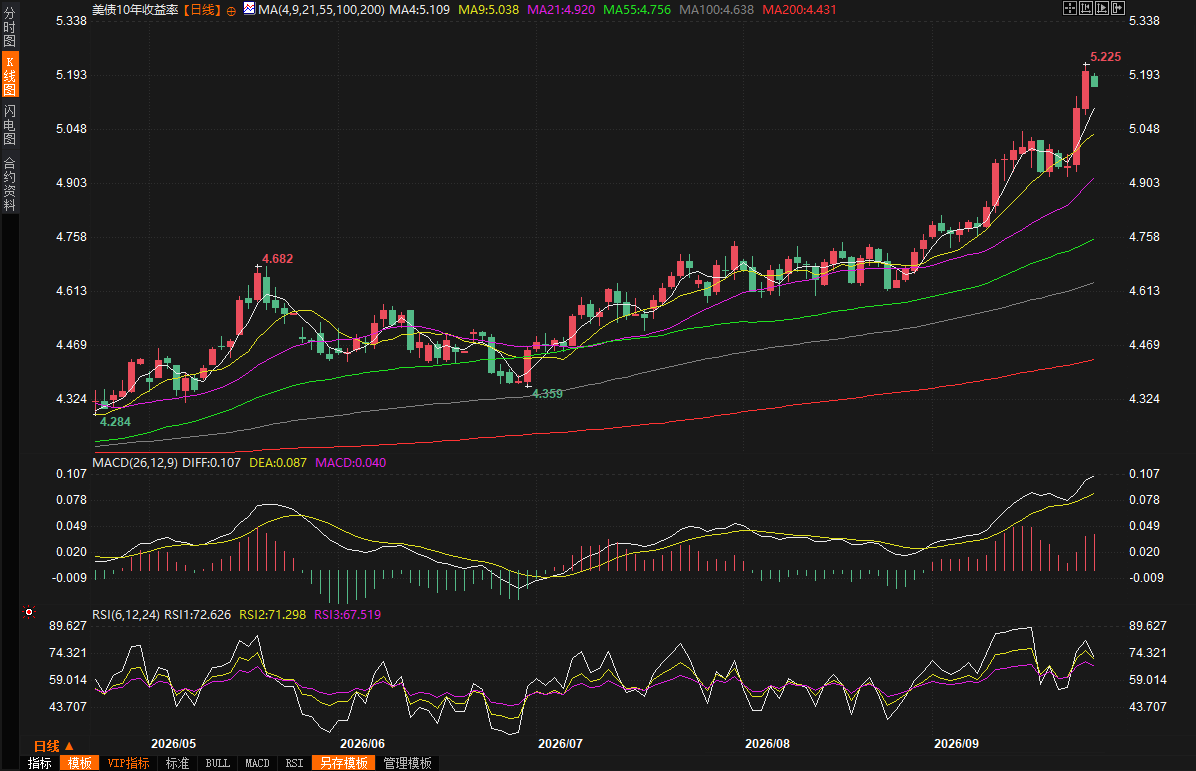 (Daily chart of the yield on the 10-year US Treasury note, source: EasyTrade) At 15:00 Beijing time, the yield on the 10-year US Treasury note was 5.165%.
The superficial logic of the link between rising oil prices and yields
On the surface, the link between rising oil prices and rising US Treasury yields seems straightforward. Rising oil prices are pushing up inflation expectations, and the Federal Reserve, under Kevin Warsh's chairmanship, has made it clear that it must respond. Therefore, the higher the oil price, the stronger the market's expectation of rising short-term interest rates. The interest rate futures market currently reflects a high probability of multiple rate hikes by the end of next year. However, the question remains: why does rising short-term interest rate expectations necessarily lead to a simultaneous rise in long-term bond yields? The sensitivity of 10-year and even 30-year bonds to short-term interest rate changes should be significantly reduced unless the market is convinced that high interest rates will persist for a long time. Former European Central Bank Vice President Vitor Constancio bluntly stated, "It makes no sense that the movement of oil today would affect 10-year government bonds."Misalignment between one-off shocks and long-term pricing
The fundamental problem lies in the fact that rising oil prices are largely a one-off shock. Even considering the cascading costs, its inflationary impact is only temporary, not permanent. Once oil prices stop rising, regardless of their eventual stabilization level, their direct effect on inflation will subside. If oil prices are high enough to drag down economic growth, they may actually suppress non-oil inflation. However, the recent correlation between oil and bonds is unusually strong, with long-term Treasury bonds showing an even higher correlation with oil than short-term bonds. Even after removing short-term yields and constructing synthetic bonds with a five-year maturity, this correlation remains robust. The yield on 2-year Treasury bonds is extremely sensitive to expectations from the upcoming Federal Reserve meetings, so its fluctuations with oil prices are not surprising; however, for 10-year and even 30-year bonds, the impact of short-term interest rate changes should be much smaller.Multiple explanations coexist: fiscal, growth, and pricing behavior
The market offers several possible explanations. First, high oil prices are forcing governments to intervene through subsidies, tax cuts, or export restrictions, which could either exacerbate fiscal deficits or damage trade, growth, and the tax base. Bond investors are already highly sensitive to high debt levels; if rising oil prices ultimately lead to more debt or weakened debt repayment capacity, they should demand higher yields as compensation. Second, the "last straw" effect. High oil prices coincide with a period of robust US economic activity driven by AI-related spending. A stronger economy is better positioned to withstand high oil prices; the expectation of accelerated growth simultaneously raises bond yields and oil prices, which is logical. The recent trend following strong data releases exemplifies this. Perhaps it is the combination of AI-driven growth and supply shocks from Middle East geopolitical conflicts that has resulted in this striking correlation. Third, investors may not be correctly assessing long-term bonds. Former Federal Reserve Vice Chairman Alan Blinder pointed out as early as thirty years ago that there is a very strong correlation between the daily price of a one-year bond and the implied one-year interest rate 29 years later, even though almost everything that happens on a particular day is insignificant 29 years later. He deduced from this that if pricing were truly accurate, long-term yields shouldn't be so sensitive to short-term interest rates. Former hedge fund manager and former Bank of England policymaker Sushil Wadhwani believes that the market doesn't know the extent to which rising interest rates are permanent, and therefore tends to assume that at least some of it is permanent, unless interest rates are already significantly too high, causing recent changes in interest rate expectations to propagate to longer maturities. Constâncio dismisses intraday correlations, believing their significance is limited and more of a mixture of coincidence and co-current fluctuations than a strict causal relationship. However, he also believes that higher 10-year yields are reasonable because, in the long run, real interest rates, adjusted for inflation, need to be higher.Historical experience and current judgment
This high correlation between oil and bonds is not new. Similar linkages have occurred during the first Gulf War in 1990-1991, during market concerns about growth prospects in 2010, during the Eurozone crisis in 2012, during the deep recession in the oil industry in 2016, and during the COVID-19 pandemic's impact on various asset prices in 2020. There are no hard and fast rules. Current bond indicators themselves are fraught with perplexing contradictions, but traders' belief that oil and bonds should move in tandem has a basis in reality. Depending on which theory is followed, the current high yields are either extremely attractive (if the market is overly focused on short-term impacts) or still far from sufficient to offset the risks (if they stem from further expansion of government debt). Various theories likely have some merit. US Treasury yields can be seen as a defensive line in the current environment against potential stock market volatility, but the level of US debt, the Federal Reserve's lagging response to rapid economic growth, and the uncertainty of oil supply remain the focus of common market concerns.Editor's Summary
The current high correlation between oil prices and US Treasury yields reflects both the real constraints of inflation expectations and monetary policy paths, and exposes the risk that the market may be over-pricing a one-off supply shock. The 10-year yield has risen to a near 20-year high of approximately 5.2%, coupled with geopolitical conflicts and fiscal pressures, making long-term bond pricing more complex. Investors need to find a balance between short-term oil price fluctuations and long-term real interest rate trends to avoid perpetuating temporary shocks. Historical experience shows that such correlations often disintegrate rapidly with changes in geopolitical or growth narratives; the market should remain vigilant about multi-factor drivers rather than relying solely on oil price signals. (Daily chart of the yield on the 10-year US Treasury note, source: EasyTrade) At 15:00 Beijing time, the yield on the 10-year US Treasury note was 5.165%.
- Risk Warning and Disclaimer
- The market involves risk, and trading may not be suitable for all investors. This article is for reference only and does not constitute personal investment advice, nor does it take into account certain users’ specific investment objectives, financial situation, or other needs. Any investment decisions made based on this information are at your own risk.