The US bond market is sending a strong signal, putting the Federal Reserve in a dilemma.
2026-09-25 15:38:14
The US bond market is sending a strong signal to the Federal Reserve, but conflicting information from various sources is leaving policymakers in a dilemma as they try to find a policy balance to avoid monetary policy dragging down the overall economy. On Thursday, US Treasury yields continued their upward trend, with investors pricing in multiple factors: inflation remains significantly above the Fed's 2% target, energy prices are rising again, and a massive increase in new debt supply is driven by a financing race among large global technology companies.
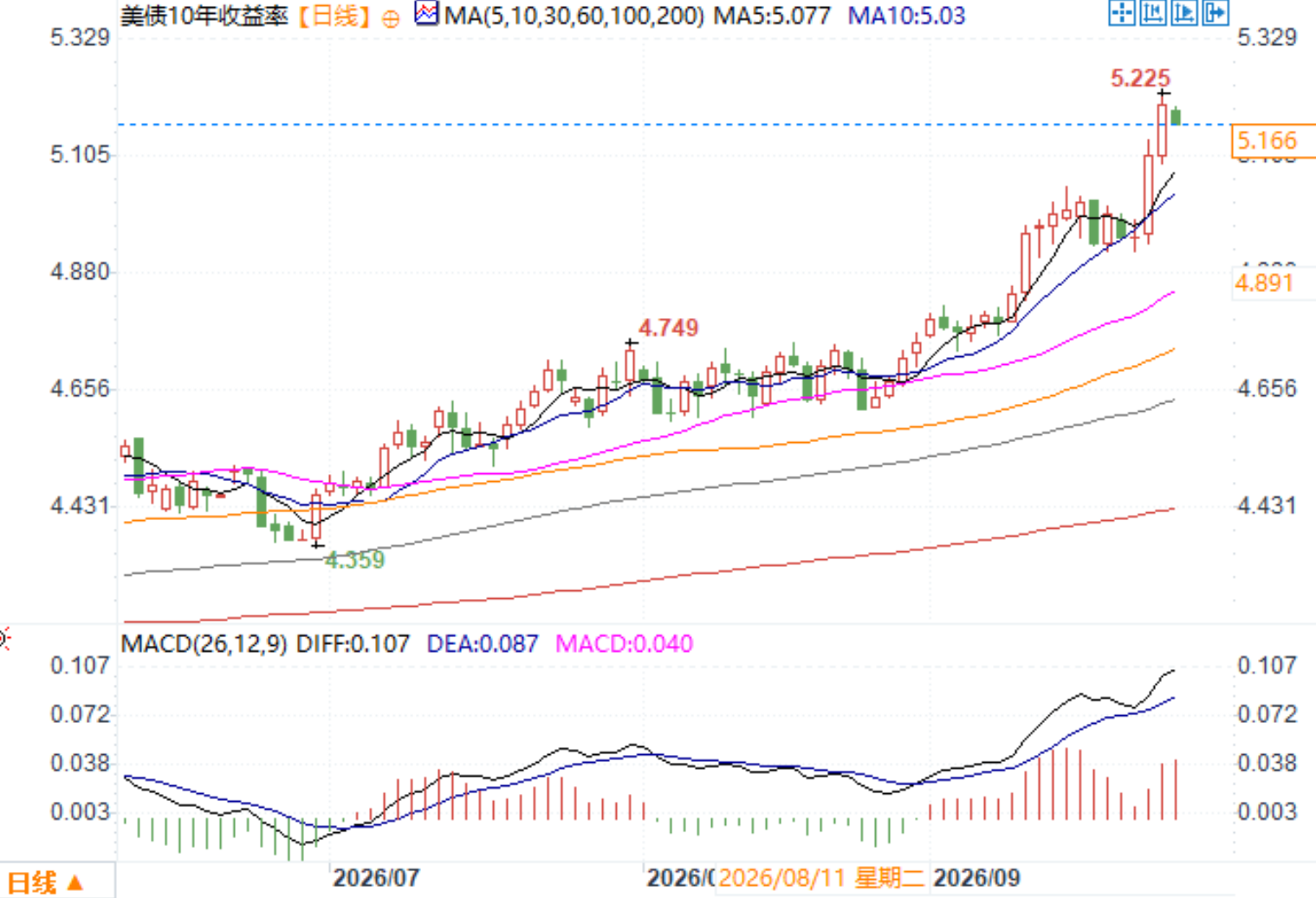 10-year US Treasury yield daily chart. Source: EasyTrade. At 15:33 Beijing time on September 25th, the 10-year US Treasury yield was 5.166%.
The logic of inflation has changed, and the Federal Reserve is reassessing the risks.
In the past, policymakers were willing to temporarily ignore short-term inflationary shocks such as energy price increases and tariffs. Not long ago, the prevailing market view was that the AI investment boom would only last a year or two and would eventually curb inflation. Now, Federal Reserve officials are reassessing various factors and recognizing the risk of prolonged inflation. At the same time, the Fed has changed its communication style, no longer releasing policy clues in advance, making it difficult for the market to determine whether policymakers are driving interest rates or market forces are prevailing. Joseph Brusuelas, chief economist at RSM, stated, "The phase of simply ignoring short-term supply shocks is over. Policy must prioritize restoring price stability, and the Fed should take the current situation seriously." The market widely expects the Fed to take a tougher stance against inflation. In the past day, traders raised their probability of an October rate hike. The market also anticipates a third rate hike by the Fed between the end of this year and early 2027, with the possibility of further rate hikes in the following months.Expectations have shifted dramatically, with significant disagreement emerging about the number of interest rate hikes.
Market expectations have seen a dramatic reversal compared to June. In June, the Federal Reserve had predicted only one rate hike this year, followed by a pause in rate increases, with a wait of several years before resuming rate cuts. Bruzuelas stated that after the September policy meeting, he initially judged the Fed to implement three rate hikes, but institutional model calculations based on high yields and long-term AI capital investment changed this assessment. Model calculations show that even if long-term US Treasury yields rise sharply, slowing economic growth and pushing up unemployment, it will not be able to pull inflation back to 2%. RSM calculations show that if the 10-year US Treasury yield remains at 5.5% (it was approximately 5.15% on Thursday), economic growth will fall to 1.5%, the unemployment rate will rise to 4.7%, but core inflation will remain stuck at 2.4%. Bruzuelas believes the Fed underestimated the policy力度 needed to stabilize prices, and the subsequent number of rate hikes may not be two or three, but five or six. Not all Wall Street institutions agree with this assessment. Some strategists believe that market expectations have already been exceeded, and the current rise in yields is essentially pricing in a strong economic recovery, while being overly influenced by the volatility of Brent crude oil prices due to the Middle East situation. Citigroup economist Andrew Hollenhorst stated in a research report that the rise in yields is not due to market concerns that the Federal Reserve is being too accommodative and allowing inflation to continue to exceed targets, but rather to rising real yields. Investors are pricing in the Fed maintaining higher policy rates, making a simultaneous rise in both short-term and long-term yields reasonable.Policy faces dilemma, officials adopt a cautious stance.
Several key Federal Reserve officials, while acknowledging the necessity of short-term interest rate hikes, also advocated for caution. John Williams, president of the New York Fed and vice chairman of the Federal Open Market Committee, stated on Thursday that another rate hike this year is reasonable, but he also emphasized that officials need to continuously monitor economic data and should not prematurely lock in the rate hike path or apply fixed forward guidance. Anna Paulson, president of the Philadelphia Fed, similarly believes that further policy tightening is highly likely, but she described the potential adjustment as "moderate," not signaling a continuous series of rate hikes. The Fed is at a policy crossroads. Excessive tightening could end economic expansion; insufficient tightening would weaken market confidence in the Fed's ability to control inflation. Krishna Guha, head of economics and central bank strategy at Evercore ISI, noted in a report that weakened guidance would put the central bank in a dilemma: either raise rates with unsatisfactory results or disappoint the market by not raising rates, eroding hard-won policy credibility. The lack of clear guidance means that any decision made by the Federal Reserve could trigger a sharp market reaction, pushing market interest rates to tighten or loosen significantly. He believes market expectations for rate hikes are too aggressive and also recognizes the Fed's policy dilemma. Successive rate hikes, especially without forward guidance to explain the policy logic, would send a strong hawkish signal, causing unpredictable repricing of the yield curve; however, skipping a rate hike that the market has already priced in could trigger another round of market adjustments towards easing.Policy framework changes enhance the market's influence in the bond market.
This current contradiction is particularly critical. Federal Reserve Chairman Kevin Warsh emphasized the need to consider market signals when formulating monetary policy . This represents a significant reversal from the policy approach adopted after the 2008 global financial crisis, when the Fed relied heavily on forward guidance to communicate interest rate trends to the market. UBS economist Jonathan Pingle, analyzing Warsh's policy framework, wrote that it no longer relies excessively on sophisticated economic data calculations, but rather on market narratives. No other Fed chairman has used financial market signals as a crucial reference for monetary policy decisions as much as Warsh. With yields soaring, the 30-year Treasury yield hit its highest level since 2004. This changing market environment has also shifted Warsh's policy stance. Before taking office in May, he favored rate cuts, but now a hawkish camp has emerged within the Federal Open Market Committee. Jonathan Pingle speculates that the press conference following last week's policy meeting indicated that Warsh's position is closer to that of Beth Hammac, the hawkish representative among this year's voting committee members and president of the Cleveland Fed. The market generally interprets this as Warsh gradually raising the benchmark interest rate, following signals from the US Treasury market. Bruzuelas points out that there is real basis for central bank officials' concerns about an overheated investment sector, and the bond market is sending a signal to policymakers like Warsh that deserves attention.Conclusion
In conclusion, the continued rise in US Treasury yields places multiple pressures on the Federal Reserve, including inflation, fiscal policy, and capital investment in AI. On one hand, there are persistently high prices; on the other, the risk of economic recession. The Fed must maintain its credibility in combating inflation while avoiding excessive tightening that could stifle economic growth. This interplay between the bond market and policymakers will continue to influence global asset pricing. 10-year US Treasury yield daily chart. Source: EasyTrade. At 15:33 Beijing time on September 25th, the 10-year US Treasury yield was 5.166%.- Risk Warning and Disclaimer
- The market involves risk, and trading may not be suitable for all investors. This article is for reference only and does not constitute personal investment advice, nor does it take into account certain users’ specific investment objectives, financial situation, or other needs. Any investment decisions made based on this information are at your own risk.