A chart: Capesize shipping rates dragged down the Baltic Dry Index, causing it to fall intraday, but the weekly chart showed a steady increase.
2026-09-25 22:50:12
Latest data shows that on September 25, 2026, the Baltic Dry Index (BDI) closed at 3426 points, a four-day low, down 1.35% from the previous day, marking the largest drop since September 15, 2026. Looking at the short-term charts, the BDI has seen positive growth 5 times, negative growth 6 times, and zero growth 0 times in the last 11 BDI readings. Specifically, the Panamax Freight Index (BPI) closed at 2407 points, up 1.05% from the previous day; the Capesize Freight Index (BCI) closed at 5784 points, down 2.61%; and the Supramax Freight Index (BSI) closed at 1786 points, up 0.22%. For detailed charts of the Baltic Dry Index and its three main sub-indices, including the latest 720-day and 10-year trends, please refer to the charts provided by FX678. 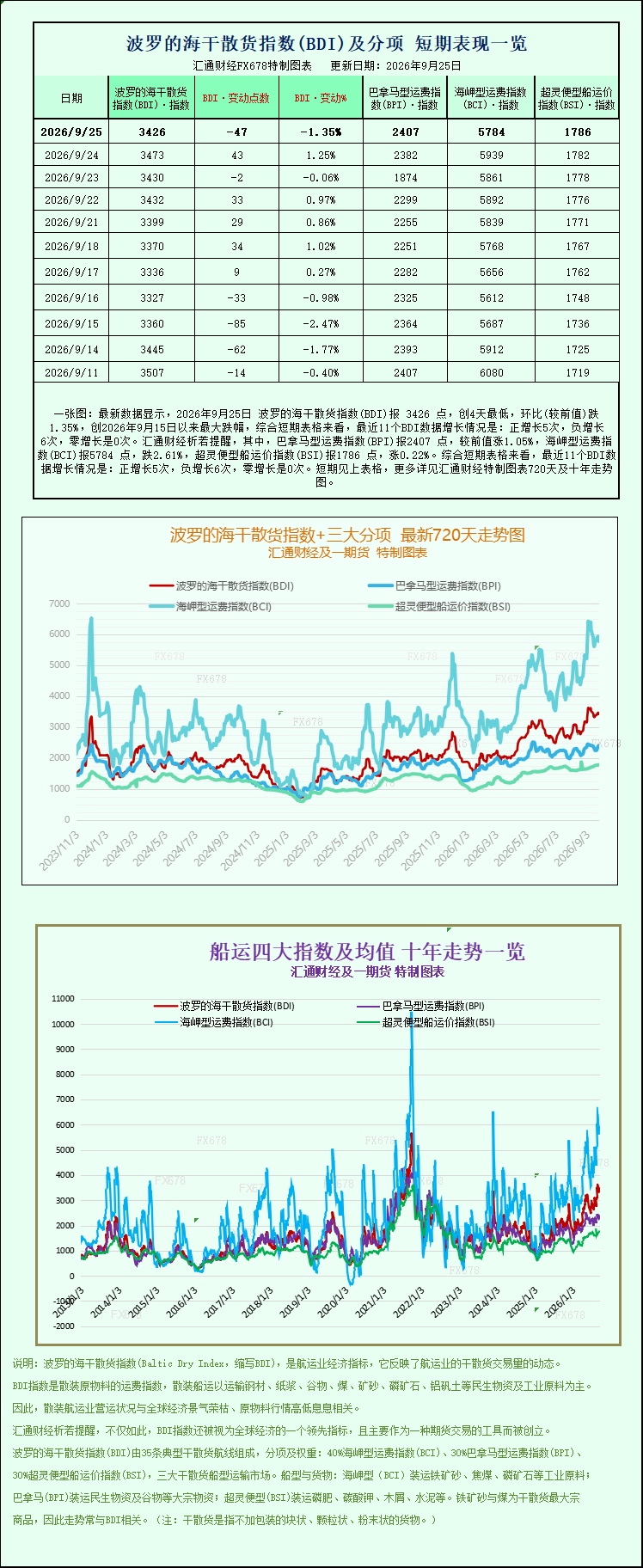 On September 25, 2026, the latest shipping market data showed that the Baltic Dry Index (BDI), a key indicator of global dry bulk shipping, experienced a temporary decline on Friday. The main decline was driven by weakening Capesize bulk carrier freight rates. However, thanks to the strong performance of small and medium-sized vessels during the week, the index maintained its overall upward trend, recording a solid weekly gain. This week, the dry bulk market exhibited a significant divergence in vessel types, with a particularly prominent pattern of correction in large mining vessels and strength in small and medium-sized cargo vessels. Specifically, the Baltic Dry Index, which tracks freight rates for the three major dry bulk carrier types—Capesize, Panamax, and Supramax—fell 47 points on the day, a 1.3% drop, closing at 3426 points. Despite the slight pressure on Friday, the index rose 1.6% cumulatively throughout the week, continuing the upward trend since September. This reflects that overall global dry bulk shipping demand is still in a recovery phase, and the short-term single-day correction has not changed the medium-term positive outlook of the market. The core drag on the index today was the significant weakening of freight rates for large Capesize bulk carriers. As the main transport vessel type for bulk industrial raw materials such as iron ore and coal, fluctuations in the Capesize market have the greatest impact on the overall market. The Capesize bulk carrier index fell 155 points, a drop of 2.6%, closing at 5784 points, completely erasing most of the week's gains, and the expected slight weekly increase of 0.3% ultimately failed to materialize. On the revenue side, the average daily earnings of 150,000-ton Capesize vessels mainly engaged in transoceanic bulk mineral transportation decreased by $1,407, with the latest daily revenue falling to $48,954, indicating a significant short-term decline in the profitability of large mining vessels. Industry analysts pointed out that the weakening of Capesize freight rates stems primarily from the marginal easing of the iron ore seaborne supply and demand pattern. Currently, global iron ore futures prices are generally fluctuating moderately, lacking upward momentum, and the fundamental battle between bulls and bears in the market is intensifying. On the one hand, there are expectations of a temporary reduction in Brazilian iron ore shipments, providing some support for demand in the ocean-going iron ore shipping sector. On the other hand, as the world's largest iron ore importer, China's domestic steel industry continues to face significant operational pressures. Steel mill raw material inventories are steadily rising, and weak end-user demand is exacerbating corporate losses, leading to a sharp decline in the willingness to actively replenish inventory. This directly offsets the positive support from reduced overseas supplies, resulting in insufficient growth in seaborne iron ore cargoes. The supply and demand of large Capesize vessels is becoming more relaxed, causing freight rates to fall accordingly. In stark contrast to the decline in large vessel types, the small and medium-sized bulk carrier market performed strongly this week, showing an independent upward trend and becoming the core driver of the BDI index's weekly gain. Among them, medium-sized Panamax vessels saw the most significant increase, with the Panamax index rising 25 points, or 1.05%, to 2407 points on the day, and a cumulative weekly gain of nearly 7%, leading the three vessel types. This vessel type primarily carries 60,000 to 70,000 tons of bulk commodities such as coal and grain. The average daily revenue for Panamax vessels increased by $228 to $21,662. The strong performance of Panamax vessels is mainly due to the robust support from global energy and agricultural product seaborne demand. Currently, restocking demand for thermal power plants in the Asia-Pacific region continues to be released, seaborne orders for industrial coal remain stable, and the peak season for global grain exports is still in full swing, with cross-regional grain seaborne trade proceeding smoothly, providing ample cargo support for Panamax vessels. Compared to Capesize vessels, which rely heavily on industrial and mineral demand, the demand for small and medium-sized energy and agricultural products is more resilient. Combined with the vessel type's wider route adaptability and better market liquidity, this has driven its freight rates to continue rising. The small vessel market also continued its steady upward trend. The Supramax bulk carrier index rose slightly by 4 points, or 0.2%, to close at 1786 points, with a cumulative increase of 1.1% this week, showing a stable and firm trend. Supramax vessels primarily serve short-haul, small-volume bulk cargo transportation, suitable for niche trade routes in Southeast Asia and the region. Benefiting from the continued release of demand for short-haul transportation of regional building materials, minor minerals, and grains, the market supply and demand structure is stable, and freight rates have maintained a slight upward trend with extremely low volatility risk. Overall, the Baltic Dry Index (BDI) market this week showed significant structural differentiation: large Capesize vessels experienced a short-term correction due to weak restocking in China's steel industry and sluggish iron ore demand, while small and medium-sized vessels achieved strong gains thanks to the essential demand for energy and agricultural products, offsetting the decline in large vessels and ensuring a weekly increase in the index. Market institutions indicate that the future BDI trend will continue to focus on the pace of resumption of production at Chinese steel mills, the sustainability of the peak season for global commodity trade, and the pace of global bulk carrier capacity deployment. A recovery in demand for mineral shipping may drive a recovery in freight rates for large vessels, and the overall market is expected to continue its upward trend with fluctuations.
On September 25, 2026, the latest shipping market data showed that the Baltic Dry Index (BDI), a key indicator of global dry bulk shipping, experienced a temporary decline on Friday. The main decline was driven by weakening Capesize bulk carrier freight rates. However, thanks to the strong performance of small and medium-sized vessels during the week, the index maintained its overall upward trend, recording a solid weekly gain. This week, the dry bulk market exhibited a significant divergence in vessel types, with a particularly prominent pattern of correction in large mining vessels and strength in small and medium-sized cargo vessels. Specifically, the Baltic Dry Index, which tracks freight rates for the three major dry bulk carrier types—Capesize, Panamax, and Supramax—fell 47 points on the day, a 1.3% drop, closing at 3426 points. Despite the slight pressure on Friday, the index rose 1.6% cumulatively throughout the week, continuing the upward trend since September. This reflects that overall global dry bulk shipping demand is still in a recovery phase, and the short-term single-day correction has not changed the medium-term positive outlook of the market. The core drag on the index today was the significant weakening of freight rates for large Capesize bulk carriers. As the main transport vessel type for bulk industrial raw materials such as iron ore and coal, fluctuations in the Capesize market have the greatest impact on the overall market. The Capesize bulk carrier index fell 155 points, a drop of 2.6%, closing at 5784 points, completely erasing most of the week's gains, and the expected slight weekly increase of 0.3% ultimately failed to materialize. On the revenue side, the average daily earnings of 150,000-ton Capesize vessels mainly engaged in transoceanic bulk mineral transportation decreased by $1,407, with the latest daily revenue falling to $48,954, indicating a significant short-term decline in the profitability of large mining vessels. Industry analysts pointed out that the weakening of Capesize freight rates stems primarily from the marginal easing of the iron ore seaborne supply and demand pattern. Currently, global iron ore futures prices are generally fluctuating moderately, lacking upward momentum, and the fundamental battle between bulls and bears in the market is intensifying. On the one hand, there are expectations of a temporary reduction in Brazilian iron ore shipments, providing some support for demand in the ocean-going iron ore shipping sector. On the other hand, as the world's largest iron ore importer, China's domestic steel industry continues to face significant operational pressures. Steel mill raw material inventories are steadily rising, and weak end-user demand is exacerbating corporate losses, leading to a sharp decline in the willingness to actively replenish inventory. This directly offsets the positive support from reduced overseas supplies, resulting in insufficient growth in seaborne iron ore cargoes. The supply and demand of large Capesize vessels is becoming more relaxed, causing freight rates to fall accordingly. In stark contrast to the decline in large vessel types, the small and medium-sized bulk carrier market performed strongly this week, showing an independent upward trend and becoming the core driver of the BDI index's weekly gain. Among them, medium-sized Panamax vessels saw the most significant increase, with the Panamax index rising 25 points, or 1.05%, to 2407 points on the day, and a cumulative weekly gain of nearly 7%, leading the three vessel types. This vessel type primarily carries 60,000 to 70,000 tons of bulk commodities such as coal and grain. The average daily revenue for Panamax vessels increased by $228 to $21,662. The strong performance of Panamax vessels is mainly due to the robust support from global energy and agricultural product seaborne demand. Currently, restocking demand for thermal power plants in the Asia-Pacific region continues to be released, seaborne orders for industrial coal remain stable, and the peak season for global grain exports is still in full swing, with cross-regional grain seaborne trade proceeding smoothly, providing ample cargo support for Panamax vessels. Compared to Capesize vessels, which rely heavily on industrial and mineral demand, the demand for small and medium-sized energy and agricultural products is more resilient. Combined with the vessel type's wider route adaptability and better market liquidity, this has driven its freight rates to continue rising. The small vessel market also continued its steady upward trend. The Supramax bulk carrier index rose slightly by 4 points, or 0.2%, to close at 1786 points, with a cumulative increase of 1.1% this week, showing a stable and firm trend. Supramax vessels primarily serve short-haul, small-volume bulk cargo transportation, suitable for niche trade routes in Southeast Asia and the region. Benefiting from the continued release of demand for short-haul transportation of regional building materials, minor minerals, and grains, the market supply and demand structure is stable, and freight rates have maintained a slight upward trend with extremely low volatility risk. Overall, the Baltic Dry Index (BDI) market this week showed significant structural differentiation: large Capesize vessels experienced a short-term correction due to weak restocking in China's steel industry and sluggish iron ore demand, while small and medium-sized vessels achieved strong gains thanks to the essential demand for energy and agricultural products, offsetting the decline in large vessels and ensuring a weekly increase in the index. Market institutions indicate that the future BDI trend will continue to focus on the pace of resumption of production at Chinese steel mills, the sustainability of the peak season for global commodity trade, and the pace of global bulk carrier capacity deployment. A recovery in demand for mineral shipping may drive a recovery in freight rates for large vessels, and the overall market is expected to continue its upward trend with fluctuations.
- Risk Warning and Disclaimer
- The market involves risk, and trading may not be suitable for all investors. This article is for reference only and does not constitute personal investment advice, nor does it take into account certain users’ specific investment objectives, financial situation, or other needs. Any investment decisions made based on this information are at your own risk.