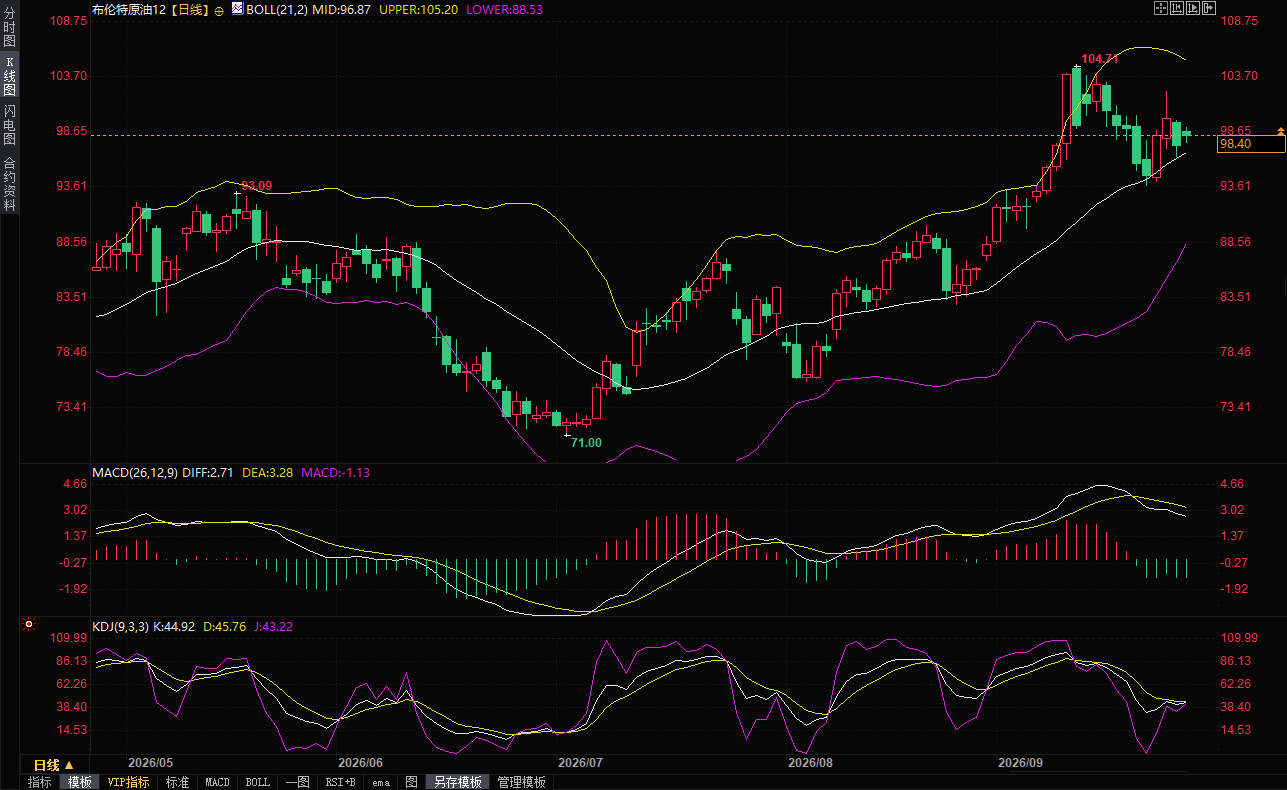
Trump rejected Iran's proposal to reopen the Strait of Hormuz, causing Brent crude oil to rebound more than 1% to nearly $99.
2026-09-28 09:44:13
Geopolitical tensions in the Middle East have escalated again after US President Trump explicitly rejected Iran's proposal to reopen the Strait of Hormuz over the weekend. Iran insists on resolving the conflict through diplomatic means, while the US continues to intensify economic and commercial pressure on Iran. Markets reacted swiftly, with international oil prices rebounding on Monday (September 28), while global energy supply risks remain high. 
Trump rejects seven-day plan; Iran insists diplomacy is the only way out.
Iran presented a concrete peace proposal last week during the UN General Assembly in New York, which was relayed to the US through mediator Qatar. The core of the proposal was a seven-day ceasefire across multiple fronts, including Lebanon; the US would lift its maritime blockade of Iranian ports, unfreeze Iranian assets, and grant oil sanctions waivers; Iran would reopen the Strait of Hormuz on the seventh day of the ceasefire, followed by broader negotiations on issues such as its nuclear program. Trump told reporters outside the White House on Saturday (September 26) that he had rejected the proposal. He pointed out that Iran was eager to reach an agreement and immediately open the strait because it was suffering heavy losses. "They want to open the Strait of Hormuz immediately because they've lost badly," Trump said. US Ambassador to the UN, Walz, further explained in an interview that the US believed the proposal, which demanded all concessions before committing to negotiations, lacked sincerity and had doubts about the credibility of negotiations to end the nuclear program. Despite the public rejection, Trump told Axios in a telephone interview on Sunday (September 27) that he expected US negotiators to hold more consultations this week, leaving room for diplomacy. Iranian Foreign Minister Araqchi emphasized on social media that the conditions are clear: any move to reopen the Straits must be contingent upon these conditions being met, and only a negotiated solution can break the deadlock. He also stated that the mediators have not yet formally conveyed the US's final position, and Iran will make its decision accordingly. Iranian Army Commander-in-Chief Hatami warned that the war has entered a critical and decisive phase; if Iran cannot trade and survive, neither can the other parties.US pressure to sever Iran's external connections has prompted Gulf states to accelerate their cooperation.
Parallel to the diplomatic stalemate is the US's commercial pressure on Iran. Jonathan Burke, a senior US Treasury official, has recently been shuttling between the Middle East and Europe, making it clear to Iran's trading partners: they must choose between doing business with Tehran and doing business with Washington. This strategy has already proven effective. Oman, the UAE, and Turkey have taken action. Oman banned flights from Mahan Air, which is linked to the Iranian Islamic Revolutionary Guard Corps, and subsequently blocked all flights from Iranian airlines; the UAE banned transactions involving Iran by the local branch of the National Bank of Iran and banned all flights from Iranian airlines; Turkey canceled Mahan Air flights and revoked the license of Bank Mellat, one of Iran's largest private lending institutions. The UK announced it would not renew waivers for Iranian banks operating in London, potentially leading to the closure of the National Bank of Iran's London subsidiary. Jared Kushner, a British lawyer who has long advised on Iranian sanctions, pointed out that the pressure exerted by the US on Iran's banking and aviation sectors in just a few weeks has exceeded the impact of the prolonged pressure campaign since 2010. Iranian President Pezechzian acknowledged the pain caused by the sanctions at the UN General Assembly but emphasized that popular resistance would only increase and that Iran would never back down.Houthi escalation and Saudi involvement put pressure on energy supply chains.
As the largest country in the Gulf, Saudi Arabia has been further embroiled in the conflict this month. The Iranian-backed Houthi rebels have advanced into Yemen, threatening Saudi oil exports via the Red Sea and repeatedly firing into Saudi territory. Parents in Riyadh received notices from schools that week that classes would switch to remote learning, indicating a potential escalation of the situation. The Houthi-controlled Yemeni Ministry of Health reported an attack on a market in the southwestern Taiz province, resulting in seven deaths and forty injuries, including children. The conflict continues to disrupt oil supplies. Kpler data shows that as Saudi Arabia and the UAE increased exports, crude oil exports from major Middle Eastern oil-producing countries rebounded to 12.8 million barrels per day in September, the highest level since the start of the war between the US, Israel, and Iran in February. Crude oil exports via the Strait of Hormuz are estimated at approximately 7.4 million barrels per day. Following attacks on the east-west oil pipeline, Saudi Arabia shifted some exports from the Red Sea port of Yanbu to the eastern port of Rastanura, with exports rebounding to approximately 5.4 million barrels per day in September. Refined oil products have become a point of pressure. U.S. diesel prices hit a record high, with the national average retail price exceeding $6.50 per gallon, exacerbating inflation risks and sparking discussions about potential export restrictions. If the U.S. restricts diesel exports, overseas supplies will tighten, and European oil prices have already reacted to the potential reduction in U.S. supplies. ANZ analysts pointed out that geopolitical risks remain high, with Houthi rebels and Iran continuing attacks on Saudi Arabia, jeopardizing regional energy supplies. On Monday, Brent crude futures for December delivery rose as much as 1.3% to around $98.64 per barrel; U.S. crude futures for November delivery rose as much as 1.5% to around $93.80 per barrel. Market concerns about the prospect of reopening the Strait of Hormuz drove the oil price rebound.Editor's Summary
Trump's rejection of Iran's seven-day proposal to reopen the Strait of Hormuz highlights the US's deep skepticism about Tehran's sincerity and its strategy of prioritizing economic pressure to force concessions. Iran insists on preconditions and emphasizes the uniqueness of its diplomacy; the gap between the two sides is significant, but indirect negotiation channels remain. The US's swift cutoff of Iranian aviation and banking sectors, coupled with the cooperation of Gulf states, has significantly compressed Tehran's external economic space. Meanwhile, the Houthi escalation and Saudi Arabia's involvement have exacerbated regional instability. Although Middle Eastern oil exports have seen a temporary rebound, traffic flow in the Strait of Hormuz remains far below pre-war levels, and tight supplies of refined oil products, especially diesel, continue to push up global inflationary pressures. The rebound in oil prices reflects the market's pricing in supply risks; in the short term, geopolitical premiums are unlikely to dissipate, and the global energy market will remain highly volatile.Frequently Asked Questions
Q: Why did Trump reject Iran's peace proposal? A: Trump believed that Iran's demand for the immediate opening of the Strait of Hormuz was a desperate move after suffering severe military and economic losses. The US pointed out that the proposal required the lifting of sanctions, the unfreezing of assets, and the end of the maritime blockade before committing to further negotiations, a "take the benefits first, then talk" approach. US Ambassador to the UN, Walz, clearly stated that the president lacked confidence in Iran's sincerity and did not believe it would engage in substantive negotiations to end its nuclear program. The US preferred to use continued pressure to force Iran to accept an agreement more in line with the interests of the US and the Gulf Arab states. Q: What exactly did Iran's seven-day proposal include? A: The proposal, conveyed through Qatar, essentially involved a seven-day plan: a ceasefire on multiple fronts in the Middle East (including Lebanon), the US lifting the port blockade, unfreezing at least some Iranian assets, and granting oil sanctions waivers; Iran would reopen the Strait of Hormuz on the seventh day, followed by broader negotiations on issues such as the nuclear program. Iranian Foreign Minister Araghchi emphasized that the conditions were clear and non-negotiable, and only a negotiated solution could break the deadlock. Iranian President Peshichiyan stated that he is prepared to negotiate, but will not accept bullying or coercion. Q: What specific effects have the US commercial pressure on Iran achieved? A: US Treasury officials recently warned trading partners in the Middle East and Europe that they have to choose between two options. Oman banned Mahan Air flights and blocked all Iranian airline flights; the UAE banned transactions by the National Bank of Iran and banned flights from Iran; Turkey canceled related flights and revoked Bank Mellat's license; the UK did not renew waivers for Iranian banks. Experts say the impact in just a few weeks exceeds that of more than a decade of prolonged pressure. These actions have cut off Iran's vital air and banking channels, further isolating its economy. Q: How will the conflict affect global oil supply and prices? A: The Strait of Hormuz, which accounts for about one-fifth of global oil transportation, remains disrupted, leading to high supply risks. Kpler data shows that Middle Eastern crude oil exports rebounded to 12.8 million barrels per day in September, with about 7.4 million barrels per day passing through the Strait, but still far below pre-war levels. Saudi Arabia's shift in export routes has partially alleviated the pressure. Oil prices rebounded by more than 1% on Monday after Trump rejected the offer, with Brent briefly approaching $99. Tight supplies of refined oil products, especially diesel, have driven U.S. diesel prices to record highs, exacerbating inflation concerns. Q: What impact will the current situation have on Saudi Arabia and regional stability? A: The Houthi advance in Yemen and attacks on Saudi targets threaten its Red Sea oil exports; the shift of Riyadh schools to remote learning reflects escalating tensions. Attacks in Yemeni markets have caused casualties. Saudi Arabia is further embroiled, and regional energy infrastructure faces continued risks. Declining trust in Iran among Gulf states makes U.S. pressure more effective. Overall, the conflict not only pushes up oil prices but may also prolong uncertainty in global energy markets, impacting inflation and the economic outlook. At 09:41 Beijing time, Brent crude futures for December delivery were trading at $98.40 per barrel.- Risk Warning and Disclaimer
- The market involves risk, and trading may not be suitable for all investors. This article is for reference only and does not constitute personal investment advice, nor does it take into account certain users’ specific investment objectives, financial situation, or other needs. Any investment decisions made based on this information are at your own risk.