Crude oil trading alert: US-Iran negotiations stall, US crude oil continues its rebound.
2026-09-28 09:56:14
International oil prices have recently continued to be influenced by both the situation in the Middle East and diplomatic developments. Iran previously conveyed a proposal to the United States through Qatar, suggesting that the Strait of Hormuz could be reopened within approximately seven days and nuclear negotiations resume, provided the US reduces military pressure, lifts some restrictions, and meets certain conditions. US President Trump subsequently publicly rejected Iran's latest proposal, but at the same time indicated that he expected further contact with Iran this week. This means that negotiations have not completely stalled, but significant differences remain between the two sides on the Strait of Hormuz, sanctions, the nuclear issue, and ceasefire conditions.  Iran continues to maintain its policy of "dual diplomatic engagement and military preparation." Iranian Foreign Minister Abbas Araqchi stated that Tehran is still awaiting the mediators to convey the US's formal position to Iran, while emphasizing that Iran is prepared for a renewed escalation of the conflict but remains willing to resolve the issue through diplomatic channels. Previously, Iran's proposal included reopening the Strait of Hormuz, resuming nuclear negotiations, and easing some economic restrictions, with the core objective of de-escalating regional tensions through a comprehensive package. This change directly impacts the risk premium in the crude oil market. The Strait of Hormuz is a crucial global energy transport route; during periods of tension, any news regarding the reopening of the strait, the resumption of shipping, or an escalation of conflict can quickly alter oil price expectations. Trump stated that the amount of crude oil transported through the Strait of Hormuz has increased significantly recently, and US defense officials said that approximately 22 million barrels of crude oil were exported through the waterway on Friday evening. If subsequent cargo flows continue to recover, supply concerns may gradually ease; however, if military action escalates again, the recovery of shipping could quickly reverse. In terms of price performance, WTI crude oil has recently rebounded after a significant correction. Data shows that WTI futures reached approximately $101.91 on September 17th, followed by a period of adjustment, hitting a low of approximately $88.67 on September 22nd. It rebounded to around $96.78 on September 24th, before falling back to $92.41 on September 25th. Prices recovered to approximately $93.30 on September 27th. This price movement indicates that $90 has become a crucial area of contention between bulls and bears. The decline in oil prices does not mean that supply risks have disappeared. US gasoline prices remain high. Data from the American Automobile Association shows that as of September 27th, the national average price of regular gasoline in the US was approximately $4.48 per gallon, the same as the price announced on September 24th, marking a record high for the same period. The continued high gasoline prices indicate that supply pressures in the crude oil, refining, and transportation sectors remain. The pressure in the diesel market is even more pronounced. Previously, US diesel prices had risen to around $6.51 per gallon, a significant increase compared to a year ago. Diesel fuel not only affects residential transportation costs but also directly impacts logistics, agriculture, construction, and industrial activities. Therefore, a sustained rise in refined oil prices could be transmitted to broader commodity prices through transportation costs. If high oil prices persist for an extended period, energy inflation could become a significant variable for global central banks to reassess their interest rate paths. For the crude oil market, the most crucial factor remains the actual cargo flow through the Strait of Hormuz, rather than mere diplomatic statements. If strait traffic continues to increase while the US maintains indirect negotiations with Iran, the market may further reduce the supply disruption premium previously priced in, putting WTI under profit-taking pressure from its high levels. Conversely, if negotiations break down again, and new shipping attacks or disruptions to energy facilities occur, the market may quickly re-priced in supply disruption risks, potentially amplifying oil price volatility. Simultaneously, the market also needs to monitor the US response to refined oil prices. The Trump administration has previously stated it is seriously considering measures to lower diesel prices, including coordinating export plans with refineries. Given the already high utilization rate of US refining capacity, simply increasing refinery load may not be enough to quickly alleviate diesel market pressure. Therefore, whether policy measures can truly improve refined oil supply will affect the extent to which energy prices are transmitted to inflation. From the perspective of the global energy market, the biggest impact of the US-Iran negotiations is not merely reflected in the daily rise and fall of oil prices, but in the market's assessment of the future speed of supply recovery. If the Strait of Hormuz can maintain stable navigation, some crude oil and liquefied natural gas transportation in the Gulf region will gradually return to normal, and the supply tightness is expected to decrease. If the situation deteriorates again, marine insurance, freight rates, and spot premiums may expand again, further pushing up global energy costs. Currently, market sentiment is clearly in a state of "tug-of-war between diplomatic expectations and supply risks." On the one hand, Trump's rejection of Iran's latest proposal has weakened the market's optimistic expectations for a rapid short-term recovery of normal shipping; on the other hand, Trump still indicated that negotiations might continue this week, making it impossible for the market to completely rule out the possibility of a de-escalation. This fundamental uncertainty is an important reason why WTI is currently unable to form a sustained unilateral trend. From a technical perspective, WTI crude oil prices retreated rapidly after surging above $100 on the daily chart, subsequently finding support near $90 and rebounding. Currently, prices remain within a large range of $90 to $100, with the short-term trend leaning more towards high-level consolidation than a clear one-sided movement. If oil prices can regain a foothold above $95, the first resistance level to watch is around $98, followed by the psychological level of $100. A decisive break above $100 could lead to a retest of previous highs. Conversely, if prices remain under pressure at $95 and fall below $90, the $89-$88 area will become a crucial support level, and a breach of this level could extend the pullback. Therefore, $95 is a key dividing line for judging the short-term strength or weakness of WTI, while $90 is a critical support level to prevent further weakening. Looking at the 4-hour chart, WTI rebounded after forming a low near $88.7, currently back above $93, but still facing resistance near $95. Short-term momentum has recovered somewhat, but this is insufficient to confirm a new upward trend. If the price breaks through $95 with increased volume and continues to hold, it may advance further towards $98 and $100 in the short term; if it encounters resistance again near $95 and falls below $90, the previous rebound may be redefined as a technical correction, and the price will seek support in the $88 to $90 area again.
 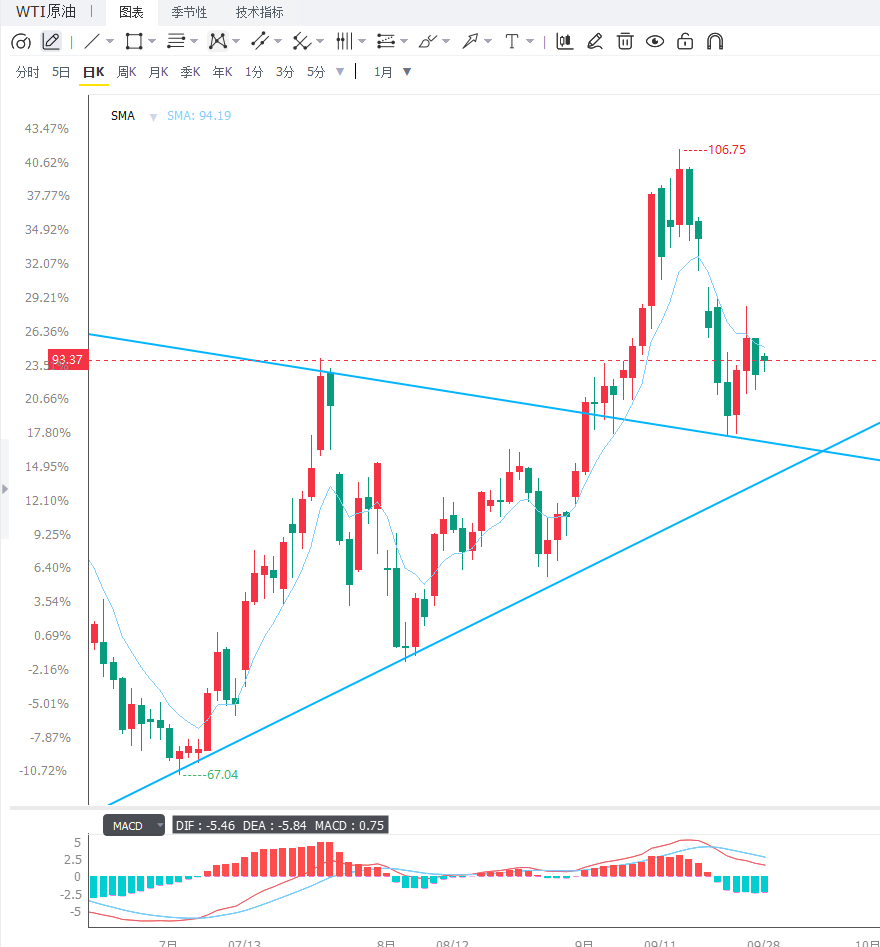 Editor's Summary: While US-Iran negotiations are temporarily stalled, diplomatic channels are not completely closed, keeping the oil market news-driven. Trump's rejection of Iran's seven-day reopening plan for the Strait of Hormuz has suppressed expectations of supply recovery; meanwhile, the possibility of renewed negotiations this week and recent increased cargo traffic in the strait have limited further upside potential for oil prices. In the short term, WTI will likely remain in the $90-$100 range, with $95 determining the strength of any rebound and $90 determining the downside. The market's real focus going forward will be on actual traffic volume in the Strait of Hormuz, whether negotiations can achieve substantial progress, and any new developments in regional energy infrastructure and shipping security. As long as these variables do not show a clear direction, oil prices are likely to remain highly volatile and continue to be priced around the supply risk premium.
Iran continues to maintain its policy of "dual diplomatic engagement and military preparation." Iranian Foreign Minister Abbas Araqchi stated that Tehran is still awaiting the mediators to convey the US's formal position to Iran, while emphasizing that Iran is prepared for a renewed escalation of the conflict but remains willing to resolve the issue through diplomatic channels. Previously, Iran's proposal included reopening the Strait of Hormuz, resuming nuclear negotiations, and easing some economic restrictions, with the core objective of de-escalating regional tensions through a comprehensive package. This change directly impacts the risk premium in the crude oil market. The Strait of Hormuz is a crucial global energy transport route; during periods of tension, any news regarding the reopening of the strait, the resumption of shipping, or an escalation of conflict can quickly alter oil price expectations. Trump stated that the amount of crude oil transported through the Strait of Hormuz has increased significantly recently, and US defense officials said that approximately 22 million barrels of crude oil were exported through the waterway on Friday evening. If subsequent cargo flows continue to recover, supply concerns may gradually ease; however, if military action escalates again, the recovery of shipping could quickly reverse. In terms of price performance, WTI crude oil has recently rebounded after a significant correction. Data shows that WTI futures reached approximately $101.91 on September 17th, followed by a period of adjustment, hitting a low of approximately $88.67 on September 22nd. It rebounded to around $96.78 on September 24th, before falling back to $92.41 on September 25th. Prices recovered to approximately $93.30 on September 27th. This price movement indicates that $90 has become a crucial area of contention between bulls and bears. The decline in oil prices does not mean that supply risks have disappeared. US gasoline prices remain high. Data from the American Automobile Association shows that as of September 27th, the national average price of regular gasoline in the US was approximately $4.48 per gallon, the same as the price announced on September 24th, marking a record high for the same period. The continued high gasoline prices indicate that supply pressures in the crude oil, refining, and transportation sectors remain. The pressure in the diesel market is even more pronounced. Previously, US diesel prices had risen to around $6.51 per gallon, a significant increase compared to a year ago. Diesel fuel not only affects residential transportation costs but also directly impacts logistics, agriculture, construction, and industrial activities. Therefore, a sustained rise in refined oil prices could be transmitted to broader commodity prices through transportation costs. If high oil prices persist for an extended period, energy inflation could become a significant variable for global central banks to reassess their interest rate paths. For the crude oil market, the most crucial factor remains the actual cargo flow through the Strait of Hormuz, rather than mere diplomatic statements. If strait traffic continues to increase while the US maintains indirect negotiations with Iran, the market may further reduce the supply disruption premium previously priced in, putting WTI under profit-taking pressure from its high levels. Conversely, if negotiations break down again, and new shipping attacks or disruptions to energy facilities occur, the market may quickly re-priced in supply disruption risks, potentially amplifying oil price volatility. Simultaneously, the market also needs to monitor the US response to refined oil prices. The Trump administration has previously stated it is seriously considering measures to lower diesel prices, including coordinating export plans with refineries. Given the already high utilization rate of US refining capacity, simply increasing refinery load may not be enough to quickly alleviate diesel market pressure. Therefore, whether policy measures can truly improve refined oil supply will affect the extent to which energy prices are transmitted to inflation. From the perspective of the global energy market, the biggest impact of the US-Iran negotiations is not merely reflected in the daily rise and fall of oil prices, but in the market's assessment of the future speed of supply recovery. If the Strait of Hormuz can maintain stable navigation, some crude oil and liquefied natural gas transportation in the Gulf region will gradually return to normal, and the supply tightness is expected to decrease. If the situation deteriorates again, marine insurance, freight rates, and spot premiums may expand again, further pushing up global energy costs. Currently, market sentiment is clearly in a state of "tug-of-war between diplomatic expectations and supply risks." On the one hand, Trump's rejection of Iran's latest proposal has weakened the market's optimistic expectations for a rapid short-term recovery of normal shipping; on the other hand, Trump still indicated that negotiations might continue this week, making it impossible for the market to completely rule out the possibility of a de-escalation. This fundamental uncertainty is an important reason why WTI is currently unable to form a sustained unilateral trend. From a technical perspective, WTI crude oil prices retreated rapidly after surging above $100 on the daily chart, subsequently finding support near $90 and rebounding. Currently, prices remain within a large range of $90 to $100, with the short-term trend leaning more towards high-level consolidation than a clear one-sided movement. If oil prices can regain a foothold above $95, the first resistance level to watch is around $98, followed by the psychological level of $100. A decisive break above $100 could lead to a retest of previous highs. Conversely, if prices remain under pressure at $95 and fall below $90, the $89-$88 area will become a crucial support level, and a breach of this level could extend the pullback. Therefore, $95 is a key dividing line for judging the short-term strength or weakness of WTI, while $90 is a critical support level to prevent further weakening. Looking at the 4-hour chart, WTI rebounded after forming a low near $88.7, currently back above $93, but still facing resistance near $95. Short-term momentum has recovered somewhat, but this is insufficient to confirm a new upward trend. If the price breaks through $95 with increased volume and continues to hold, it may advance further towards $98 and $100 in the short term; if it encounters resistance again near $95 and falls below $90, the previous rebound may be redefined as a technical correction, and the price will seek support in the $88 to $90 area again. Editor's Summary: While US-Iran negotiations are temporarily stalled, diplomatic channels are not completely closed, keeping the oil market news-driven. Trump's rejection of Iran's seven-day reopening plan for the Strait of Hormuz has suppressed expectations of supply recovery; meanwhile, the possibility of renewed negotiations this week and recent increased cargo traffic in the strait have limited further upside potential for oil prices. In the short term, WTI will likely remain in the $90-$100 range, with $95 determining the strength of any rebound and $90 determining the downside. The market's real focus going forward will be on actual traffic volume in the Strait of Hormuz, whether negotiations can achieve substantial progress, and any new developments in regional energy infrastructure and shipping security. As long as these variables do not show a clear direction, oil prices are likely to remain highly volatile and continue to be priced around the supply risk premium.
- Risk Warning and Disclaimer
- The market involves risk, and trading may not be suitable for all investors. This article is for reference only and does not constitute personal investment advice, nor does it take into account certain users’ specific investment objectives, financial situation, or other needs. Any investment decisions made based on this information are at your own risk.