RBA Decision Preview: After 4.60%, is the market still leaving room for a November decision?
2026-09-28 19:00:13
On Monday, September 28th, the Australian dollar was trading around 0.70 against the US dollar, a significant pullback from its earlier high of around 0.724. Market focus has shifted from the spot exchange rate itself to the Reserve Bank of Australia's (RBA) decision the following day and the August inflation figures to be released on September 30th. The cash rate target has remained at 4.35% since August 12th. 30-day bank bill futures indicate a near 90% probability of a 25 basis point rate hike at this meeting, raising the cash rate to 4.60%. For the market, whether or not a rate hike occurs is no longer a surprise; the key factors determining the repricing path of short-term interest rates and the Australian dollar will be whether the vote is unanimous and how the statement rewrites the August statement that "the cash rate target will be further increased if upside risks materialize." 
 The Australian dollar's pricing is driven by a combination of factors, including short-term interest rate expectations, commodity prices, and interest rate differentials. With the policy decision and August inflation data released consecutively, the repricing of short-term interest rates will precede the completion of the spot exchange rate. The market treats the statement's wording, voting records, and the following day's inflation data separately, rather than viewing a single decision as the final outcome of the year's trajectory.
The interest rate hike path has been priced in; communication is the key to pricing.
The Reserve Bank of Australia's Monetary Policy Committee (RBA) met on September 28-29. If a 25 basis point rate hike is implemented, the cash rate will rise to its highest level since November 2011. Major banks' public expectations are consistent with interest rate futures. Currently, the market is pricing in a cumulative rate hike of approximately 40 basis points this year, which already includes this near-certain step, meaning the November meeting is still considered an unresolved pricing item. The August statement stated that the Committee will continue to take actions it deems necessary to sustainably return inflation to its target, including further raising the cash rate target if upside risks materialize. Any adjustments towards a softer or harder stance will immediately be reflected in the short end of the yield curve. If the statement retains strong conditions and emphasizes upside risks, the market will tilt the probability of subsequent rate hikes towards 4.85%; if the conditions are downplayed, even if a rate hike occurs, the Australian dollar may react with a "buy the rumor, sell the fact" mentality. A dissenting vote would be interpreted as a disagreement within the Committee regarding the weighting of cooling employment and sticky inflation.Inflation stickiness and easing of employment occur simultaneously
Australia's Consumer Price Index (CPI) rose 3.5% year-on-year in July, down from 3.8% in June, but still above the 2% to 3% target range. The trimmed mean, excluding extreme items, remained unchanged at 3.6% year-on-year, marking the second consecutive month of stagnation; the trimmed mean rose 0.5% month-on-month, the fastest pace in nearly a year. Housing prices rose 5.0% year-on-year, food and non-alcoholic beverages rose 3.2%, and service prices remained at 3.7% year-on-year. August inflation figures will be released the day after the policy decision; the committee will not see these figures during its meeting, and the statement will be based solely on the published July data, employment report, and energy price path. Australia's unemployment rate rose to 4.6% in August, up from 4.5% in July; employment increased by 39,500, but full-time jobs decreased by 6,300, while part-time jobs increased by approximately 45,800, with the participation rate rising to 67.1%. The number of unemployed increased by 28,200 to 722,900. The simultaneous expansion of the labor force and the decline in full-time jobs left the committee with dual evidence that demand is cooling but not yet sufficient to suppress prices.Block changed the upside risk from an assumption to a reality.
Chair Michelle Bullock testified before the House Economics Committee on September 18, saying, "Inflation is too high. Our focus is on pushing it back down and ensuring it doesn't embed itself in price and wage setting." She also noted that the August Monetary Policy Statement projected inflation wouldn't return to near the midpoint of the target range until late 2027. "At the August meeting, we considered the risks to the outlook skewed to the upside. Subsequent developments suggest that some of these upside risks to inflation appear to be materializing, despite slowing economic growth in Australia." She specifically mentioned the unresolved Middle East conflict, the significant resurgence of oil and related prices, and the expansion of artificial intelligence driving up some technology and labor costs. Bullock directly posed the question to the committee: are the current 75 basis point rate hikes sufficient to bring inflation back to target within a reasonable timeframe? Assistant Governor Sarah Hunt also reiterated at the same time that a fourth rate hike this year is not ruled out. These statements shifted the market's focus from whether to raise rates at all to whether the statement would include a November hike as a viable option.The exchange rate structure shows that policy expectations have already been priced in.
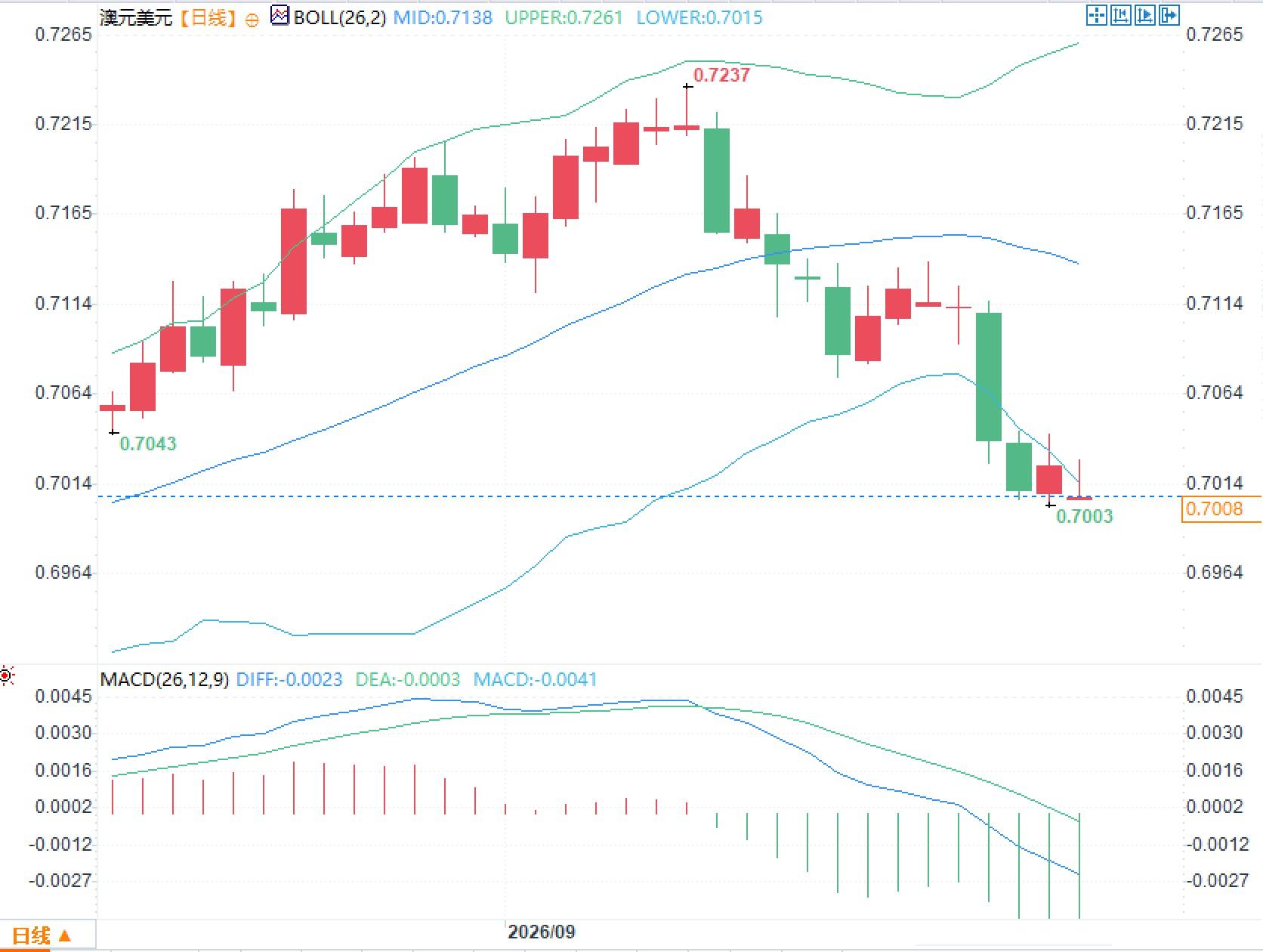
The daily Bollinger Bands have the middle band at approximately 0.7138, the upper band at approximately 0.7261, and the lower band at approximately 0.7015. After falling from its high in early September, the price is currently trading close to the lower band. The MACD parameters DIFF and DEA are approximately -0.0023 and -0.0003, respectively, with the histogram below the zero line. The Australian dollar's pricing is driven by a combination of factors, including short-term interest rate expectations, commodity prices, and interest rate differentials. With the policy decision and August inflation data released consecutively, the repricing of short-term interest rates will precede the completion of the spot exchange rate. The market treats the statement's wording, voting records, and the following day's inflation data separately, rather than viewing a single decision as the final outcome of the year's trajectory.Frequently Asked Questions
Question 1: Why does the market consider the decision itself a secondary variable? Answer: 30-day interest rate futures have pushed the probability of a 25 basis point rate hike to nearly 90%. If the cash rate rises from 4.35% to 4.60% as expected, it only completes one step in the curve. What truly rewrites the November pricing is whether the statement retains the condition of "further raising the cash rate target if upside risks materialize," and whether the vote passes unanimously. Question 2: Why didn't the decline in year-on-year inflation eliminate expectations of a rate hike? Answer: The July consumer price index fell from 3.8% year-on-year to 3.5%, but remained above the 2% to 3% target. The committee's more pressing concern, the trimmed mean, remained at 3.6% year-on-year, with a month-on-month increase of 0.5%. Sticky indicators did not decline in tandem, so slightly looser employment figures are insufficient to offset the price evidence alone. Question 3: Why might August inflation have more pricing weight than the decision statement? Answer: The committee cannot see August price data when it meets. The statement can only be written based on July data and the employment report. The inflation reading on September 30 will directly test the assessment that "upside risks are materializing," thus determining how the market will rewrite the probability of the remaining meetings before the end of the year.- Risk Warning and Disclaimer
- The market involves risk, and trading may not be suitable for all investors. This article is for reference only and does not constitute personal investment advice, nor does it take into account certain users’ specific investment objectives, financial situation, or other needs. Any investment decisions made based on this information are at your own risk.