The US plans to restrict diesel exports, putting pressure on both European energy and currency markets.
2026-09-28 20:28:14
With only weeks remaining until the US midterm elections in November, soaring domestic fuel prices have become a core livelihood and political challenge for the Trump administration. To address record-high diesel prices and alleviate voter discontent, President Trump has publicly stated that he is seriously considering implementing diesel export restrictions in an attempt to stabilize domestic fuel prices by regulating supply and demand. However, energy industry and market analysts generally warn that while this policy may only slightly alleviate domestic diesel prices in the short term, it could backfire on the US gasoline market in the long term, exacerbate the global fuel supply crisis, and trigger a chain reaction in international trade. The pressure on the US fuel market is already evident. Data shows that in September 2026, the average price of diesel in the US climbed to $6.52 per gallon, a surge of nearly $3 compared to the same period last year, reaching a historical peak of $6.53 per gallon on September 22nd; during the same period, the average price of regular gasoline reached $4.47 per gallon, a significant increase of $1.30 year-on-year. Diesel fuel, a core power fuel for agricultural production, land freight, and industrial manufacturing, has seen its price soar, directly driving up the cost of end-products such as food and daily necessities in the United States. This has intensified pressure on people's livelihoods and become a key weakness hindering the Republican Party's election prospects ahead of the midterm elections. The proposed diesel export restrictions are essentially an emergency measure by the Trump administration for the midterm elections. Many Republican lawmakers, especially representatives from major agricultural states, have been pressuring the White House to alleviate the domestic diesel shortage and reduce production and living costs through export controls. Core agricultural states like Iowa heavily rely on diesel-powered agricultural machinery for the autumn harvest, and the soaring oil prices have severely impacted farmers' interests. These states are crucial Republican strongholds in the midterm elections, and voter dissatisfaction directly affects the race for seats in the House and Senate. Faced with a slight lead in the Democratic polls and a precarious Republican majority, Trump urgently needs to introduce tangible oil price control measures to regain voter support. 
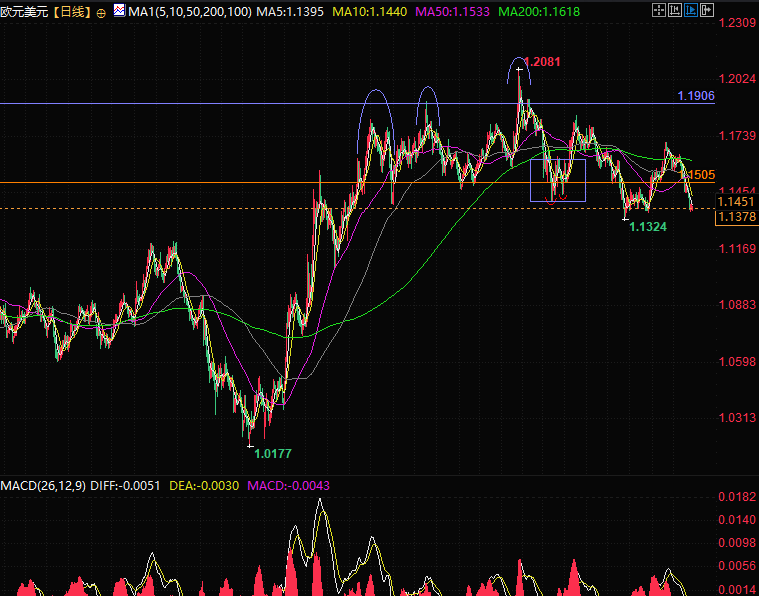 (EUR/USD daily chart, source: FX678) EUR/USD is currently trading at 1.1375/76.
White House policy shift: from blanket ban to flexible control assessment
Regarding market rumors of a 90-day nationwide diesel export ban, Trump publicly confirmed it, stating that the government is carefully evaluating the situation and does not rule out its implementation. He also acknowledged the potential side effects of the policy—it might slightly lower domestic diesel prices in the short term, but would most likely drive up gasoline prices. Compared to Trump's tough stance, the U.S. Department of Energy adopted a more cautious approach. Energy Secretary Chris Wright revealed that the government is not solely pursuing a complete ban, but is evaluating various options such as comprehensive restrictions, partial controls, or voluntary export caps, striving to avoid the impact of aggressive policies on the domestic refining system. The Treasury Department is also simultaneously conducting feasibility studies, optimizing policy options based on national refining capacity and regional supply and demand differences.Industry collectively warns: Export bans may disrupt the US refining system
However, mainstream energy industry professionals and analysts in the United States unanimously oppose a radical diesel export ban, arguing that such a measure is merely a stopgap measure and could even exacerbate the chaos in the refined oil market. The American Petroleum Institute (API) explicitly points out that restricting diesel exports would disrupt the mature refining and trading system in the United States, failing to address the high price problem and instead worsening the current global refining capacity shortage. U.S. refineries operate at full capacity year-round, and crude oil refining involves a fixed product mix; diesel accounts for approximately 30% and gasoline for nearly 46% of a barrel of crude oil, making it impossible to adjust the production of a single product individually. Industry analysts further explain that U.S. refining capacity is extremely unevenly distributed regionally. The Gulf Coast concentrates 54% of the nation's refining capacity, with local diesel production far exceeding consumer demand, relying on exports to absorb excess capacity. Meanwhile, regions like the East Coast have insufficient capacity and rely on imports to fill the gap. A blanket ban on diesel exports would leave surplus diesel stockpiled along the Gulf Coast, forcing refineries to reduce crude oil processing volumes. This would consequently reduce the production capacity of all refined petroleum products, including gasoline and jet fuel, ultimately leading to a contraction in the overall supply of refined petroleum products in the United States and pushing up domestic gasoline prices. Experts estimate that the export ban could increase US retail fuel prices by 30 cents per gallon, with further increases potentially possible.Global supply chains under pressure: European and American refined oil product trading systems face shocks
From a global market perspective, Trump's diesel export restrictions will trigger a severe chain reaction. The global refined oil supply chain is already deeply mired in crisis. The ongoing conflict between Russia and Ukraine continues to impact European refining and transportation routes. Ukraine's attacks on Russian refining facilities, coupled with the instability in the Middle East and restrictions on shipping through the Strait of Hormuz, have led to Russia's early implementation of a diesel export ban. The world's two largest diesel suppliers are tightening their supplies in succession. The United States, as the world's largest diesel exporter, accounts for 20% of global trade daily seaborne diesel exports and is a core source of nearly half of Europe's diesel imports. If the US tightens exports, European diesel prices will reach record highs, further widening the global refined oil supply-demand gap. In addition, the policy carries a significant risk of trade repercussions. The refined oil trade between the US and Europe is highly complementary; the US exports diesel to Europe, and Europe exports gasoline to the US. If the US implements a diesel export ban, Europe is highly likely to implement retaliatory measures, restricting gasoline exports to the US. The northeastern US, heavily reliant on imported gasoline, will be the first to face supply shortages and soaring prices. Morgan Stanley's research report also predicts that the US diesel restriction policy can only slightly stabilize domestic diesel prices in the short term. Subsequently, it will push up the overall price of refined oil products in the US through the transmission chain of refining capacity contraction and trade retaliation, forming a vicious cycle.Market forecast: Aggressive bans unlikely in the short term; oil price volatility to increase in the fourth quarter.
As of now, the White House has not finalized its policy proposal and is still balancing the political demands of the midterm elections, the interests of the domestic energy industry, and global market stability. European energy traders generally predict that, considering the significant impact on US oil companies, the probability of the White House implementing a comprehensive, long-term diesel export ban is low; short-term, localized controls or phased restrictions are likely to be the alternative. Against the backdrop of ongoing global geopolitical conflicts and weak recovery in refined oil production capacity, this policy maneuvering by the US also indicates that the global refined oil market will continue to experience high volatility and high premiums in the fourth quarter. If the US implements diesel export restrictions, the euro will face dual pressures: increased European diesel import costs will push up the eurozone's import bills, widen the trade deficit, and directly drag down the euro exchange rate. Rising energy prices will further push up eurozone inflation, putting the European Central Bank in a dilemma: maintaining high interest rates to suppress inflation will exacerbate downward economic pressure; easing monetary policy to protect growth will amplify expectations of euro depreciation. In an environment where the US dollar dominates energy settlements, higher diesel procurement costs will increase Europe's demand for US dollars, creating a negative cycle of "rising oil prices → increased demand for US dollars → pressure on the euro." Once the market begins to price in the risk of stagflation in Europe, the euro may face a new round of downward pressure. (EUR/USD daily chart, source: FX678) EUR/USD is currently trading at 1.1375/76.
- Risk Warning and Disclaimer
- The market involves risk, and trading may not be suitable for all investors. This article is for reference only and does not constitute personal investment advice, nor does it take into account certain users’ specific investment objectives, financial situation, or other needs. Any investment decisions made based on this information are at your own risk.