Policies pushing up inflation and dragging down household income may signal a turning point for the US economy.
2026-09-28 21:30:18
With the US midterm elections approaching, the Trump administration has repeatedly touted its record as the "best in American economic history," but a series of core macroeconomic data and labor market performance present a stark contrast to the public's actual experience. Currently, the US is experiencing rebounding inflation, a significant slowdown in economic growth, and the Federal Reserve's continued interest rate hikes and tightening of monetary policy. The labor market is trapped in a structural dilemma of "low unemployment, weak job growth, and shrinking real wages." Multiple indicators show that US real interest rates are under continued pressure, the economy is weakening marginally, and the macroeconomic fundamentals are approaching a critical turning point, laying the groundwork for important economic variables in the midterm elections. 
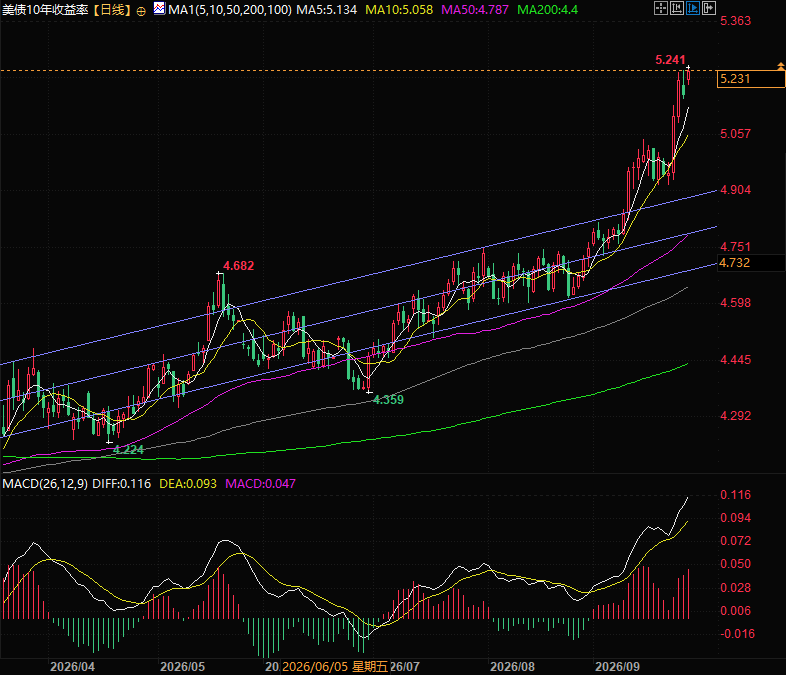 (Daily chart of US 10-year Treasury yield, source: EasyTrade) At 21:24 Beijing time, the US 10-year Treasury yield is currently at 5.241/242.
Policy-driven inflation rebounds, price pressures rise sharply.
High inflation is the most prominent contradiction in the current US economy, and a core source of disturbances in real interest rates and squeezes on household income. Data shows that the current US inflation rate has risen to 3.4%, a significant rebound from the 3.0% level when Biden left office, with the price recovery completely reversing the previous stable pattern. This round of inflation is not a short-term market fluctuation, but rather a direct result of two major Trump policies: tariffs imposed on China have increased the import costs of industrial and consumer goods, while the energy shock caused by the conflict with Iran has directly triggered a surge in energy prices across the US. Prices of consumer goods have risen across the board, and the cost of living for residents has increased significantly. In the past 12 months, US fuel prices have surged by 52%, and the prices of everyday consumer goods such as beef, seafood, coffee, and electricity have generally increased by 3.8%-7.2%, with the average price of gasoline across the US soaring to $4.47 per gallon. Against the backdrop of widespread price increases, the growth rate of household wages has failed to keep pace with inflation, resulting in a continuous shrinking of real income and a significant decline in purchasing power. To curb stubborn inflation, the Federal Reserve has initiated a sustained interest rate hike cycle, and nominal market interest rates have continued to rise. This trend has not only raised financing costs for the real economy but also significantly increased the burden of mortgage and consumer loans for residents, directly suppressing market consumption and investment. Public perception confirms the economic hardship: 73% of Americans rate the current economic situation as average or poor, and 71% of voters disapprove of the Trump administration's cost-of-living policies.Structural weakness in the labor market and a significant decline in the quality of employment.
In a macroeconomic environment of tightening interest rates and high inflation, the US labor market has shown significant divergence. A seemingly robust unemployment rate masks core weaknesses in job growth, with overall job quality declining sharply. Currently, during Trump's second term, the US unemployment rate remains low at 4.1%, seemingly maintaining full employment and roughly the same as in Biden's final year. However, compared to historical data, this unemployment rate is far higher than the low employment levels during the presidencies of Eisenhower, Clinton, and Nixon, indicating a weakening of the overall resilience of the job market. The sharp decline in job growth is key evidence of the labor market's weakness. Data shows that since Trump's return to power, the US has averaged only 43,000 new jobs per month, less than a third of the 145,000 monthly increase during Biden's final two years, demonstrating a significant drop in job absorption capacity. Notably, Trump's core economic policy of "tariffs to boost manufacturing" has completely failed. During his term, the US manufacturing sector lost 35,000 jobs, core jobs in the real economy continued to shrink, and industrial recovery failed to materialize. Although the latest monthly increase of 162,000 jobs represents a short-term rebound, it is a temporary fluctuation and cannot reverse the structural weakness. Overall, current job growth in the United States is concentrated in asset-light sectors such as services, while employment in manufacturing and the real economy remains sluggish. The quality of job growth is insufficient to support a sustained economic recovery.The White House and academia hold differing views, and perceptions of the economic situation are diverging.
Faced with high inflation and weak employment, the White House holds drastically different views from mainstream think tanks and economists. White House spokesman Desai attempted to downplay the economic difficulties, attributing inflation fluctuations to short-term market disruptions caused by the Iranian conflict, and claiming the effectiveness of targeted government policies based on short-term price declines in categories such as beef, prescription drugs, and car insurance. Regarding employment, the White House denied allegations of declining job quality, claiming that job growth during the Biden administration relied on inefficient public sector jobs created by government fiscal expansion, while the current administration focuses on cultivating sustainable private sector employment through tax cuts and deregulation, thus solidifying the long-term foundation of the economy. The academic community generally holds a cautious or even pessimistic view of the current economic situation. American Enterprise Institute analyst Sterling pointed out that the current US economy exhibits a typical "hot-cold imbalance": low unemployment and private investment growth demonstrate a certain market resilience, but high inflation continues to erode residents' wages and income, which is the core obstacle to economic recovery. Owens, president of the progressive think tank Grassroots Collaboration, bluntly stated that the US economy is in dire straits. She believes that the Federal Reserve's continued interest rate hikes, against the backdrop of already high living and credit costs, further exacerbate the burden on families, suppress consumption and housing market activity, and make the economic situation of ordinary people increasingly difficult. Data also corroborates this collapse in public opinion; currently, only 28% of Americans approve of Trump's economic policies, and positive assessments of the economy within the Republican Party have plummeted from 72% at the beginning of the year to 29%.The risks of a false economic recovery are becoming increasingly apparent, and the foundation for growth is extremely unstable.
Industry analysts point out that the current short-term resilience of the US economy harbors significant structural risks and is not a genuine, sustainable recovery, relying entirely on two special pillars for support. First, the artificial intelligence industry has become the sole core growth engine, continuously driving GDP growth, corporate investment, and the US stock market, thus supporting the basic foundation of the US economy. However, this sector currently faces multiple uncertainties, including tightening regulations, security controversies, and increased risk aversion in the capital markets, leading to a continuous decline in growth stability and making it difficult to provide long-term support for the macroeconomy. Second, the US consumer market exhibits severe polarization, with economic resilience entirely dependent on high-income groups. The top 10% of earners contribute nearly half of household consumption expenditure, while the bottom 50% are continuously squeezed by inflation, resulting in a significant contraction in their purchasing power. This unbalanced consumption structure means that the foundation for domestic demand growth in the US is extremely weak, and the economic recovery lacks nationwide support. More importantly, the current US economic predicament is a typical "policy-driven" dilemma. Data from the Yale Budget Lab and Moody's shows that Trump's tariff policies and energy price increases triggered by the Iran conflict will increase the annual expenditure of ordinary American families by an additional $1,000 to $1,100. Inflation caused by such policies is long-term and persistent, further compressing the Federal Reserve's room for monetary policy adjustments and significantly increasing the difficulty of repairing real interest rates and the job market.Economic turning point looms, midterm elections bring a major test of public opinion.
Looking at core growth indicators, the decline in US economic momentum is clear. In the second quarter of this year, US GDP growth was only 1.5%, far below the annual high growth rates of over 6% during the Kennedy and Reagan eras, and also lower than the 2.7% growth rate in the last six months of Biden's term. Coupled with persistent inflation, high market interest rates, and sluggish job growth, US consumer confidence has fallen to the second lowest level in the 74-year history of the Michigan Index, and market pessimism has spread across the board. The US economy is currently at a crucial turning point: low real interest rates are suppressing policy space, structural weaknesses in the labor market continue to be exposed, policy-driven inflation is unlikely to subside quickly, and the apparent economic resilience may loosen at any time. With the November midterm elections approaching, voters' true perceptions of prices, employment, and income will directly affect the election landscape and reshape the short-term direction of US economic policy and market expectations. (Daily chart of US 10-year Treasury yield, source: EasyTrade) At 21:24 Beijing time, the US 10-year Treasury yield is currently at 5.241/242.
- Risk Warning and Disclaimer
- The market involves risk, and trading may not be suitable for all investors. This article is for reference only and does not constitute personal investment advice, nor does it take into account certain users’ specific investment objectives, financial situation, or other needs. Any investment decisions made based on this information are at your own risk.