Gold fell more than 3% in a single day: US Treasury yields rose to high levels, can non-interest-bearing assets still hold up?
2026-09-28 21:30:15
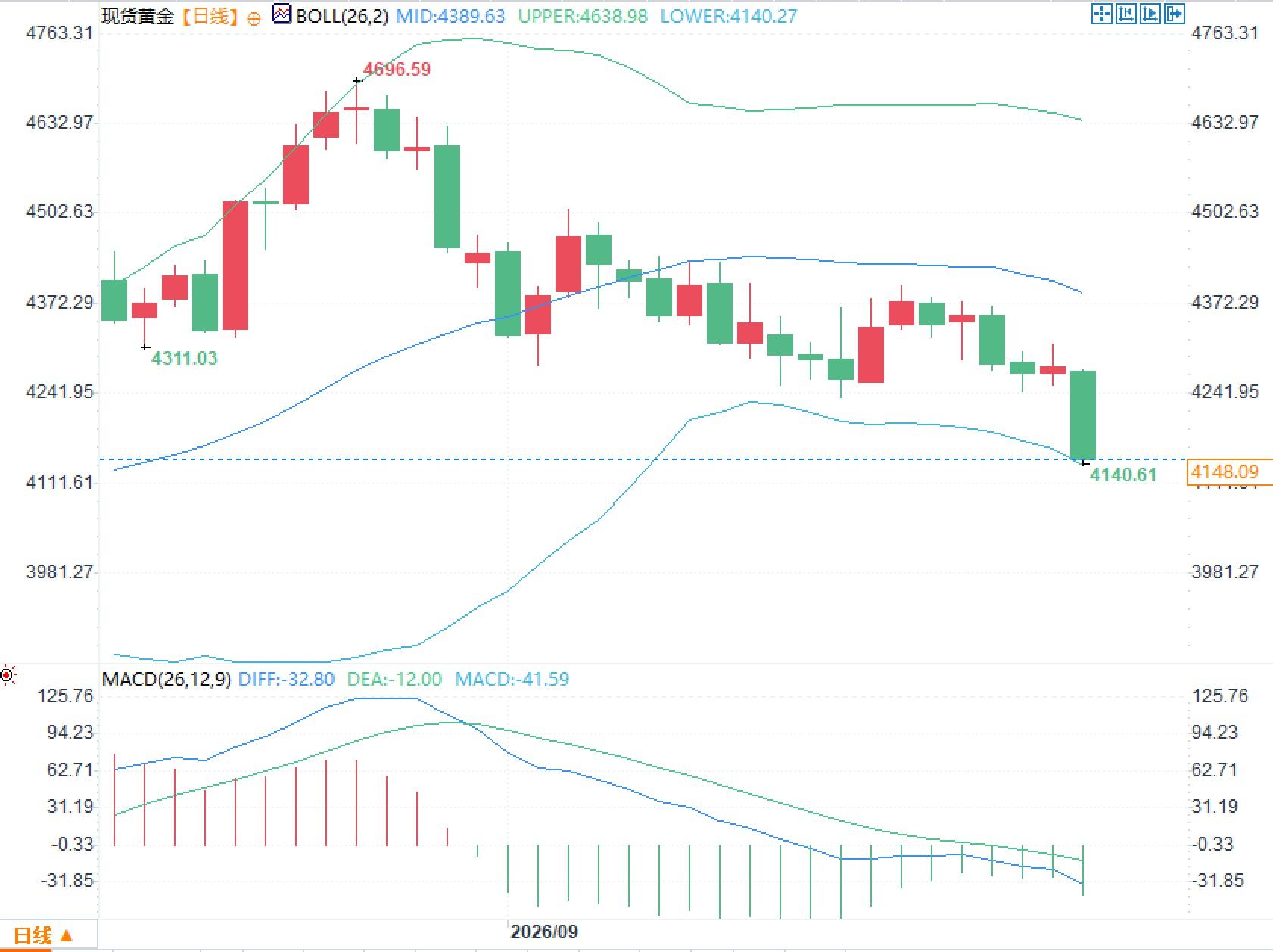
On Monday, September 28th, spot gold was under significant pressure, currently trading around $4150 per ounce, down more than 3% on the day and falling back to its lowest range since August 5th. The weekend's negotiations regarding the Middle East conflict failed to yield clear progress, oil prices strengthened again, and concerns about sticky inflation were reignited, raising the pricing of further tightening by the Federal Reserve. US Treasury yields rose in tandem with the dollar, increasing the cost of holding non-interest-bearing assets, and the support for gold from the safe-haven and inflation-hedging narratives was suppressed by the interest rate path. This week, the US will also release the Personal Consumption Expenditures Price Index, the ISM Purchasing Managers Index, and non-farm payroll data; gold pricing will continue to revolve around policy expectations and real interest rates. 
Interest rate path becomes the main constraint on gold pricing.
Spot gold has fallen about 25% from its January high of around $5,600/oz, with the pricing focus shifting from safe-haven premiums to interest rates and real yields this year. The Federal Reserve raised the target range for the federal funds rate by 25 basis points to 3.75% to 4.00% at its September 15-16 meeting, the first rate hike in three years. The median dot plot shows a year-end policy rate expectation of 4.1%, implying one more rate hike this year. Fed Chairman Warsh reiterated his standard at the post-meeting press conference: the committee must be confident that underlying inflation is clearly and at a sufficient pace toward the 2% target; otherwise, it still has work to do. He also stated that it is difficult to describe current broad financial conditions as restrictive. Fed Governor Barr called the September rate hike a significant move last week and publicly supported continuing to assess further tightening. Based on this, the market has raised the probability of a 25 basis point rate hike at the October meeting to around 70%. For gold, the upward shift in policy rate expectations will directly increase holding costs, compressing the relative attractiveness of non-interest-bearing assets.How crude oil price fluctuations rewrite the inflation transmission chain
Crude oil prices have fluctuated more sharply since the escalation of the Middle East conflict and disruptions to passage through the Strait of Hormuz in late February. Over the weekend, the US rejected Iran's proposal to reopen the strait within seven days, while indicating that negotiations might continue this week. On Monday, Brent crude rebounded to around $99 per barrel, with US crude also strengthening. Rising energy prices will push up global inflation expectations, leading the bond market to demand higher nominal yields. Gold has traditionally been seen as a safe-haven and inflation hedge, but this function has not dominated pricing since the outbreak of the current conflict. This is because the energy shock has simultaneously reinforced expectations of central bank tightening: the inflationary pressure from rising oil prices is primarily interpreted by the market as an upward risk to policy and real interest rates, rather than simply safe-haven buying. Strait of Hormuz passage, Middle East supply disruptions, and negotiation progress will continue to influence inflation expectations through crude oil, which will then be transmitted to bonds and gold, rather than directly altering the supply and demand of metals.US Treasury yields and the US dollar constitute a double discount constraint.
The yield on 10-year US Treasury bonds rose to between 5.21% and 5.23%, its highest level since 2007. Rising yields mean a higher opportunity cost for holding gold, especially when real interest rates are high, the discounting effect is more direct. The US dollar index is trading around 101.20, near its recent high. Gold is priced in US dollars, and a stronger dollar increases the purchase cost for holders of other currencies, reinforcing the tendency to reallocate funds from metals to dollar assets. Two layers of logic need to be distinguished. The first is nominal interest rates: expectations of interest rate hikes increase the cost of short-term funds. The second is term premium: energy shocks, bond supply, and inflation uncertainty will push up long-term yields. When both layers are in effect simultaneously, gold faces not just a single exchange rate fluctuation, but the dual constraints of holding costs and the currency of pricing. If subsequent data changes the market's pricing of the policy path, yields and the dollar will be revalued before the metal itself.This week's US data window and gold price indicators
This week's key focus is on the Personal Consumption Expenditures (PCE) price index on Wednesday, the Institute for Supply Management (ISM) Purchasing Managers' Index (PMI) on Thursday, and non-farm payrolls and official speeches on Friday. The PCE price index is the Federal Reserve's primary inflation reference, and its core reading will influence pricing at the October meeting. Employment and economic indicators are used to determine whether demand continues to support prices. Gold's daily Bollinger Bands show the middle band at $4389.63/oz, the upper band at $4638.98/oz, and the lower band at $4140.27/oz, with the price trading near the lower band. The MACD parameters are DIFF -32.80, DEA -12.00, and MACD -41.59, with the histogram below the zero line.Frequently Asked Questions
Question 1: Spot gold has clearly retreated, why hasn't its safe-haven function dominated pricing? Answer: The Middle East conflict has increased uncertainty, but the simultaneous strengthening of crude oil prices has reinforced inflation and interest rate hike expectations. US Treasury yields have risen to around 5.21% to 5.23%, and the US dollar index is near 101, increasing the cost of holding non-interest-bearing assets. The market is prioritizing the energy shock in its policy path, rather than directly translating it into gold buying. Question 2: Why is the probability of a Fed rate hike in October rising to about 70% suppressing gold? Answer: The September meeting already raised interest rates to 3.75% to 4.00%. If there is another 25 basis point rate hike in October, short-term funding costs and real interest rate expectations will rise in tandem, resulting in a higher interest rate for discounting future cash flows to gold. Warsh emphasized that underlying inflation needs to fall at a sufficient pace, and Barr stated that the September action was important; these official statements reinforced this pricing. Question 3: What information this week is most likely to rewrite the pricing weight of gold? Answer: The US personal consumption expenditure price index, purchasing managers' index, non-farm payrolls, and official speeches will revise the probability of the Fed's October meeting. If the Strait of Hormuz negotiations alter the oil route, it will also affect yields through inflation expectations.- Risk Warning and Disclaimer
- The market involves risk, and trading may not be suitable for all investors. This article is for reference only and does not constitute personal investment advice, nor does it take into account certain users’ specific investment objectives, financial situation, or other needs. Any investment decisions made based on this information are at your own risk.