Gold Trading Alert: High oil prices trigger interest rate hike storm, gold prices plunge 4% to a seven-week low! Is the next target $4000?
2026-09-29 07:16:13
Spot gold plunged 4% on Monday (September 28) to close at $4,114.93 per ounce, after hitting a low of $4,110.80 during the session, its lowest level since August 5. U.S. gold futures also fell 3.5%, settling at $4,168.40. This was a "perfect storm" triggered by a combination of factors: oil prices, inflation expectations, bets on a Fed rate hike, a stronger dollar, and soaring U.S. Treasury yields. Gold, as a traditional safe-haven asset, briefly lost its luster under multiple pressures, and market sentiment quickly turned cautious. On Tuesday (September 29) in early Asian trading, spot gold hovered at lower levels, currently trading around $4,122.5 per ounce. 
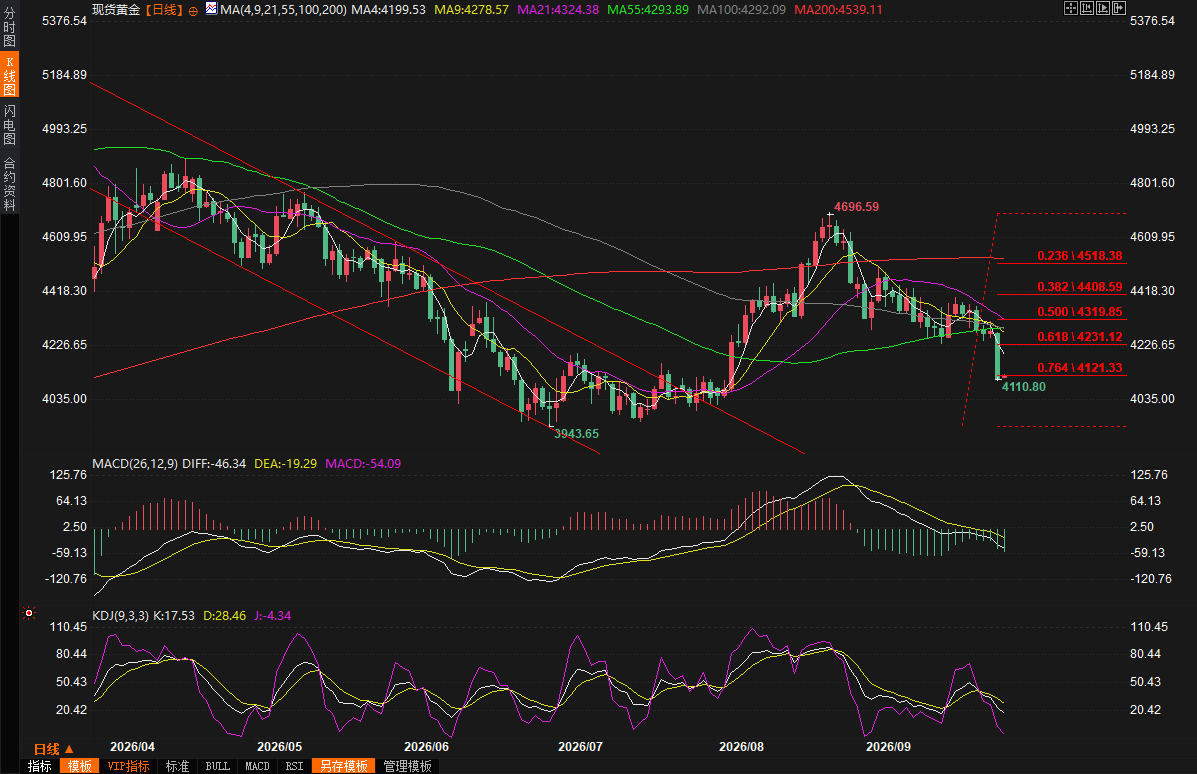 (Spot gold daily chart, source: FX678) At 07:14 Beijing time, spot gold is currently trading at $4123.52 per ounce.
The surge in oil prices has ignited inflation, temporarily relegating gold to a safe-haven asset.
The initial trigger for this round of sharp gold price declines came from the oil market. US President Trump rejected a peace deal proposed by Iran, an agreement intended to resolve the conflict and reopen the Strait of Hormuz. Following the news, oil prices surged by more than $4 per barrel at one point during the session. Brent crude futures ultimately closed up $0.96, or 0.9%, at $105.28 per barrel; US crude futures rose $0.19, or 0.2%, to settle at $92.60 per barrel. Although Qatari mediators subsequently pledged to hold separate talks with the US and Iran, narrowing the price gains, market concerns about supply disruptions did not truly dissipate. The reason why rising oil prices dealt a heavy blow to gold is that it directly ignited inflation concerns. Jim Wyckoff, a market analyst at American Gold Exchange, pointed out that the sharp rise in oil prices means that inflation may become more difficult to manage, thus implying that the Federal Reserve will adopt a tighter monetary policy. Gold is typically viewed as an inflation hedge, but in the current market logic, rising inflation has actually strengthened expectations of central bank interest rate hikes, thus pushing up real interest rates and the US dollar, putting significant pressure on non-interest-bearing gold. In other words, rising oil prices are not driving safe-haven buying of gold, but rather fear of a more hawkish Federal Reserve. The situation in the Middle East itself remains highly uncertain. Iran insisted over the weekend that only diplomatic means could resolve its conflict with the US and Israel, and Trump also stated on Sunday that he expects US negotiators to hold more talks this week. Preliminary data from Kpler shows that crude oil exports from major Middle Eastern oil-producing countries rebounded to 12.8 million barrels per day in September, the highest since the outbreak of the war in February, as Saudi Arabia and the UAE increased exports. However, UBS analyst Giovanni Staunovo cautioned that despite increased shipping through the Strait of Hormuz, oil flows remain below pre-conflict levels, and market supply remains insufficient. Diesel prices have also risen sharply due to the Middle East war, the Russia-Ukraine conflict, and export bans imposed by Russia and major Asian powers. The White House is even considering easing regulations to expand sales of red diesel and discussing a possible ban on diesel exports. These factors are reinforcing inflation expectations and temporarily suppressing gold's safe-haven appeal due to interest rate logic.With both the US dollar and US Treasury yields high, the cost of holding gold has risen sharply.
If oil prices were the trigger, then the US dollar and US Treasury yields were the two major obstacles that crushed gold prices. The US dollar rose 0.15% against major currencies on Monday, with the dollar index reaching 101.18, remaining near a two-month high. A stronger dollar makes dollar-denominated gold more expensive for overseas buyers, directly weakening global demand for gold. Meanwhile, US Treasury yields continued their upward trend, further increasing the opportunity cost of holding non-interest-bearing gold. The 10-year Treasury yield rose 4.88 basis points to 5.23%, reaching a high of 5.2741% during the session, the highest since mid-June 2007; the 30-year Treasury yield rose 5.36 basis points to 5.5556%, touching 5.5829% during the session, the highest since mid-May 2004; and the two-year Treasury yield, which typically moves in tandem with the Federal Reserve's interest rate expectations, rose 4.99 basis points to 4.914%, reaching a high of 4.9555% during the session, the highest since May 2024. The spread between the closely watched 2-year and 10-year yields on the yield curve also fluctuated, briefly falling to 28.50 basis points before steepening to 31.4 basis points. Marc Chandler, chief market strategist at Bannockburn Forex, stated that the current situation is that the US rejected Iran's proposal, causing oil prices to jump and putting upward pressure on US Treasury yields, which is precisely the factor driving the general strengthening of the US dollar. Lawrence Gillum, chief fixed income strategist at LPL Financial, also pointed out that as long as the uncertainty of the Iranian conflict remains, bond yields are likely to continue to face upward pressure, and rising oil prices will be reflected in future inflation data; the market has already priced in the Fed's rate hike cycle over the next 12 months. For gold, the strengthening dollar and high US Treasury yields together constitute a "perfect storm." Jim Wyckoff bluntly stated that rising US Treasury yields, coupled with the dollar being at a multi-week high, jointly pushed metal prices down sharply.The Federal Reserve's hawkish rhetoric has pushed bets on interest rate hikes to unprecedented highs.
The underlying reason for the sharp drop in gold prices is a dramatic shift in market expectations regarding the Federal Reserve's monetary policy. Earlier this month, the Fed raised its benchmark interest rate by 25 basis points and hinted at further rate hikes in the coming months. Several policymakers echoed the Fed's hawkish stance, warning that inflation risks remain high and interest rates may need to rise further. Cleveland Fed President Hammark was one of the latest officials to reiterate this view. On Monday, Fed Governor Cook also stated that she expects continued inflationary pressures in the coming months due to demand related to artificial intelligence and rising oil prices, although she did not explicitly indicate the need for further rate hikes. The data in the interest rate market is even more striking. The CME Group's FedWatch tool shows that traders believe there is approximately a 94% probability of a Fed rate hike in December. In bond market trading, market expectations for a 25 basis point rate hike in October rose from 64% last Friday to about 70%, with the probability reaching 73% at one point during the session. Traders have almost fully priced in expectations of four 25 basis point rate hikes over the next 12 months. This means that the market is pricing in a much more aggressive tightening cycle than before. For gold, rising expectations of interest rate hikes are fatal. Gold does not generate interest, and when US Treasury yields rise and the dollar strengthens, the relative attractiveness of holding gold decreases significantly. More importantly, rising oil prices could transmit to inflation, forcing central banks to maintain a stance of higher interest rates for a longer period. The market is currently focused on job openings, the ADP employment report, the personal consumption expenditure price index, and the non-farm payroll report, all of which will be released this week. If these data align with expectations of further monetary tightening, gold will remain under pressure in the short term.Geopolitical risks have not disappeared, but the market has temporarily opted for a "tightening" of trading.
Despite the ongoing conflict in the Middle East and the continued disruption of oil and gas transport through the Strait of Hormuz, gold has not received significant safe-haven support. This indicates that the current market's dominant logic is not safe-haven demand, but rather inflation and deflation. Qatari mediators are expected to hold talks in New York on Monday or Tuesday with Iranian Foreign Minister Araqchi and US officials respectively. The talks are expected to focus on a revised version of the seven-day proposal Iran submitted during the UN General Assembly last week. Renewed hopes for negotiations led to a partial pullback in crude oil futures, offering some relief to investors concerned about persistently high inflation and the Fed's interest rate hikes. However, geopolitical risks have not truly dissipated. Supply disruptions related to the Middle East and Ukraine wars continue to impact the energy market, with diesel prices surging. Discussions in Washington about a possible ban on diesel exports pushed the Brent crude premium over US crude futures to its highest level since May, indicating that the market expects US refiners to reduce crude oil processing volumes if diesel exports are not possible. These factors could potentially push inflation back up in the future and solidify the Fed's tightening stance. For gold, geopolitical risks are a double-edged sword: on the one hand, they can bring safe-haven buying, but on the other hand, they can strengthen expectations of interest rate hikes through rising oil prices, thus suppressing gold prices. The market has clearly chosen the latter.Market Outlook
Looking ahead, gold's short-term price movement will heavily depend on a series of economic data releases this week. Wednesday's Personal Consumption Expenditures Price Index (PCE) and Friday's non-farm payrolls report are particularly crucial, both expected to align with expectations of further monetary tightening. Strong data, especially better-than-expected inflation figures, will further fuel market bets on a Fed rate hike in October or even December, potentially pushing the dollar and Treasury yields higher, and gold could test lower levels. Conversely, if the data shows signs of cooling, or if substantial progress in Middle East negotiations leads to a decline in oil prices, gold may get a breather. It's worth noting that while traders are betting on up to four more rate hikes in the coming year, Gillem stated that he expects inflation to slow next year, and that some market pricing is overly aggressive. This suggests that the current gold price plunge may already contain an overreaction to tightening expectations. Once the market realizes that the Fed may not be so aggressive, or that the oil price surge is only a short-term shock, a corrective rebound in gold could be equally rapid. Until then, however, gold will remain under pressure from high interest rates, and any rebound is likely to be limited by a strong dollar and high Treasury yields. Overall, gold prices hitting a seven-week low was a result of a combination of factors, including rising oil prices, inflation concerns, bets on a Fed rate hike, a stronger dollar, and soaring US Treasury yields. This "perfect storm" temporarily neutralized gold's safe-haven appeal, shifting the market's focus from geopolitical risks to tightening expectations. In the short term, gold will continue to be driven by inflation data and the Fed's stance; PCE, non-farm payrolls, and progress in Middle East talks will be key variables determining whether gold prices can stabilize. (Spot gold daily chart, source: FX678) At 07:14 Beijing time, spot gold is currently trading at $4123.52 per ounce.
- Risk Warning and Disclaimer
- The market involves risk, and trading may not be suitable for all investors. This article is for reference only and does not constitute personal investment advice, nor does it take into account certain users’ specific investment objectives, financial situation, or other needs. Any investment decisions made based on this information are at your own risk.