With the Reserve Bank of Australia raising interest rates almost a certainty, will Block open another door for November?
2026-09-29 08:18:14
On Tuesday (September 29) during Asian trading hours, the Australian dollar fluctuated slightly lower against the US dollar, currently trading around 0.7010, remaining in its lowest range since August 5. With the exchange rate hovering at these lows, the upcoming interest rate decision by the Reserve Bank of Australia (RBA) is the focus of market attention. The RBA is expected to raise interest rates by 25 basis points to 4.60% on Tuesday, ending two previous meetings where rates remained unchanged, pushing borrowing costs to their highest level since November 2011. This would be the fourth rate hike by 2026. Market consensus is almost unanimous: a survey of 34 economists showed only one expecting rates to remain unchanged, all four major banks predict a September rate hike, and the money market is pricing in a very high probability of a rate hike, estimated at between 80% and 95%. 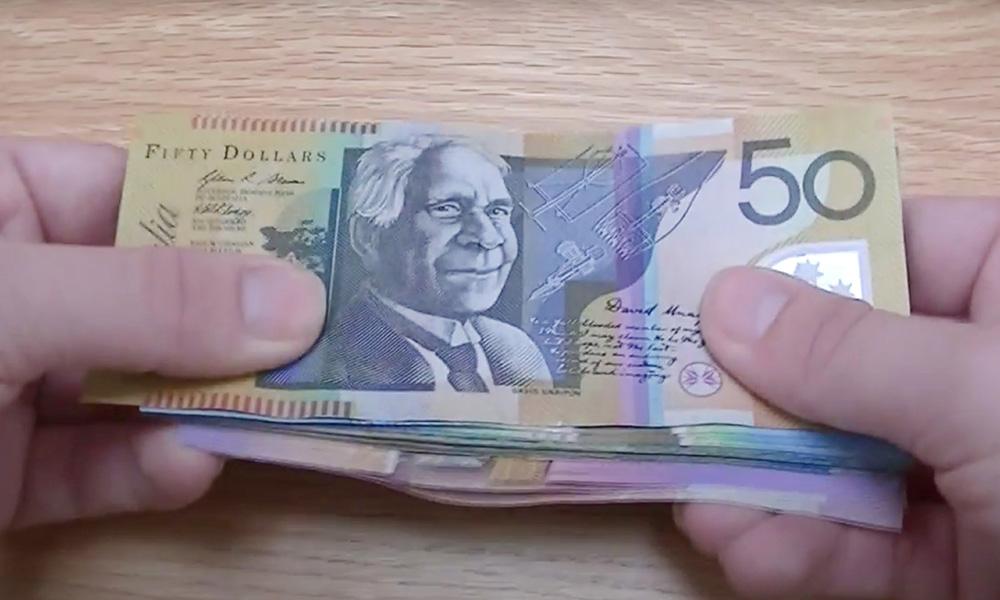
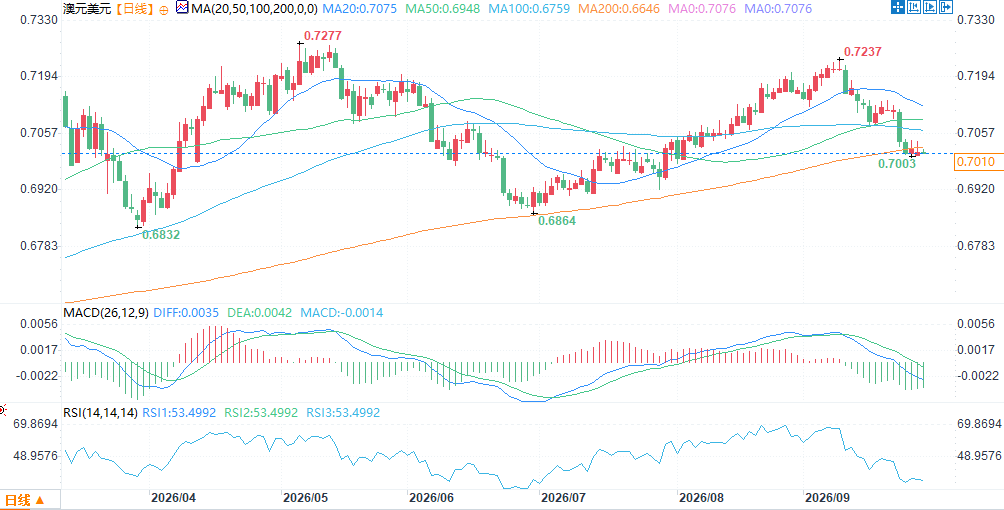 (Australian dollar to US dollar daily chart, source: EasyForex) At 8:12 Beijing time, the Australian dollar to US dollar exchange rate was 0.7010/11.
Interest rate hikes are almost a certainty, with near consensus.
The Reserve Bank of Australia (RBA) is expected to raise the cash rate by 25 basis points to 4.60%, the highest since November 2011 and the fourth rate hike by 2026. A survey showed that all but one of 34 economists expected a rate hike. The four major banks—Commonwealth Bank, Westpac, National Australia Bank, and ANZ—all predict a rate hike in September. Money markets are pricing in a very high probability of a rate hike, estimated at between 80% and 95%. This expectation has strengthened significantly in recent weeks: a month ago, almost all economists expected the RBA to keep the rate unchanged at 4.35%.Sticky core inflation coupled with resilient growth is driving a shift in expectations.
The drivers of this shift in expectations are sticky core inflation and resilient growth. July's cut-off mean inflation remained at 3.6%, well above the Reserve Bank of Australia's (RBA) year-end forecast of around 3.3%, while growth and employment proved more resilient than expected. Senior RBA officials appeared before a parliamentary committee on September 18, and many economists interpreted their comments as confirmation of impending action in September. The Commonwealth Bank moved its forecasts forward from November, citing factors such as higher oil prices; ANZ economists stated that the bank no longer views the surge in energy prices as a temporary phenomenon.The focus is on the statement and the vote; hawkish rhetoric may support the Australian dollar.
The rate hike is almost fully priced in, so the Australian dollar's reaction may depend on the tone of the statement rather than the decision itself. Commonwealth Bank expects a unanimous decision with hawkish rhetoric, while Westpac anticipates a divided vote reflecting differing views on supply capacity and labor market easing. ING expects a hawkish rate hike to support the Australian dollar but marks a near-term risk of a drop below 0.70 against the US dollar, as the dollar is near a two-month high, and the Australian dollar is trading around 0.7010 ahead of the decision. Oil prices are a broader oscillator, as higher energy prices linked to the Middle East conflict directly translate into the RBA's inflation concerns. If the board deems the energy transmission sustainable, a November rate hike will remain priced in; if information is more restrained, the currency may instead rely on interest rate differentials.Most economists see 4.60% as the peak, but a minority expect further rate hikes.
Following today, most economists consider 4.60% to be the peak of the cycle. In a survey of 31 respondents, 26 expected the cash rate to remain at 4.60% at the end of December, with a minority expecting 4.85%. The Commonwealth Bank stated that a quarterly cutoff mean reading of 1% or higher in September could put another rate hike on the agenda; ANZ predicts a second rate hike in November; and the Commonwealth Bank has postponed its expected start date for rate cuts to August 2027. Households have already felt the shift: interest rate tracking data shows that 18 lending institutions raised at least one fixed rate in September, and if the 25 basis point rate hike is fully transmitted, it will increase the monthly payment on a $600,000 loan by approximately $90.Summarize
A 25 basis point rate hike by the Reserve Bank of Australia (RBA) today is almost a certainty, marking the fourth rate hike in 2026. Core inflation stickiness (July cutoff average 3.6%, higher than the year-end forecast of 3.3%) and growth resilience have driven a significant shift in expectations in recent weeks. The focus is on the tone of the statement and the voting divergence: the Commonwealth Bank expects a unanimously hawkish stance, while Westpac expects a divergent one. The Australian dollar's reaction will depend on the statement's tone; ING expects a hawkish rate hike to support the Australian dollar but marks a near-term risk of falling below 0.70 against the US dollar. Oil prices are a key swing factor; if energy transmission is seen as sustainable, a November rate hike will remain priced in. Most economists see 4.60% as the peak, but the Commonwealth Bank and ANZ retain the possibility of further rate hikes. Future attention will be focused on the statement's wording, the voting results, the Bullock press conference, and whether there will be consecutive rate hikes in November. (Australian dollar to US dollar daily chart, source: EasyForex) At 8:12 Beijing time, the Australian dollar to US dollar exchange rate was 0.7010/11.
- Risk Warning and Disclaimer
- The market involves risk, and trading may not be suitable for all investors. This article is for reference only and does not constitute personal investment advice, nor does it take into account certain users’ specific investment objectives, financial situation, or other needs. Any investment decisions made based on this information are at your own risk.