Crude Oil Trading Alert: The prospects for US-Iran negotiations are influencing expectations of a potential reopening of the Strait of Hormuz; US crude oil continues its range-bound trading.
2026-09-29 09:34:15
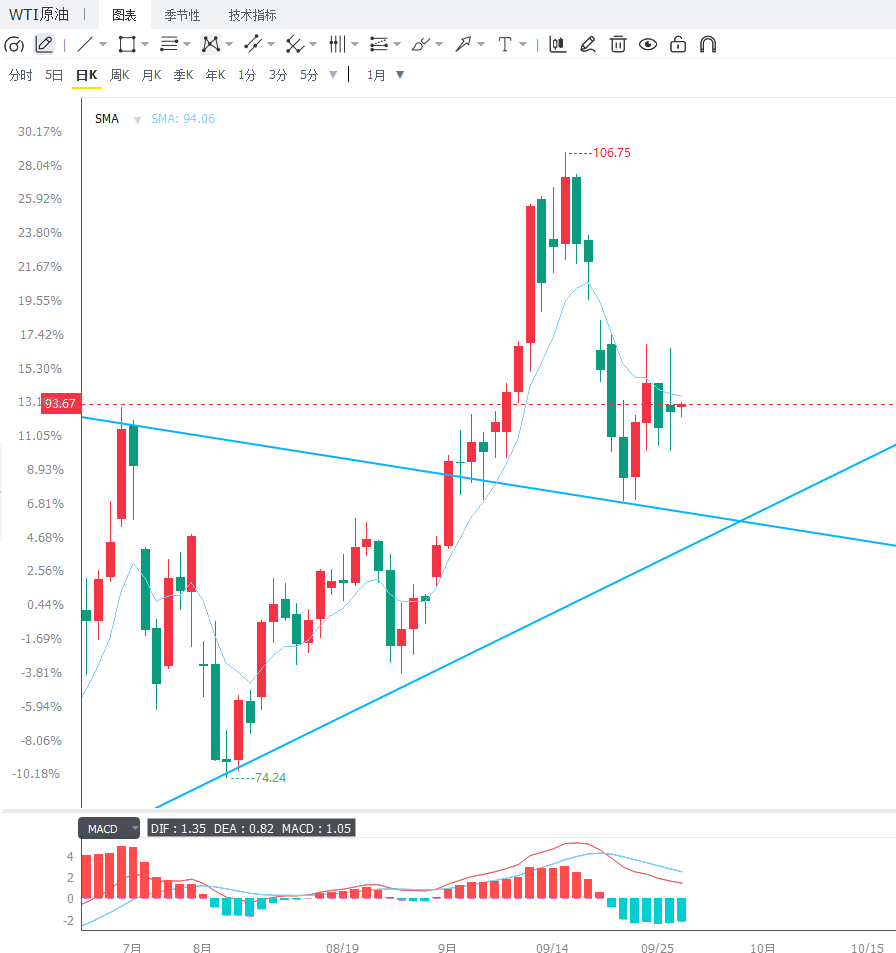
International oil prices remained slightly higher in early Asian trading on Tuesday, with WTI crude trading around $93.60. The market is currently repricing around the status of traffic through the Strait of Hormuz, the prospects for US-Iran negotiations, and the speed of recovery in Middle Eastern oil supplies. Oil prices had previously been pressured by potential diplomatic progress, but the supply risk premium remains as the market has yet to see concrete arrangements to ensure a stable reopening of the Strait of Hormuz.  Discussions surrounding the reopening of the Strait of Hormuz have increased recently. Qatar is reportedly pushing for communication to facilitate further consultations between the US and Iran on strait passage and the regional situation. Iranian Foreign Minister Abbas Araqchi stated that Tehran has discussed relevant proposals with Qatari mediators, and Qatar will subsequently convey the information to the US. Meanwhile, Iran emphasizes that the reopening of the Strait of Hormuz still requires meeting its own set of conditions; therefore, the market is not currently equating progress in negotiations directly with the resolution of supply risks. This is a significant reason for recent fluctuations in oil prices. Previously, the market had bet on a breakthrough through diplomatic channels, leading to a narrowing of WTI gains. However, the lack of clear outcomes in the negotiations has given oil prices renewed support from risk premiums. Currently, the core issue for oil prices is not simply changes in demand, but whether stable passage through the Strait of Hormuz can be restored, and how long the supply disruption will last. If the strait reopens and transportation gradually resumes, the previously accumulated geopolitical risk premium may be quickly reversed; conversely, if negotiations continue to lack progress, the market may still maintain a high valuation of the supply gap. At the same time, Saudi Arabia is alleviating some export pressure by exploring alternative transportation routes. Following attacks on key oil pipelines, Saudi Arabia was forced to adjust some of its crude oil exports. Currently, the flow of oil through the East-West pipeline towards the Red Sea has recovered to at least 3.5 million barrels per day, equivalent to a partial restoration of previously affected transportation capacity. The restoration of alternative transportation routes means some supply pressure has been buffered, which will be an important factor limiting further increases in WTI crude oil prices. If Saudi Arabia's oil transportation capacity continues to recover, and exports from other oil-producing countries gradually normalize, market concerns about actual supply shortages may ease. However, from a global market perspective, the impact of the Strait of Hormuz issue should not be underestimated. This waterway connects the Persian Gulf to the international energy market and is a vital transportation route for Middle Eastern energy exports. If passage remains restricted, the transportation of crude oil, refined oil products, and liquefied natural gas could be affected, thereby pushing up global energy costs and transmitting this to inflation through fuel prices. For major economies, a renewed rise in energy prices could increase pressure on monetary policy to maintain a restrictive stance, while simultaneously increasing the cost risks facing global economic growth. Market sentiment is therefore exhibiting a clear two-way pull. On the one hand, diplomatic communication has created a potential expectation of supply recovery, limiting the potential for a sustained and significant rise in oil prices. On the other hand, negotiations remain highly uncertain, and any news regarding obstruction of passage through the Strait of Hormuz could reignite the risk premium for crude oil. Recent market discussions about oil prices approaching or even higher levels around $100 also indicate that investors are still pricing in supply risks. Until actual supply recovery is confirmed, the market will find it difficult to completely eliminate the risk premium from the Strait of Hormuz. Going forward, it is crucial to observe whether there is a substantial breakthrough in communication between the US and Iran, whether actual ship traffic through the Strait of Hormuz has resumed, and whether Saudi Arabia's alternative oil transport routes can further enhance transportation capacity. Furthermore, changes in US crude oil inventories, refined product inventories, refinery operating rates, and global shipping costs will also determine whether supply risks will ultimately be transmitted to actual prices. From a daily chart perspective, WTI is currently in a relatively strong structure, with prices remaining above the 100-day moving average of $84.89 and also trading above the lower Bollinger Band at $86.55, indicating that the medium-term upward structure has not been broken. The current price is around $93.60, gradually testing the resistance at $94.80. The 14-day RSI is around 52, in the neutral-to-strong zone, with no obvious overbought signal yet, indicating that the bulls still have some momentum, but the upward momentum is not extreme. $94.80 is a key breakout level to watch on the daily chart. If WTI can effectively break above this level, the space for further movement towards the upper Bollinger Band around $100.80 will open up; conversely, if it fails to break through $94.80 multiple times, oil prices may re-enter a period of high-level consolidation. From the 4-hour chart, WTI is still driven by the Middle East situation and negotiation news in the short term, with prices showing some resilience above $90, but there is significant technical resistance around $94.80. If the price breaks through $94.80 with volume and stabilizes, its short-term trend is expected to extend further upward; if it fails to break through, we need to be wary of pullback pressure from increased profit-taking. The first support level to watch is around $92, followed by technical support around $86.55. The 100-day moving average at $84.89 serves as a more significant medium-term trend support level. Overall, technical indicators do not yet show significant overbought conditions, but whether oil prices can open up new upside potential still depends on whether a valid breakout above $94.80 is possible.
  The editor summarizes that WTI crude oil is currently under the dual influence of geopolitical risks and expectations of supply recovery. If the US and Iran make substantial progress in their negotiations, the expectation of the reopening of the Strait of Hormuz could drive a rapid decline in risk premiums; if negotiations continue to lack breakthroughs, concerns about supply disruptions may still provide support for oil prices. Meanwhile, the resumption of Saudi Arabia's alternative oil transport routes will gradually alleviate some supply pressure. In the short term, the area around $92 remains an important observation zone for market sentiment, while $94.80 is a key level for further technical upside potential. Subsequent oil price movements will depend more on the actual recovery of transportation than solely on the negotiation news itself.
Discussions surrounding the reopening of the Strait of Hormuz have increased recently. Qatar is reportedly pushing for communication to facilitate further consultations between the US and Iran on strait passage and the regional situation. Iranian Foreign Minister Abbas Araqchi stated that Tehran has discussed relevant proposals with Qatari mediators, and Qatar will subsequently convey the information to the US. Meanwhile, Iran emphasizes that the reopening of the Strait of Hormuz still requires meeting its own set of conditions; therefore, the market is not currently equating progress in negotiations directly with the resolution of supply risks. This is a significant reason for recent fluctuations in oil prices. Previously, the market had bet on a breakthrough through diplomatic channels, leading to a narrowing of WTI gains. However, the lack of clear outcomes in the negotiations has given oil prices renewed support from risk premiums. Currently, the core issue for oil prices is not simply changes in demand, but whether stable passage through the Strait of Hormuz can be restored, and how long the supply disruption will last. If the strait reopens and transportation gradually resumes, the previously accumulated geopolitical risk premium may be quickly reversed; conversely, if negotiations continue to lack progress, the market may still maintain a high valuation of the supply gap. At the same time, Saudi Arabia is alleviating some export pressure by exploring alternative transportation routes. Following attacks on key oil pipelines, Saudi Arabia was forced to adjust some of its crude oil exports. Currently, the flow of oil through the East-West pipeline towards the Red Sea has recovered to at least 3.5 million barrels per day, equivalent to a partial restoration of previously affected transportation capacity. The restoration of alternative transportation routes means some supply pressure has been buffered, which will be an important factor limiting further increases in WTI crude oil prices. If Saudi Arabia's oil transportation capacity continues to recover, and exports from other oil-producing countries gradually normalize, market concerns about actual supply shortages may ease. However, from a global market perspective, the impact of the Strait of Hormuz issue should not be underestimated. This waterway connects the Persian Gulf to the international energy market and is a vital transportation route for Middle Eastern energy exports. If passage remains restricted, the transportation of crude oil, refined oil products, and liquefied natural gas could be affected, thereby pushing up global energy costs and transmitting this to inflation through fuel prices. For major economies, a renewed rise in energy prices could increase pressure on monetary policy to maintain a restrictive stance, while simultaneously increasing the cost risks facing global economic growth. Market sentiment is therefore exhibiting a clear two-way pull. On the one hand, diplomatic communication has created a potential expectation of supply recovery, limiting the potential for a sustained and significant rise in oil prices. On the other hand, negotiations remain highly uncertain, and any news regarding obstruction of passage through the Strait of Hormuz could reignite the risk premium for crude oil. Recent market discussions about oil prices approaching or even higher levels around $100 also indicate that investors are still pricing in supply risks. Until actual supply recovery is confirmed, the market will find it difficult to completely eliminate the risk premium from the Strait of Hormuz. Going forward, it is crucial to observe whether there is a substantial breakthrough in communication between the US and Iran, whether actual ship traffic through the Strait of Hormuz has resumed, and whether Saudi Arabia's alternative oil transport routes can further enhance transportation capacity. Furthermore, changes in US crude oil inventories, refined product inventories, refinery operating rates, and global shipping costs will also determine whether supply risks will ultimately be transmitted to actual prices. From a daily chart perspective, WTI is currently in a relatively strong structure, with prices remaining above the 100-day moving average of $84.89 and also trading above the lower Bollinger Band at $86.55, indicating that the medium-term upward structure has not been broken. The current price is around $93.60, gradually testing the resistance at $94.80. The 14-day RSI is around 52, in the neutral-to-strong zone, with no obvious overbought signal yet, indicating that the bulls still have some momentum, but the upward momentum is not extreme. $94.80 is a key breakout level to watch on the daily chart. If WTI can effectively break above this level, the space for further movement towards the upper Bollinger Band around $100.80 will open up; conversely, if it fails to break through $94.80 multiple times, oil prices may re-enter a period of high-level consolidation. From the 4-hour chart, WTI is still driven by the Middle East situation and negotiation news in the short term, with prices showing some resilience above $90, but there is significant technical resistance around $94.80. If the price breaks through $94.80 with volume and stabilizes, its short-term trend is expected to extend further upward; if it fails to break through, we need to be wary of pullback pressure from increased profit-taking. The first support level to watch is around $92, followed by technical support around $86.55. The 100-day moving average at $84.89 serves as a more significant medium-term trend support level. Overall, technical indicators do not yet show significant overbought conditions, but whether oil prices can open up new upside potential still depends on whether a valid breakout above $94.80 is possible. The editor summarizes that WTI crude oil is currently under the dual influence of geopolitical risks and expectations of supply recovery. If the US and Iran make substantial progress in their negotiations, the expectation of the reopening of the Strait of Hormuz could drive a rapid decline in risk premiums; if negotiations continue to lack breakthroughs, concerns about supply disruptions may still provide support for oil prices. Meanwhile, the resumption of Saudi Arabia's alternative oil transport routes will gradually alleviate some supply pressure. In the short term, the area around $92 remains an important observation zone for market sentiment, while $94.80 is a key level for further technical upside potential. Subsequent oil price movements will depend more on the actual recovery of transportation than solely on the negotiation news itself.
- Risk Warning and Disclaimer
- The market involves risk, and trading may not be suitable for all investors. This article is for reference only and does not constitute personal investment advice, nor does it take into account certain users’ specific investment objectives, financial situation, or other needs. Any investment decisions made based on this information are at your own risk.