Trump claims the US will soon win the war against Iran; US and Iran separately contact Qatari mediators to restart ceasefire talks; will oil prices plummet?
2026-09-29 09:38:16
US and Iranian officials have recently met separately with mediators, including Qatar, in an attempt to revive efforts to end the conflict, which has lasted for about seven months. The talks focused on a revised version of Iran's seven-day proposal submitted last week. Iranian Foreign Minister Araqchi remains in New York awaiting a US response, while US President Trump has publicly stated that the US will soon achieve victory. 
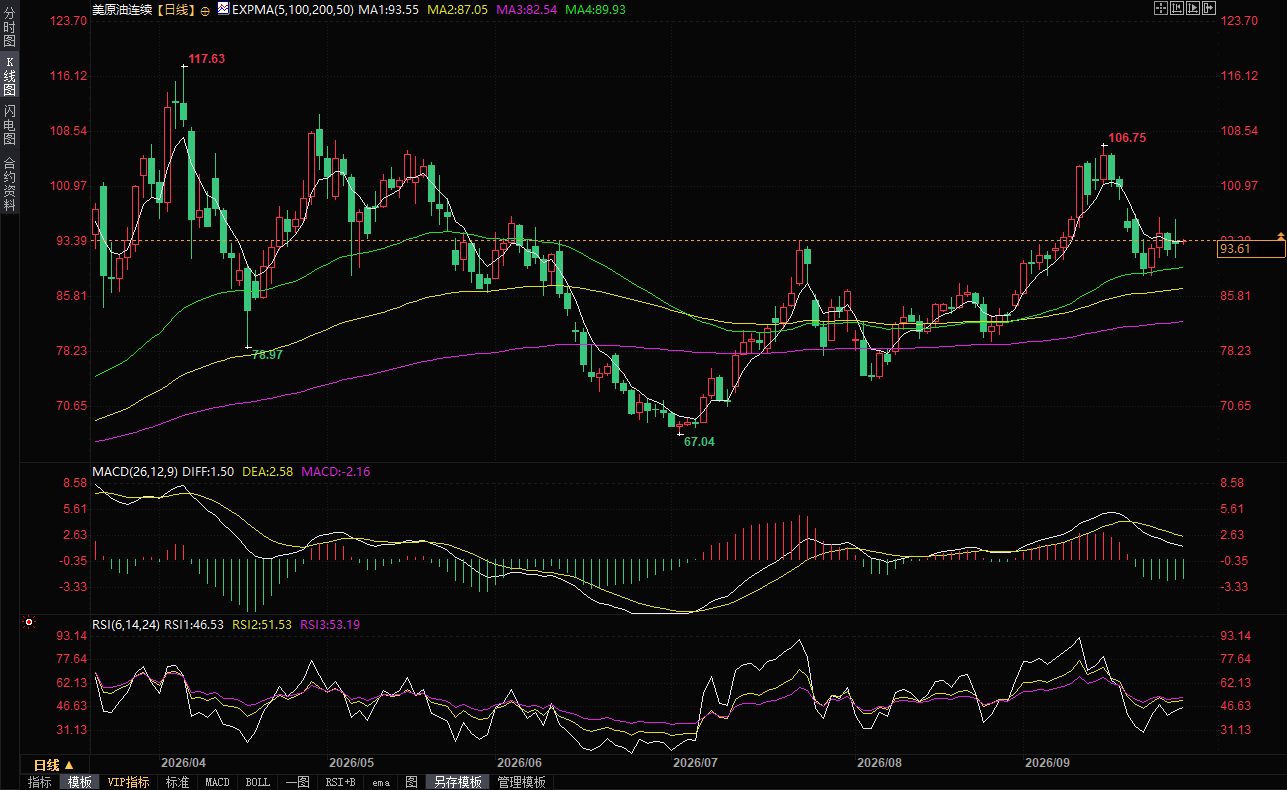 (US crude oil daily chart, source: FX678)
Both parties contacted the mediator separately to focus on the revised version of the seven-day proposal.
According to officials from both countries, U.S. and Iranian officials held separate talks with mediators on Monday (September 28) to resume efforts to end the war. An official familiar with the negotiations indicated that any subsequent talks are expected to focus on a revised version of the seven-day proposal Iran submitted on the sidelines of the UN General Assembly. Following this news, oil prices gave up gains; U.S. crude oil rose more than 4% to $96.554 per barrel during Monday's trading session but fell back to around $93.29 per barrel at the close. On Tuesday (September 29) in Asian trading, U.S. crude oil is currently hovering around $93.59 per barrel. Iranian state news agency reported that Iranian Foreign Minister Araqchi remained in New York after attending the UN General Assembly. He stated that Iran expects a response from the United States regarding its latest ceasefire proposal and the restoration of maritime traffic conditions in the Strait of Hormuz. Araqchi emphasized, "If the U.S. claims to be seeking an agreement or a peaceful solution, then we have already presented a solution." Trump told reporters at the White House that U.S. officials had contacted mediators on Monday but did not provide further details. He also indicated that further talks would be held this week.Core Contents of Iran's Seven-Day Plan and the US Position
Iran's seven-day plan includes ending all hostilities in Iran and Lebanon, unfreezing billions of dollars worth of Iranian overseas assets, ending sanctions on Iranian oil, and lifting the US blockade of Iranian ports. In exchange, Iran would allow the reopening of the Strait of Hormuz, and the two sides would resume negotiations on Iran's nuclear program, including Trump's demand to seize or eliminate Iran's stockpile of highly enriched uranium. Trump said on Saturday (September 26) that he had rejected Iran's proposal, saying that Iran was eager to reach an agreement due to heavy economic pressure. However, he told the media on Sunday that he expected US negotiators to participate in further consultations this week. Trump also told reporters that the US would win the war against Iran "very soon," and that "this war will be over soon." Araghchi said on Sunday that the mediators had not yet formally conveyed the US's rejection of the proposal, and Iran was still waiting for a clear statement from the US before deciding on its next steps. "Our conditions are clear, and any move to reopen the Strait of Hormuz depends on whether these conditions are met," he added, emphasizing that only a negotiated solution could break the deadlock. An official confirmed that the Qatari mediators are expected to hold talks with Iranian Foreign Minister Araqchi and the US side separately in New York on Monday or Tuesday. Iran also stated that it has discussed the proposal to be submitted to the US with the Qatari mediators and looks forward to receiving a final response from Washington through Doha.Background of the conflict and the current stalemate
The conflict has lasted for approximately seven months. As a vital global energy corridor, the safety of passage through the Strait of Hormuz directly impacts the international oil market and shipping. Iran insists on reopening the strait only after the blockade is lifted, hostilities cease, and assets are unfrozen. The US, however, emphasizes that military and economic pressure has already put Iran in a difficult position, while denying that it ever offered to lift sanctions and unfreeze funds in exchange for concessions on the nuclear issue. Trump has repeatedly stated publicly that the US will win and predicts that the end of the conflict will lead to a drop in oil prices. The two sides have been indirectly contacting each other through mediators, indicating that direct negotiation channels are not yet fully established, but technical consultations and discussions on revising proposals are progressing.Editor's Summary
The resumption of contact between the US and Iran through mediators such as Qatar indicates a renewed willingness to end the seven-month conflict. However, core disagreements remain focused on the lifting of sanctions, the unfreezing of assets, passage through the Strait of Hormuz, and the order of nuclear negotiations. Iran insists on meeting its conditions before reopening the strait, while the US emphasizes imminent military victory and rejects the original proposal. Current progress depends on whether the New York talks this week can reach a preliminary consensus on a revised version, and the global energy market and regional security remain uncertain. The ongoing US-Iran conflict continues to disrupt shipping through the Strait of Hormuz, which carries about one-fifth of global oil trade, putting upward pressure on international oil prices. If the two sides resume a ceasefire through mediation and reopen the strait, supply concerns will be significantly alleviated, and oil prices are expected to fall further. Conversely, a breakdown in negotiations or an escalation of the conflict will exacerbate supply risks, push up prices, and amplify market volatility. Trump's statement that the war will end soon and oil prices will fall suggests that the market will remain driven by news in the short term, exhibiting an overall high-level fluctuation pattern. Referring to the market reaction during the brief agreement in June this year, oil prices once fell by more than 9% in a single day and retreated to pre-war levels. According to various institutions, the price may initially fall by $10-15 in the short term (within a few weeks), and in the medium term, as traffic gradually recovers (which will take several months), it is expected to further decline to the $80-90 range, with a cumulative drop of approximately $15-25. The actual magnitude will depend on the sustainability of the ceasefire, the speed of traffic recovery, and global inventory levels; if there are fluctuations, the decline will narrow. (US crude oil daily chart, source: FX678)Frequently Asked Questions
Q: What is the core of the current US-Iran talks? A: The two sides are holding talks in New York and other locations through mediators such as Qatar, focusing on a revised version of Iran's seven-day proposal. This proposal demands that the US first end hostilities, unfreeze assets, lift oil sanctions and port blockades, and then Iran would reopen the Strait of Hormuz and resume nuclear negotiations. Q: What specific steps does Iran's seven-day plan include? A: The plan covers ending hostilities in Iran and Lebanon, unfreezing billions of dollars in overseas assets, ending oil sanctions, and lifting port blockades. In return, Iran would allow the Strait of Hormuz to reopen and initiate nuclear negotiations, including on the issue of highly enriched uranium. Iran claims the US can complete these steps within days, with the strait reopening on the sixth day and broader negotiations starting on the seventh. Q: What is Trump's attitude towards the Iranian proposal and the prospect of war? A: Trump has rejected the original proposal, believing Iran is eager to reach an agreement due to economic pressure. He also stated that US officials have contacted mediators and further consultations are expected this week, repeatedly emphasizing that the US will soon win the war, the conflict will end quickly, and oil prices will subsequently fall. Q: Why has the Strait of Hormuz become a key issue? A: The Strait of Hormuz is a crucial passage for about one-fifth of the world's oil and liquefied natural gas. Iran uses it as a major bargaining chip, insisting that the US must first meet conditions such as lifting the blockade and sanctions before reopening the strait. The conflict has severely disrupted shipping and energy supplies, and any progress will directly affect the stability of the international oil market. Q: Where is the main bottleneck in the negotiations? A: The main disagreement lies in the order of implementation. Iran demands the unfreezing of assets, the lifting of sanctions, and the cessation of hostilities before opening the strait; the US emphasizes that military and economic pressure has put Iran in a weak position and denies any proposal to exchange sanctions and unfreezing for nuclear concessions. The two sides are communicating indirectly through mediators, and direct talks have not yet been confirmed. The outcome of this week's New York contacts will determine the next step. Q: If negotiations break down, how high might oil prices rise? Goldman Sachs warns that if the Strait of Hormuz is closed for another month, the average Brent price in 2026 could exceed $100 per barrel, and there is a risk of reaching $120 in the event of an escalation of the conflict. Bank of America is even more aggressive, believing that if supply tightens further, oil prices could break through $150. However, the Saudi East-West oil pipeline and the UAE Fujairah pipeline can bypass the Strait of Hormuz to transport approximately 2 to 3 million barrels per day, partially alleviating the pressure of supply disruptions. As of 09:33 Beijing time, US crude oil is trading at $93.62 per barrel.- Risk Warning and Disclaimer
- The market involves risk, and trading may not be suitable for all investors. This article is for reference only and does not constitute personal investment advice, nor does it take into account certain users’ specific investment objectives, financial situation, or other needs. Any investment decisions made based on this information are at your own risk.