Institutions predict that gold prices may fall to $4,000 in the short term, but could still reach $5,000 within six months.
2026-09-29 11:18:16
With rising market expectations of interest rate hikes and a continued surge in US Treasury yields, gold prices could potentially fall back to $ 4,000 per ounce next week. However, Aakash Doshi, head of gold strategy at State Street Investment Management, believes that the $4,000 support level is resilient. While the upward path for gold prices has become more difficult, there is still a chance to reach $5,000 per ounce within the next six months. He points out that expectations of Fed tightening and a stronger dollar will put short-term pressure on gold, but there is stable structural buying in the market in the medium to long term. Rising US Treasury term premiums, global fiscal imbalances, strong physical gold demand from major Asian countries, and continued allocation of gold ETFs by Western institutions are multiple underlying forces supporting gold prices, breaking the traditional negative correlation between gold and interest rates.
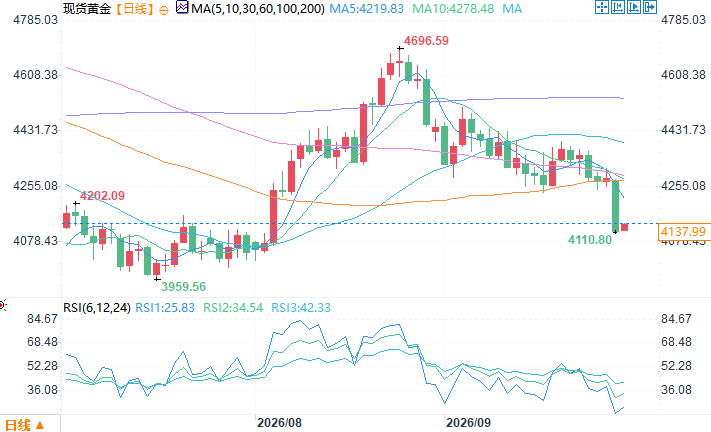 Spot gold daily chart source: FX678. At 11:17 AM Beijing time on September 29th, spot gold was trading at $4135.49 per ounce.
Gold prices may test the $4,000 support level in the short term, facing tactical headwinds.
Akash Doshi stated that the market is repricing towards a more aggressive tightening path by the Federal Reserve, leading to a simultaneous strengthening of the dollar and significant short-term pressure on gold. Since mid-August, the market has priced in two additional rate hikes by the Fed, and long-term interest rate expectations have also undergone significant adjustments. Gold is currently bearing the brunt of the most hawkish expectations in the market, with rising nominal and real yields coupled with a stronger dollar suppressing precious metal prices. The sharp shift in interest rate expectations has made a gold price correction unsurprising. He said, "A few more rate hikes by the Fed would indeed be a short-term negative for gold, as high real yields would make it more difficult for gold to reach $5,000." However, he emphasized that this price correction has not fundamentally changed the long-term structural outlook for gold. Rate hikes can only regulate short-term demand and cannot solve the long-term fiscal problems of the US and major economies. Rising financing costs will amplify the pressure of government debt payments, further exacerbating fiscal imbalances. This is the core reason why gold prices have shown remarkable resilience amidst the drastic adjustments in the global bond market. Doshi cited the example of the US 10-year Treasury yield, which was around 1.5% before the COVID-19 pandemic. Few investors could have predicted that, six and a half years later, the 10-year US Treasury yield would rise to nearly 5.3%, while gold prices would remain around $4,000. This divergence demonstrates that, in addition to traditional interest rate logic, strong structural factors are driving gold price movements.The US Treasury yield spread has risen sharply, with fiscal imbalances becoming the core variable.
State Street's September gold monthly report emphasizes the crucial importance of identifying the causes of rising yields. Influenced by fiscal imbalances, persistent inflationary risks, and geopolitical uncertainties, long-term term premiums in the US, UK, France, and Germany have climbed to their highest levels since 2011. The US public debt surpassed $40 trillion in August, with the recent $1 trillion increase occurring in just about five months. Doshi states that three main factors are driving up term premiums: market concerns about the credibility of policy institutions, persistent inflationary pressures, and the combination of fiscal imbalances and a surge in US Treasury supply. Rising interest rates essentially represent a market repricing of US fiscal sustainability; such risks cannot be resolved by raising interest rates, and gold, as a hedge against fiat currencies, will continue to demonstrate its long-term value.Supported by both physical and investment demand, bullish signals emerge in the derivatives market.
Demand for gold remains robust, with physical and investment buying from major Asian countries continuing to provide support. State Street data shows that in the first seven months of 2026, non-monetary gold imports from major Asian countries reached a record 1,000 tons, a 78% increase compared to the same period last year. Western investors have also continued to increase their gold holdings during the price decline. September gold ETF inflow data shows that institutions are strategically allocating gold to hedge against macroeconomic policy uncertainties and fiat currency risks. Western investment demand had already rebounded significantly in August, with global gold ETFs attracting $17.1 billion that month, and US-listed gold funds seeing inflows of $7.9 billion, marking the strongest monthly inflow since September 2025. The position structure in the options market also favors rising gold prices. According to Doshi, long-term volatility skew remains bullish, and investors are more willing to establish option positions that support rising gold prices. State Street's September report points out that the flow of funds in gold derivatives has shifted from being dominated by put options to being dominated by call options, with the premium of call options relative to put options continuing to rise, reflecting institutional funds' long-term bullish view on gold prices.Conclusion
In summary, short-term expectations of a Fed rate hike and rising US Treasury yields will put pressure on gold, with a possibility of prices testing $4,000/ounce. However, the $4,000 level provides solid support. The US fiscal deficit and high debt repayment pressure continue to push up the term premium of US Treasury bonds. Coupled with strong physical gold imports from major Asian countries and continuous inflows into global gold ETFs, these structural forces will not disappear despite a few rate hikes. Although the path to $5,000 has become more tortuous, the upward logic over a six-month timeframe remains intact. Investors need to closely monitor changes in long-term US Treasury yields, speeches by Fed officials, and global gold ETF fund flows to determine the depth of any pullback and the timing of any rebound. Spot gold daily chart source: FX678. At 11:17 AM Beijing time on September 29th, spot gold was trading at $4135.49 per ounce.
- Risk Warning and Disclaimer
- The market involves risk, and trading may not be suitable for all investors. This article is for reference only and does not constitute personal investment advice, nor does it take into account certain users’ specific investment objectives, financial situation, or other needs. Any investment decisions made based on this information are at your own risk.