US Treasury yields rose to multi-year highs, coupled with a rebound in oil prices, causing gold to accelerate its decline to a new low before fluctuating weakly.
2026-09-29 10:44:13
Spot gold continued to face selling pressure in early Asian trading on Tuesday, with XAU/USD trading around $4,125. The previous trading day, gold prices had fallen by more than 4%, hitting a low of around $4,110, the lowest level since August 5th. The main pressure on the gold market recently stems from the continued rise in US Treasury yields and market expectations that the Federal Reserve will maintain a tight interest rate policy.  The yield on 10-year US Treasury bonds had previously risen to its highest level since June 2007 before retreating. The rapid rise in US Treasury yields directly increased the opportunity cost of holding non-interest-bearing gold, while also enhancing the attractiveness of dollar assets, leading to significant selling pressure on gold in the short term. The simultaneous rise in high yields and high oil prices is forming the most significant dual suppressive factor in the current gold market. Rising energy prices further amplify this impact. Crude oil prices have rebounded after being supported by supply risks and uncertainty in the Middle East, while rising energy costs may be transmitted to overall inflation through transportation, manufacturing, and consumption. When the market is again concerned about persistent inflationary pressures, US interest rates may remain high for a longer period, further pushing up real yields and weakening the attractiveness of gold as an asset allocation. Recent price performance shows that the previous upward momentum of gold has clearly weakened. Commerzbank analysts believe that the simultaneous rise in real and nominal yields is a key factor in the recent pressure on precious metals. As a non-interest-bearing asset, gold is more likely to face pressure from fund reallocation in an environment of continuously rising yields. If US Treasury yields continue to remain high, the short-term rebound in gold may still be significantly limited. Meanwhile, the market is reassessing the outlook for US monetary policy. This week, the US will release the Personal Consumption Expenditures Price Index (PCE) and employment-related data, both of which could be crucial in determining the future path of interest rates. If inflation or employment data is weaker than market expectations, the dollar and US Treasury yields may come under pressure, providing room for a short-term rebound in gold. If the data continues to show economic resilience while inflationary pressures remain high, the market may further reduce its expectations for easing policies. The correlation between oil prices and gold is also worth noting. Rising energy prices can increase demand for inflation-safe havens, theoretically supporting gold; however, if rising oil prices lead to a revaluation of interest rate prospects and push up US Treasury yields, then interest rate factors may temporarily outweigh the support for gold from inflation. Currently, the market exhibits a complex transmission relationship: rising oil prices are bullish for inflation-safe havens, but rising yields are bearish for gold. Market sentiment has therefore changed significantly. After a rapid rise in gold prices, recent pullbacks have made investors more cautious about risk, with short-term funds focusing more on the dollar, US Treasury yields, and changes in US macroeconomic data. Meanwhile, after gold prices quickly fell to around $4100, some oversold trading demand may gradually emerge. However, before the trend is clearly restored, the rebound is more likely to be seen as a technical correction. The key data to watch next includes the US PCE price index, non-farm payrolls, and the immediate reaction of the US dollar index and 10-year US Treasury yield after the data release. If inflation cools, employment weakens, and yields fall, gold is expected to gain upward momentum; if economic data remains strong and further strengthens expectations of high interest rates, gold may continue to test lower support levels. From a daily chart perspective, the XAU/USD short-term structure has clearly weakened. Gold prices are currently trading below the 100-day moving average and the Bollinger Band middle line, and have also broken below the lower Bollinger Band, indicating that bearish pressure still dominates. The 14-day RSI is around 35, approaching oversold territory, indicating a significant recent decline, but no clear trend reversal signal has yet appeared. The first resistance level to watch is the lower Bollinger Band around $4190, followed by the 100-day moving average around $4300 and the Bollinger Band middle line around $4335. Only by regaining a foothold in the $4300-$4335 area can the weakness on the daily chart be significantly alleviated. If the rebound extends further, the upper Bollinger Band near $4480 will pose stronger resistance. Looking at the 4-hour chart, gold is in a weak recovery phase after a rapid decline. While short-term selling pressure may have eased somewhat, the overall trend remains bearish. The area around $4125 is a crucial level to watch. If gold can hold near $4100 and break through $4190 again, a short-term technical rebound is possible; however, if the $4100 level is breached, further downward movement to find support should be anticipated. Since the RSI is approaching oversold territory, a rapid short-term rebound cannot be ruled out, but the upside potential may still be limited until the key technical resistance near $4300 is broken.
 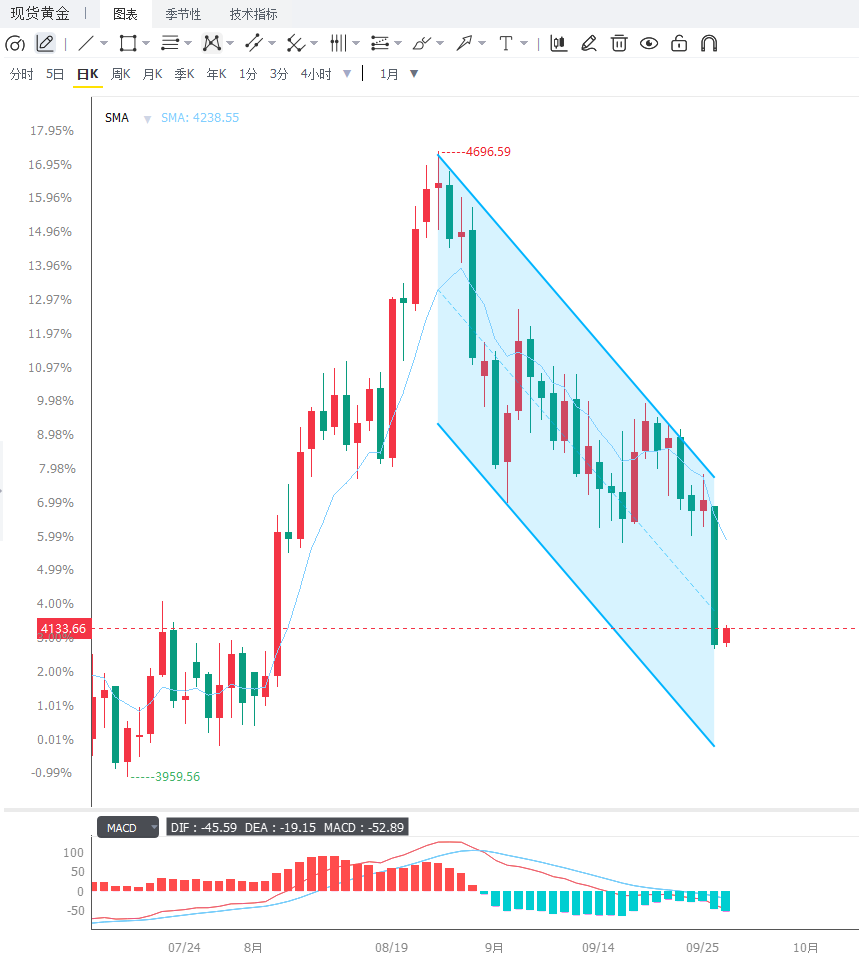 Editor's Summary: The core contradiction facing gold has shifted from simple safe-haven demand to a rebalancing of US Treasury yields, energy prices, and expectations for US monetary policy. Rising oil prices and inflationary concerns may increase market expectations for a high-interest-rate environment, while rising yields will increase the cost of holding gold, thus suppressing short-term price performance. In the short term, $4100 is a key psychological level, while $4190 and $4300 constitute major technical resistance levels. Subsequent US PCE inflation and employment data will be crucial catalysts for whether gold can stabilize. If yields peak and decline, gold may see a recovery; if yields continue to rise, gold prices still need to guard against further downside risks.
The yield on 10-year US Treasury bonds had previously risen to its highest level since June 2007 before retreating. The rapid rise in US Treasury yields directly increased the opportunity cost of holding non-interest-bearing gold, while also enhancing the attractiveness of dollar assets, leading to significant selling pressure on gold in the short term. The simultaneous rise in high yields and high oil prices is forming the most significant dual suppressive factor in the current gold market. Rising energy prices further amplify this impact. Crude oil prices have rebounded after being supported by supply risks and uncertainty in the Middle East, while rising energy costs may be transmitted to overall inflation through transportation, manufacturing, and consumption. When the market is again concerned about persistent inflationary pressures, US interest rates may remain high for a longer period, further pushing up real yields and weakening the attractiveness of gold as an asset allocation. Recent price performance shows that the previous upward momentum of gold has clearly weakened. Commerzbank analysts believe that the simultaneous rise in real and nominal yields is a key factor in the recent pressure on precious metals. As a non-interest-bearing asset, gold is more likely to face pressure from fund reallocation in an environment of continuously rising yields. If US Treasury yields continue to remain high, the short-term rebound in gold may still be significantly limited. Meanwhile, the market is reassessing the outlook for US monetary policy. This week, the US will release the Personal Consumption Expenditures Price Index (PCE) and employment-related data, both of which could be crucial in determining the future path of interest rates. If inflation or employment data is weaker than market expectations, the dollar and US Treasury yields may come under pressure, providing room for a short-term rebound in gold. If the data continues to show economic resilience while inflationary pressures remain high, the market may further reduce its expectations for easing policies. The correlation between oil prices and gold is also worth noting. Rising energy prices can increase demand for inflation-safe havens, theoretically supporting gold; however, if rising oil prices lead to a revaluation of interest rate prospects and push up US Treasury yields, then interest rate factors may temporarily outweigh the support for gold from inflation. Currently, the market exhibits a complex transmission relationship: rising oil prices are bullish for inflation-safe havens, but rising yields are bearish for gold. Market sentiment has therefore changed significantly. After a rapid rise in gold prices, recent pullbacks have made investors more cautious about risk, with short-term funds focusing more on the dollar, US Treasury yields, and changes in US macroeconomic data. Meanwhile, after gold prices quickly fell to around $4100, some oversold trading demand may gradually emerge. However, before the trend is clearly restored, the rebound is more likely to be seen as a technical correction. The key data to watch next includes the US PCE price index, non-farm payrolls, and the immediate reaction of the US dollar index and 10-year US Treasury yield after the data release. If inflation cools, employment weakens, and yields fall, gold is expected to gain upward momentum; if economic data remains strong and further strengthens expectations of high interest rates, gold may continue to test lower support levels. From a daily chart perspective, the XAU/USD short-term structure has clearly weakened. Gold prices are currently trading below the 100-day moving average and the Bollinger Band middle line, and have also broken below the lower Bollinger Band, indicating that bearish pressure still dominates. The 14-day RSI is around 35, approaching oversold territory, indicating a significant recent decline, but no clear trend reversal signal has yet appeared. The first resistance level to watch is the lower Bollinger Band around $4190, followed by the 100-day moving average around $4300 and the Bollinger Band middle line around $4335. Only by regaining a foothold in the $4300-$4335 area can the weakness on the daily chart be significantly alleviated. If the rebound extends further, the upper Bollinger Band near $4480 will pose stronger resistance. Looking at the 4-hour chart, gold is in a weak recovery phase after a rapid decline. While short-term selling pressure may have eased somewhat, the overall trend remains bearish. The area around $4125 is a crucial level to watch. If gold can hold near $4100 and break through $4190 again, a short-term technical rebound is possible; however, if the $4100 level is breached, further downward movement to find support should be anticipated. Since the RSI is approaching oversold territory, a rapid short-term rebound cannot be ruled out, but the upside potential may still be limited until the key technical resistance near $4300 is broken. Editor's Summary: The core contradiction facing gold has shifted from simple safe-haven demand to a rebalancing of US Treasury yields, energy prices, and expectations for US monetary policy. Rising oil prices and inflationary concerns may increase market expectations for a high-interest-rate environment, while rising yields will increase the cost of holding gold, thus suppressing short-term price performance. In the short term, $4100 is a key psychological level, while $4190 and $4300 constitute major technical resistance levels. Subsequent US PCE inflation and employment data will be crucial catalysts for whether gold can stabilize. If yields peak and decline, gold may see a recovery; if yields continue to rise, gold prices still need to guard against further downside risks.
- Risk Warning and Disclaimer
- The market involves risk, and trading may not be suitable for all investors. This article is for reference only and does not constitute personal investment advice, nor does it take into account certain users’ specific investment objectives, financial situation, or other needs. Any investment decisions made based on this information are at your own risk.