Gold Trading Alert: Cooling Inflation Fails to Counteract Energy Storm, Gold Prices Plunge 6.6% in September! Is the Bull Market Completely Over?
2026-10-01 08:04:18
In September, the global gold market did not surge as many investors had expected, riding the wave of the Federal Reserve's policy shift. Instead, it ended the month with a significant decline. Spot gold rebounded but met resistance on Wednesday (September 30) and closed slightly lower, ultimately settling at $4,156.85 per ounce, a cumulative drop of 6.6% for the month. Meanwhile, the continued rise in energy prices, the stalemate in US-Iran negotiations, and the complex interplay of US economic data have collectively shaped gold's current predicament. On the surface, lower-than-expected inflation data should have provided solid support for gold prices, but in reality, rising energy costs overshadowed this positive factor, putting renewed pressure on the precious metal. On Thursday (October 1) in early Asian trading, spot gold traded in a narrow range, currently hovering around $4,155 per ounce. 
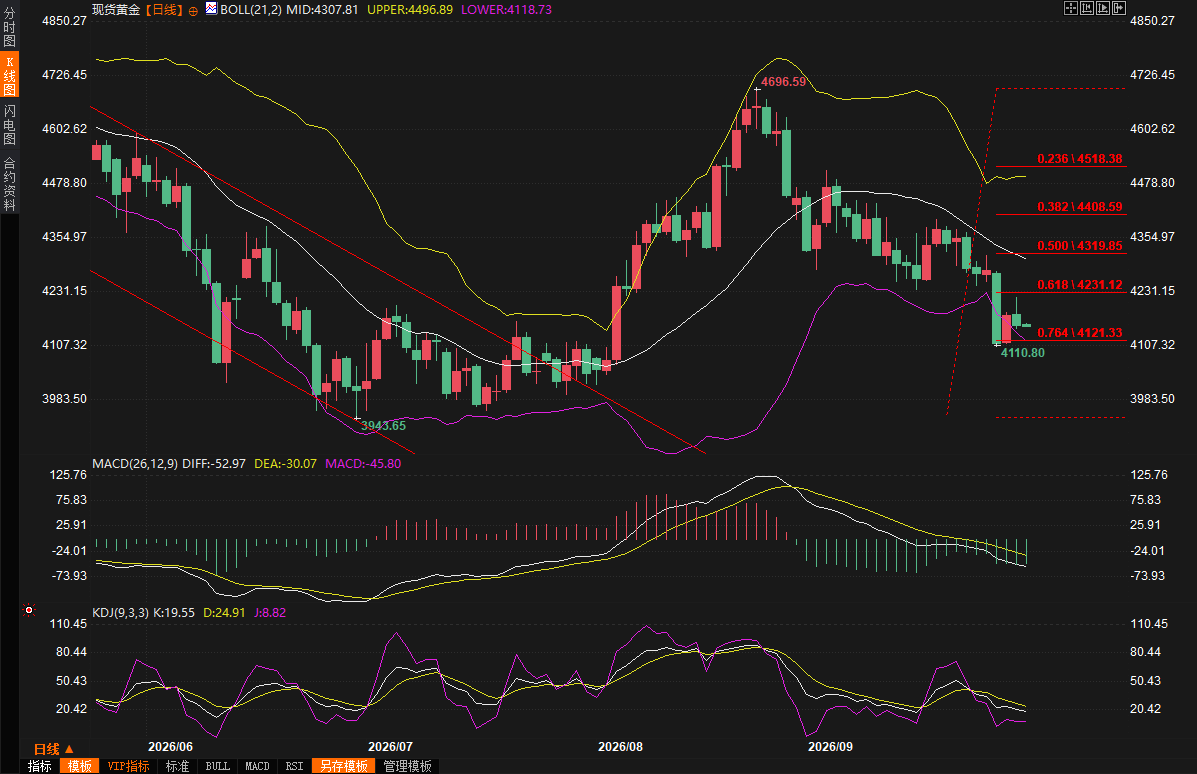 (Spot gold daily chart, source: FX678) At 08:00 Beijing time, spot gold is currently trading at $4154.69 per ounce.
Inflation data has cooled, but it hasn't changed the market's wariness of long-term pressures.
The U.S. Commerce Department's August Personal Consumption Expenditures (PCE) price index, released Wednesday, should have been a shot in the arm for gold. Data showed that the August PCE rose 0.3% month-over-month, lower than the market's previous expectation of 0.4%, while the July figure was revised down to 0.1%. The core PCE year-over-year increase remained at 3.0%, a revision from the previous report. These figures suggest that U.S. inflationary pressures have eased somewhat in the short term, at least not as bad as the market feared. This result directly impacted market expectations regarding the Federal Reserve's policy path. The CME Group's FedWatch tool shows that financial markets now believe the probability of a Fed rate hike in October has fallen to about 38%, far lower than before the data release. New York Fed President Williams had also previously stated publicly that there was no urgency for further action. Logically, a cooling of interest rate expectations should be beneficial for gold—after all, lower interest rates reduce the opportunity cost of holding non-interest-bearing assets and weaken the attractiveness of the dollar. However, gold prices initially surged to a high of $4319.10 per ounce after the data release before quickly retreating, ultimately closing slightly lower. Independent precious metals trader Tai Wong points out that although the likelihood of an October rate hike has significantly decreased after the core PCE fell short of expectations, it was still a disappointing day for gold. The reason is simple: rising energy prices are quietly rewriting the inflation narrative. As oil prices continue to climb due to the stalemate in US-Iran negotiations, the market is beginning to worry that inflation may rise again due to increased energy costs, forcing further tightening of monetary policy. This concern about "inflation stickiness" outweighs the short-term optimism brought by the single month's data. More notably, strong consumer spending has also left the Federal Reserve with room to continue observing or even act again. Consumer spending surged 0.9% in August, and still grew 0.6% after adjusting for inflation, showing that the resilience of the US economy far exceeded expectations. Although the savings rate has declined, the overall financial situation of households has not deteriorated significantly. Against this backdrop, even with the decreased probability of an October rate hike, the possibility of another rate hike before the end of the year still exists. Minneapolis Fed President Kashkari has explicitly stated that inflation remains high and expects one more rate hike this year and one next year. The coexistence of a robust economy and persistent price pressures makes it difficult for gold to simply benefit from "interest rate cut expectations".Energy Storm and Geopolitical Games: The Real Drivers of Pressure on Gold Prices
If inflation data provides superficial support for gold, then energy prices and geopolitics are the deeper forces currently suppressing gold prices. In September, Brent crude oil rose by about 14%, marking its largest monthly increase since July; US crude oil also rose by about 5%. The strength of oil prices stems directly from the back-and-forth negotiations between the US and Iran and the continued tension in the Strait of Hormuz. Iran stated that it had received the US proposal, but President Trump publicly stated that he would soon decide whether to resume strikes or reach an agreement, leaving behind the tough statement that "maybe we'll blow them up." The stalemate in negotiations has fueled market concerns about energy supply, thereby pushing up oil prices and inflation expectations. The rise in energy costs not only directly pushes up overall prices but also indirectly suppresses gold through the Treasury market. US long-term Treasury yields recorded their fastest monthly increase in many years in September, with the 10-year Treasury yield recording its largest quarterly increase since 2009, briefly touching a 17-year high during the session. Although short-term yields fell somewhat after the release of PCE data, the rise in long-term yields reflects the market's repricing of long-term inflation and growth prospects. Rising government bond yields increase the opportunity cost of holding gold, while simultaneously strengthening the relative attractiveness of the US dollar. The dollar index rose about 2% in September, ending two consecutive months of decline, further making dollar-denominated gold more expensive for overseas buyers. Meanwhile, tightening fuel markets are exacerbating overall energy pressures. Data from the US Energy Information Administration shows that gasoline and distillate fuel inventories both declined last week, and the White House even urged the EU to use its emergency diesel reserves to lower global prices. These signals all point to one reality: even if crude oil supplies recover somewhat, shortages of refined products and high freight rates could keep the energy market tight. For gold, this means that inflation expectations are unlikely to fall quickly, and the path of the Federal Reserve's policy shift will become more complex.The correlation between the US dollar and the bond market: Gold's "invisible rival"
The dollar initially retreated after the data release on Wednesday, but recovered its losses and rose slightly by the close, posting a 2% gain for the month. This "bottoming out and rebounding" performance reflects the market's oscillation between cooling inflation and economic resilience. In the short term, the downward revision of interest rate hike expectations has weakened the dollar's yield advantage, but rising long-term yields and concerns about energy inflation have provided renewed support for the dollar. For gold, the strength of the dollar directly constitutes a headwind. The performance of the bond market is also worth noting. The spread between the two-year and 10-year US Treasury yields remains positive, and the steepening curve reflects that market expectations for economic growth have not completely subsided. In this environment, gold's appeal as a safe-haven asset has been partially diluted—investors are more inclined to allocate to interest-bearing assets in a rising interest rate environment rather than zero-yield precious metals. Although geopolitical risks remain, concerns about "stagflation" brought about by rising oil prices have not yet fully translated into large-scale safe-haven demand for gold.Gold at a crossroads: Short-term pressure, but long-term logic remains intact.
In summary, the decline in gold prices in September was not a simple case of "sell the news," but rather the result of a rebalancing of multiple macroeconomic forces. While moderate inflation data did reduce the urgency for an immediate rate hike by the Federal Reserve, persistently high energy prices, strong consumer spending, and rising long-term yields collectively created significant resistance for gold prices. The market is shifting from simply betting on rate cuts to a more complex pricing logic—considering both potential policy shifts and the secondary impacts of persistent inflation and geopolitical risks. Looking ahead, gold remains at a critical crossroads. If there is a substantial breakthrough in US-Iran negotiations and a significant drop in oil prices, inflation expectations are likely to cool further, potentially providing renewed support for gold prices. Conversely, if energy tensions persist and economic data continues to show resilience, the likelihood of further Fed action before the end of the year will increase, and gold may face a longer period of adjustment. The current lower monthly close is more like a calm pricing of complex realities by the market than a complete trend reversal. For investors, patience and a shift in perspective are crucial at this time. The long-term logic behind gold – hedging against currency devaluation, geopolitical uncertainty, and eventual policy easing – has not been overturned by a single month's data. However, given the current interplay between energy storms and economic resilience, short-term volatility is inevitable. (Spot gold daily chart, source: FX678) At 08:00 Beijing time, spot gold is currently trading at $4154.69 per ounce.
- Risk Warning and Disclaimer
- The market involves risk, and trading may not be suitable for all investors. This article is for reference only and does not constitute personal investment advice, nor does it take into account certain users’ specific investment objectives, financial situation, or other needs. Any investment decisions made based on this information are at your own risk.