US Treasury yields hit multi-year highs, while international gold prices fluctuated around $4,150.
2026-10-01 09:20:20
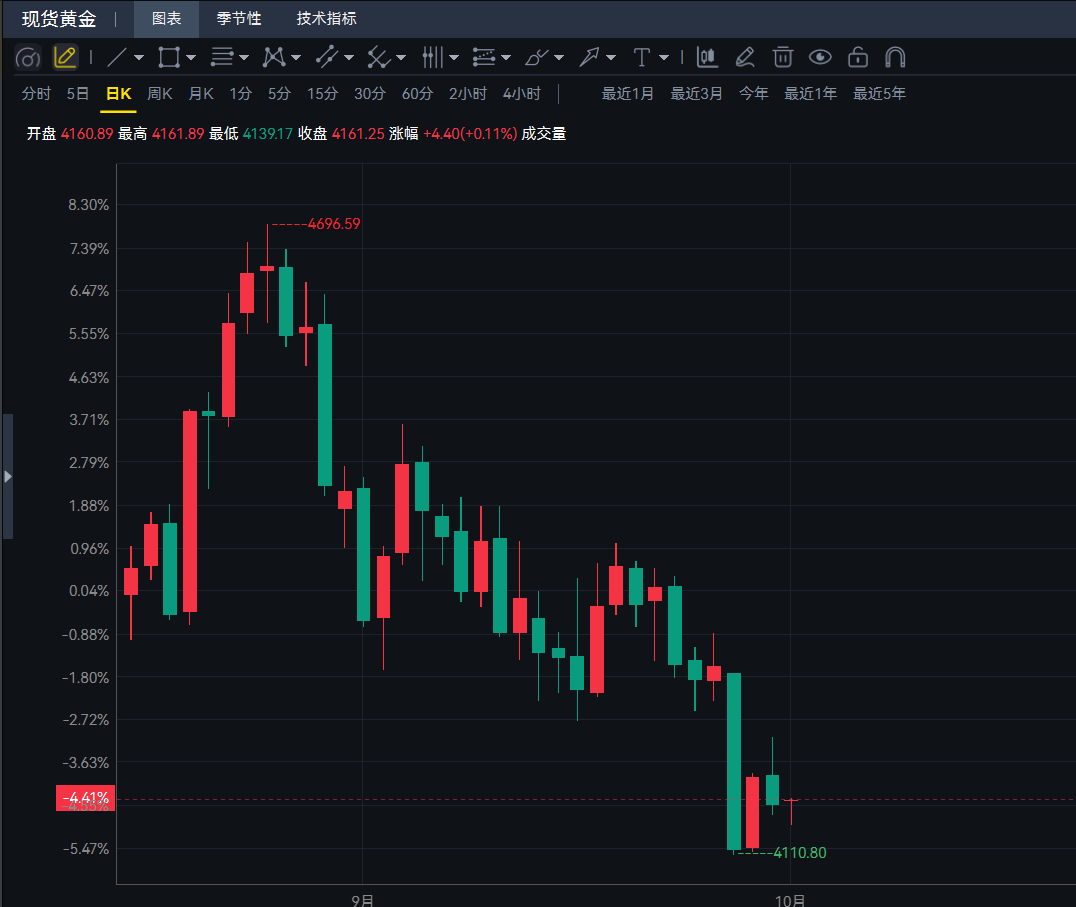
On Thursday during Asian trading hours, international gold prices continued the previous day's decline, falling below the $4,150/ounce mark and hitting a low of $4,140, with the short-term decline widening to a new low in about seven weeks . The previous trading day saw gold prices close down about 0.6%, with gains quickly erasing after a brief boost from inflation data. The continued rise in US Treasury yields is the main source of pressure in this round of declines: the 10-year US Treasury yield has risen above 5.29% , reaching 5.304% at one point during the session, the highest level since 2007; the 30-year US Treasury yield has broken through 5.62% , a nearly 24-year high since June 2002. Meanwhile, due to the stalled negotiations in the Middle East regarding ending military conflict, international oil prices rose again, with Brent crude briefly breaking through $99/barrel , further amplifying market concerns about rising inflation.  Rising energy prices will push up inflation by increasing the cost of economic operations. Although gold is regarded as a safe-haven asset against inflation, in an environment of persistently high interest rates, the opportunity cost of holding this non-interest-bearing asset is rising accordingly, making it difficult for gold prices to find support. Regarding the latest market conditions, an independent metals trader stated: "With rising energy prices and bonds giving back their gains, metals are under renewed pressure; even though the probability of an October rate hike has significantly decreased after core personal consumption expenditure data fell short of expectations, it is still a disappointing day for gold." Behind this statement is data released earlier by the U.S. Bureau of Economic Analysis: the U.S. August PCE price index rose 3.4% year-on-year , lower than the market expectation of 3.7%; the core PCE price index rose 3.0% year-on-year , lower than the market expectation of 3.3%, and also lower than the previous preliminary value. With signs of cooling inflation, traders once lowered their bets on a Fed rate hike in October to about 47%, easing market concerns about policy tightening. However, institutional views suggest that short-term pressure on gold prices has not yet been relieved. OCBC Bank analysts pointed out that gold's "decline has widened, hitting a seven-week low," with rising oil prices "reinforcing inflation concerns and expectations of further tightening by the Federal Reserve," coupled with "rising US Treasury yields and a stronger dollar," and the drop below $4,200 potentially exacerbating technical selling . The institution judges that oil price movements and corresponding interest rate reactions will be key variables affecting gold prices: if US economic data weakens or yields ease, gold is expected to stabilize; if oil prices and yields rise further, downward pressure will continue. The balance of monetary policy expectations is also tilting towards suppressing gold prices. Federal Reserve official Kashkari recently released hawkish signals, with his remarks being more hawkish than historical averages. He publicly questioned whether current monetary policy is truly restrictive , hinted that the neutral interest rate level may be higher, and predicted another rate hike this year and possibly another in 2027 , while emphasizing strong consumer spending and a broadly strengthening labor market. While indicators measuring the Federal Reserve's policy sentiment have declined, they remain significantly above neutral levels. The market continues to price in expectations of "high interest rates persisting for a longer period," further diminishing the attractiveness of gold as a non-interest-bearing asset. Looking ahead, the focus has shifted to the US September jobs report due on Friday . Current market expectations for September non-farm payrolls are between 85,000 and 95,000, with the unemployment rate likely to remain at 4.1%. Previously released September ADP private sector employment figures showed an increase of 90,000, exceeding expectations and indicating continued resilience in the labor market. The market generally believes that if the jobs data weakens significantly and US Treasury yields fall accordingly, gold may find some respite at its current level; conversely, if the jobs data remains resilient, coupled with continued high oil prices and yields, downward pressure on gold prices will be difficult to alleviate in the short term. From a technical perspective, on the daily chart, gold prices are trading below the 100-day and 20-day moving averages (coinciding with the Bollinger Band's middle line) , indicating a clear short-term bearish bias. The price is currently hovering near the lower Bollinger Band, and the RSI indicator is at 38.61 , below the neutral level of 50, reflecting weak buying interest after the recent pullback. Initial resistance is at $4285 near the 100-day moving average, followed by $4315 where the 20-day moving average/Bollinger Band middle line is located, with stronger resistance at $4490 near the upper Bollinger Band. Immediate support is at $4140, where the lower Bollinger Band is located. A decisive break below this level would open up further downside potential, while holding above this level would likely result in a weak, range-bound trading pattern under pressure from the moving average cluster. Looking at the 4-hour chart, the short-term trend remains constrained by a gradually declining high, with technical indicators repeatedly consolidating near oversold territory. The lack of significant volume during rebounds suggests a lack of sustained buying interest in the market. If gold prices can find support around $4,140 and regain their position above the downtrend line, there is a technical correction opportunity to revert to the short-term moving average. Conversely, if the short-term moving average turns downward again and breaks below $4,140, a new round of downward movement may begin.
  Editor's Summary : Overall, gold is under triple pressure from high interest rates, high oil prices, and a strong dollar, clearly exhibiting a weak short-term trend. The previously supportive inflation data has not yet reversed this situation. Federal Reserve officials are still "leaving room" to maintain their tightening stance, coupled with the risk of an inflationary rebound due to rising energy prices, meaning the macroeconomic environment for the gold market has not improved. Looking ahead, whether gold prices can stabilize largely depends on Friday's US September jobs report and the direction of oil prices: weak jobs data and a peak in yields will provide an opportunity for gold to recover from its oversold condition; conversely, strong data reinforcing high interest rate expectations and continued oil price increases could lead to a further drop below $4140 and a test of the $4000 level. Risks and opportunities coexist—downside risks lie in the breach of support levels and an inflationary rebound, while opportunities lie in the correction of expectation gaps after geopolitical disturbances subside and tightening expectations are disproven.
Rising energy prices will push up inflation by increasing the cost of economic operations. Although gold is regarded as a safe-haven asset against inflation, in an environment of persistently high interest rates, the opportunity cost of holding this non-interest-bearing asset is rising accordingly, making it difficult for gold prices to find support. Regarding the latest market conditions, an independent metals trader stated: "With rising energy prices and bonds giving back their gains, metals are under renewed pressure; even though the probability of an October rate hike has significantly decreased after core personal consumption expenditure data fell short of expectations, it is still a disappointing day for gold." Behind this statement is data released earlier by the U.S. Bureau of Economic Analysis: the U.S. August PCE price index rose 3.4% year-on-year , lower than the market expectation of 3.7%; the core PCE price index rose 3.0% year-on-year , lower than the market expectation of 3.3%, and also lower than the previous preliminary value. With signs of cooling inflation, traders once lowered their bets on a Fed rate hike in October to about 47%, easing market concerns about policy tightening. However, institutional views suggest that short-term pressure on gold prices has not yet been relieved. OCBC Bank analysts pointed out that gold's "decline has widened, hitting a seven-week low," with rising oil prices "reinforcing inflation concerns and expectations of further tightening by the Federal Reserve," coupled with "rising US Treasury yields and a stronger dollar," and the drop below $4,200 potentially exacerbating technical selling . The institution judges that oil price movements and corresponding interest rate reactions will be key variables affecting gold prices: if US economic data weakens or yields ease, gold is expected to stabilize; if oil prices and yields rise further, downward pressure will continue. The balance of monetary policy expectations is also tilting towards suppressing gold prices. Federal Reserve official Kashkari recently released hawkish signals, with his remarks being more hawkish than historical averages. He publicly questioned whether current monetary policy is truly restrictive , hinted that the neutral interest rate level may be higher, and predicted another rate hike this year and possibly another in 2027 , while emphasizing strong consumer spending and a broadly strengthening labor market. While indicators measuring the Federal Reserve's policy sentiment have declined, they remain significantly above neutral levels. The market continues to price in expectations of "high interest rates persisting for a longer period," further diminishing the attractiveness of gold as a non-interest-bearing asset. Looking ahead, the focus has shifted to the US September jobs report due on Friday . Current market expectations for September non-farm payrolls are between 85,000 and 95,000, with the unemployment rate likely to remain at 4.1%. Previously released September ADP private sector employment figures showed an increase of 90,000, exceeding expectations and indicating continued resilience in the labor market. The market generally believes that if the jobs data weakens significantly and US Treasury yields fall accordingly, gold may find some respite at its current level; conversely, if the jobs data remains resilient, coupled with continued high oil prices and yields, downward pressure on gold prices will be difficult to alleviate in the short term. From a technical perspective, on the daily chart, gold prices are trading below the 100-day and 20-day moving averages (coinciding with the Bollinger Band's middle line) , indicating a clear short-term bearish bias. The price is currently hovering near the lower Bollinger Band, and the RSI indicator is at 38.61 , below the neutral level of 50, reflecting weak buying interest after the recent pullback. Initial resistance is at $4285 near the 100-day moving average, followed by $4315 where the 20-day moving average/Bollinger Band middle line is located, with stronger resistance at $4490 near the upper Bollinger Band. Immediate support is at $4140, where the lower Bollinger Band is located. A decisive break below this level would open up further downside potential, while holding above this level would likely result in a weak, range-bound trading pattern under pressure from the moving average cluster. Looking at the 4-hour chart, the short-term trend remains constrained by a gradually declining high, with technical indicators repeatedly consolidating near oversold territory. The lack of significant volume during rebounds suggests a lack of sustained buying interest in the market. If gold prices can find support around $4,140 and regain their position above the downtrend line, there is a technical correction opportunity to revert to the short-term moving average. Conversely, if the short-term moving average turns downward again and breaks below $4,140, a new round of downward movement may begin. Editor's Summary : Overall, gold is under triple pressure from high interest rates, high oil prices, and a strong dollar, clearly exhibiting a weak short-term trend. The previously supportive inflation data has not yet reversed this situation. Federal Reserve officials are still "leaving room" to maintain their tightening stance, coupled with the risk of an inflationary rebound due to rising energy prices, meaning the macroeconomic environment for the gold market has not improved. Looking ahead, whether gold prices can stabilize largely depends on Friday's US September jobs report and the direction of oil prices: weak jobs data and a peak in yields will provide an opportunity for gold to recover from its oversold condition; conversely, strong data reinforcing high interest rate expectations and continued oil price increases could lead to a further drop below $4140 and a test of the $4000 level. Risks and opportunities coexist—downside risks lie in the breach of support levels and an inflationary rebound, while opportunities lie in the correction of expectation gaps after geopolitical disturbances subside and tightening expectations are disproven.
- Risk Warning and Disclaimer
- The market involves risk, and trading may not be suitable for all investors. This article is for reference only and does not constitute personal investment advice, nor does it take into account certain users’ specific investment objectives, financial situation, or other needs. Any investment decisions made based on this information are at your own risk.