Crude Oil Trading Alert: Middle East supply recovery coupled with large-scale reserve releases drive US crude oil prices to continue fluctuating at low levels.
2026-10-01 09:34:16
International oil markets continued to be under pressure on Thursday: WTI crude oil traded around $90.10 per barrel in Asian trading , having briefly dipped to around $89.50 during the session; at the close of the previous trading day (Wednesday) in New York, WTI crude oil fell 3.48% to approximately $89.40, a four-week low , while Brent crude oil also fell by about 2.6%. The main reason for the decline in oil prices was that the market was simultaneously weighing two opposing forces: on the one hand, there were clear signs of a recovery in regional oil supply, which reduced the previously high geopolitical risk premium; on the other hand, the US-Iran negotiations remained deadlocked, casting doubt on the "sustainability" of any supply recovery, thus limiting further downside potential for oil prices.  The recovery signals on the supply side are the core driver of this round of decline. Oil traffic through the Strait of Hormuz has rebounded to approximately 13.2 million barrels per day , and regional oil shipments are gradually approaching pre-conflict levels. A key turning point lies with Saudi Arabia: the previously attacked east-west oil pipeline has restored about half its capacity (approximately 3.5 million barrels per day) , reopening a Red Sea export route for Saudi Arabia bypassing the Strait of Hormuz. Yanbu port has also resumed oil loading operations. The restoration of this alternative route directly reduced market panic regarding the Strait's supply disruption, allowing the previously accumulated geopolitical risk premium to clear quickly. However, the decline in oil prices is not without limits. The market remains skeptical about the sustainability of the supply recovery: without a lasting peace agreement, any change in stance by either side could reignite traffic through the Strait; both Tehran and Washington claim full control of this strategic waterway , and the confrontational statements mean that a switch between "restoration" and "reversal" could occur at any time. Therefore, several institutions have warned that if negotiations encounter further changes, oil prices could rebound rapidly. Iranian government spokesman Fatme Mohajrani confirmed that Tehran has received a proposal from the United States to reopen the Strait of Hormuz , which the market interpreted as a positive signal that the two sides are continuing indirect communication channels. Meanwhile, major OPEC+ members, led by Saudi Arabia and Russia, are expected to maintain their November crude oil production quotas at their regular meeting this weekend , continuing the "wait-and-see" stance adopted in October. While the organization has completed its phased withdrawal from the production increase plan in recent months, the conflict in Iran has resulted in actual production falling far below the official quotas, limiting the nominal quotas' guiding significance for the physical market. Another pressure on the supply side comes from reserve releases. On September 29, the U.S. Department of Energy announced that it would release up to 40 million barrels of strategic petroleum reserves to the market through a "swap" mechanism , scheduled for delivery in batches in November and December. This is the final batch of the global reserve release operation coordinated by the International Energy Agency, which began earlier this year—the U.S. had previously pledged to release 172 million barrels of strategic reserves within approximately 120 days. Deutsche Bank analysts pointed out that this additional supply "helped oil prices achieve a considerable rebound during the session," but the overall oil market remained under pressure until the close: Brent crude fell 2.59%, and WTI crude fell even more sharply by 3.48% , accompanied by a widening spread between the two benchmarks, partly due to the expiration of the Brent near-month contract that day. It is worth noting that continuous large-scale releases of reserves have reduced US strategic reserves to approximately 285 million barrels, the lowest level since 1982 (44 years). The continuous depletion of the reserve buffer also raises concerns about future supply elasticity. From a global market perspective, the decline in oil prices from their highs helps alleviate inflationary pressures on various economies and lowers expectations for transportation and production costs, which is a short-term benefit for economies reliant on energy imports. However, the current oil price level is still significantly higher than pre-conflict levels, and the transmission effect of energy costs has not yet been fully released. Major central banks must still consider the risk of a rebound in energy prices when assessing the path of inflation decline. Market sentiment is generally in a state of "cautious recovery": investors welcome the resumption of supply and policy support, but remain wary of the tail risks of repeated negotiations and renewed disturbances in the Taiwan Strait. The focus going forward is on three points: whether the OPEC+ meeting this weekend will truly maintain the quotas, whether the indirect negotiations between the US and Iran regarding the reopening of the Strait will make substantial progress, and next week's US crude oil inventory data . These three factors will jointly determine whether oil prices can hold steady around the $89 mark. From a technical perspective, on the daily chart, WTI crude oil has been consolidating in a four-week low range after breaking below the $90 mark. The price center has shifted significantly downwards compared to the previous period, and the short-term moving average system remains bearish, with the trend structure not yet turning bullish. In terms of market momentum, the rebound after the sharp drop has been limited, and the daily momentum indicators are in a neutral to weak range, indicating insufficient buying interest. Key support lies in the $88.5-$89 area , which coincides with this week's low and a recent area of high trading volume. A break below this level would open up room for a pullback to the $87 level. Initial resistance is seen at $90.5 , with stronger resistance in the $91.5-$92 area. A breakout with significant volume is needed to confirm the continuation of the recovery. Looking at the 4-hour chart, the price is currently in a technical rebound structure after an oversold condition. The fast and slow indicators have recovered from their lows, but the rebound is capped at the $90.5 level. Failure to break through this level could lead to a retest of the $88.5 support. Conversely, if oil prices recover and hold above $90.5 with significant volume, a short-term push towards $91.5 and even $92 is possible. In terms of trading strategy, it is recommended to operate within the $88.5-$90.5 range, following the trend after a breakout in either direction, and closely monitoring the amplifying effect of weekend meetings and negotiation news on volatility.
 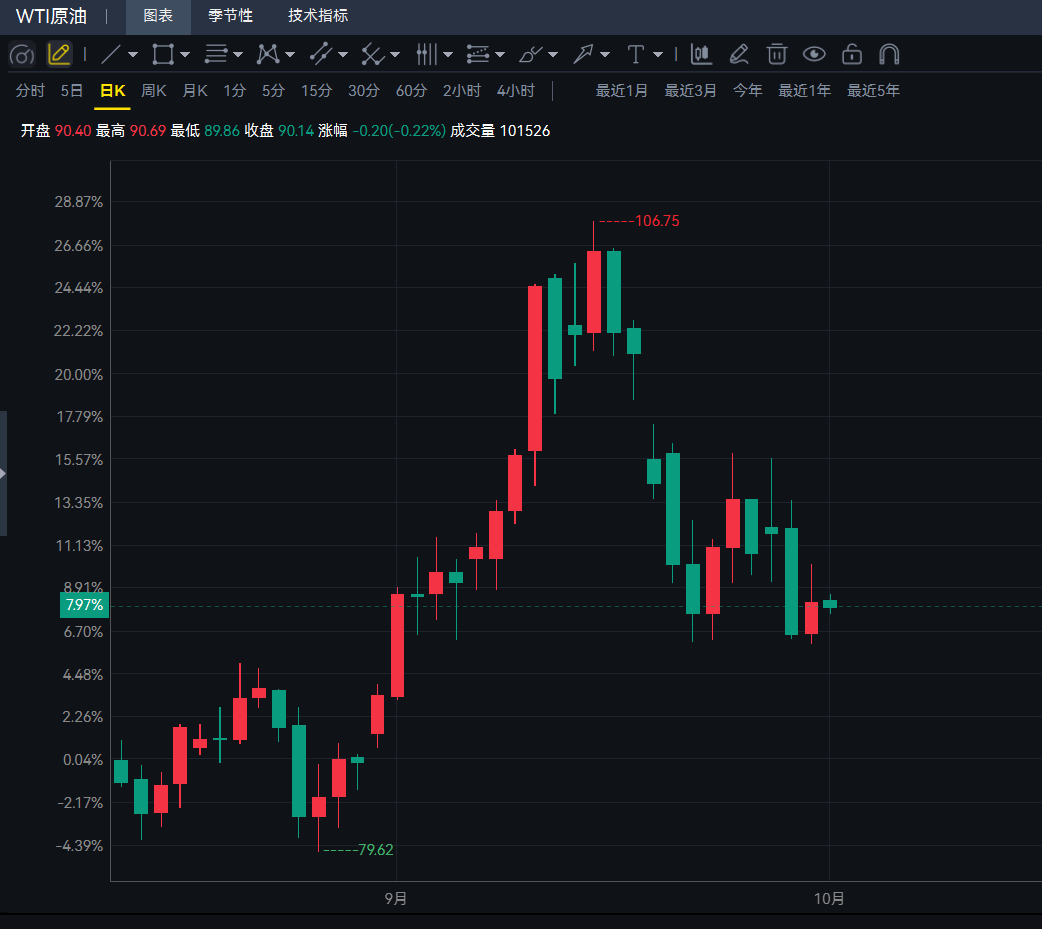 Editor's Summary : Overall, the recent decline in oil prices is a result of the combined effects of "supply recovery" and "policy support": increased traffic in the Strait of Hormuz, the restoration of capacity on Saudi alternative pipelines, and the completion of the US reserve release have significantly cleared geopolitical risk premiums in the short term, causing WTI oil prices to fall from their highs to around $89. However, this balance is quite fragile—the stalemate in US-Iran negotiations remains unresolved, and both sides are making tit-for-tat claims on control of the Strait, making the sustainability of supply recovery the biggest variable; furthermore, US strategic reserves have fallen to a 44-year low, significantly reducing their buffering capacity against future disturbances. Looking ahead, oil prices are likely to fluctuate widely between $88.5 and $92 in the short term, with the direction depending on two signals: if the OPEC+ meeting this weekend unexpectedly adjusts production policies, or if there is a breakthrough in US-Iran negotiations, oil prices will likely test $87 or even lower; conversely, if negotiations stall again or there are setbacks in Strait traffic, oil prices could rebound quickly to above $92. On the risk side, the focus is on the return of risk premiums due to the breakdown of negotiations, while on the opportunity side, there is the pullback market against the backdrop of geopolitical easing and supply recovery.
The recovery signals on the supply side are the core driver of this round of decline. Oil traffic through the Strait of Hormuz has rebounded to approximately 13.2 million barrels per day , and regional oil shipments are gradually approaching pre-conflict levels. A key turning point lies with Saudi Arabia: the previously attacked east-west oil pipeline has restored about half its capacity (approximately 3.5 million barrels per day) , reopening a Red Sea export route for Saudi Arabia bypassing the Strait of Hormuz. Yanbu port has also resumed oil loading operations. The restoration of this alternative route directly reduced market panic regarding the Strait's supply disruption, allowing the previously accumulated geopolitical risk premium to clear quickly. However, the decline in oil prices is not without limits. The market remains skeptical about the sustainability of the supply recovery: without a lasting peace agreement, any change in stance by either side could reignite traffic through the Strait; both Tehran and Washington claim full control of this strategic waterway , and the confrontational statements mean that a switch between "restoration" and "reversal" could occur at any time. Therefore, several institutions have warned that if negotiations encounter further changes, oil prices could rebound rapidly. Iranian government spokesman Fatme Mohajrani confirmed that Tehran has received a proposal from the United States to reopen the Strait of Hormuz , which the market interpreted as a positive signal that the two sides are continuing indirect communication channels. Meanwhile, major OPEC+ members, led by Saudi Arabia and Russia, are expected to maintain their November crude oil production quotas at their regular meeting this weekend , continuing the "wait-and-see" stance adopted in October. While the organization has completed its phased withdrawal from the production increase plan in recent months, the conflict in Iran has resulted in actual production falling far below the official quotas, limiting the nominal quotas' guiding significance for the physical market. Another pressure on the supply side comes from reserve releases. On September 29, the U.S. Department of Energy announced that it would release up to 40 million barrels of strategic petroleum reserves to the market through a "swap" mechanism , scheduled for delivery in batches in November and December. This is the final batch of the global reserve release operation coordinated by the International Energy Agency, which began earlier this year—the U.S. had previously pledged to release 172 million barrels of strategic reserves within approximately 120 days. Deutsche Bank analysts pointed out that this additional supply "helped oil prices achieve a considerable rebound during the session," but the overall oil market remained under pressure until the close: Brent crude fell 2.59%, and WTI crude fell even more sharply by 3.48% , accompanied by a widening spread between the two benchmarks, partly due to the expiration of the Brent near-month contract that day. It is worth noting that continuous large-scale releases of reserves have reduced US strategic reserves to approximately 285 million barrels, the lowest level since 1982 (44 years). The continuous depletion of the reserve buffer also raises concerns about future supply elasticity. From a global market perspective, the decline in oil prices from their highs helps alleviate inflationary pressures on various economies and lowers expectations for transportation and production costs, which is a short-term benefit for economies reliant on energy imports. However, the current oil price level is still significantly higher than pre-conflict levels, and the transmission effect of energy costs has not yet been fully released. Major central banks must still consider the risk of a rebound in energy prices when assessing the path of inflation decline. Market sentiment is generally in a state of "cautious recovery": investors welcome the resumption of supply and policy support, but remain wary of the tail risks of repeated negotiations and renewed disturbances in the Taiwan Strait. The focus going forward is on three points: whether the OPEC+ meeting this weekend will truly maintain the quotas, whether the indirect negotiations between the US and Iran regarding the reopening of the Strait will make substantial progress, and next week's US crude oil inventory data . These three factors will jointly determine whether oil prices can hold steady around the $89 mark. From a technical perspective, on the daily chart, WTI crude oil has been consolidating in a four-week low range after breaking below the $90 mark. The price center has shifted significantly downwards compared to the previous period, and the short-term moving average system remains bearish, with the trend structure not yet turning bullish. In terms of market momentum, the rebound after the sharp drop has been limited, and the daily momentum indicators are in a neutral to weak range, indicating insufficient buying interest. Key support lies in the $88.5-$89 area , which coincides with this week's low and a recent area of high trading volume. A break below this level would open up room for a pullback to the $87 level. Initial resistance is seen at $90.5 , with stronger resistance in the $91.5-$92 area. A breakout with significant volume is needed to confirm the continuation of the recovery. Looking at the 4-hour chart, the price is currently in a technical rebound structure after an oversold condition. The fast and slow indicators have recovered from their lows, but the rebound is capped at the $90.5 level. Failure to break through this level could lead to a retest of the $88.5 support. Conversely, if oil prices recover and hold above $90.5 with significant volume, a short-term push towards $91.5 and even $92 is possible. In terms of trading strategy, it is recommended to operate within the $88.5-$90.5 range, following the trend after a breakout in either direction, and closely monitoring the amplifying effect of weekend meetings and negotiation news on volatility. Editor's Summary : Overall, the recent decline in oil prices is a result of the combined effects of "supply recovery" and "policy support": increased traffic in the Strait of Hormuz, the restoration of capacity on Saudi alternative pipelines, and the completion of the US reserve release have significantly cleared geopolitical risk premiums in the short term, causing WTI oil prices to fall from their highs to around $89. However, this balance is quite fragile—the stalemate in US-Iran negotiations remains unresolved, and both sides are making tit-for-tat claims on control of the Strait, making the sustainability of supply recovery the biggest variable; furthermore, US strategic reserves have fallen to a 44-year low, significantly reducing their buffering capacity against future disturbances. Looking ahead, oil prices are likely to fluctuate widely between $88.5 and $92 in the short term, with the direction depending on two signals: if the OPEC+ meeting this weekend unexpectedly adjusts production policies, or if there is a breakthrough in US-Iran negotiations, oil prices will likely test $87 or even lower; conversely, if negotiations stall again or there are setbacks in Strait traffic, oil prices could rebound quickly to above $92. On the risk side, the focus is on the return of risk premiums due to the breakdown of negotiations, while on the opportunity side, there is the pullback market against the backdrop of geopolitical easing and supply recovery.
- Risk Warning and Disclaimer
- The market involves risk, and trading may not be suitable for all investors. This article is for reference only and does not constitute personal investment advice, nor does it take into account certain users’ specific investment objectives, financial situation, or other needs. Any investment decisions made based on this information are at your own risk.