Analysis of the Bank of Japan's September Meeting Summary: Policy Phase Shift, Interest Rate Hike Divergence, and Upside Risks to Inflation
2026-10-01 08:42:17
Despite a hawkish tone in the latest summary of the Bank of Japan's meeting, the yen failed to gain a boost. On Thursday (October 1st) during Asian trading hours, the USD/JPY pair rose slightly by about 0.2%, currently trading around 157.70. The summary of the Bank of Japan's meeting from September 17th to 18th showed that policymakers believe monetary policy is entering a new phase—the importance of preventing inflation from overshooting has become equal to pushing up prices. Some members indicated that if prices show signs of deviating upwards from the 2% target, the central bank may need to accelerate the pace of interest rate hikes; one member believed that the policy rate should approach its approximate target level relatively quickly. The meeting raised the policy rate by 25 basis points to 1.25% by a 7-2 vote. Overall, the forward-looking comments were hawkish, tending to support the yen and push up Japanese government bond yields. 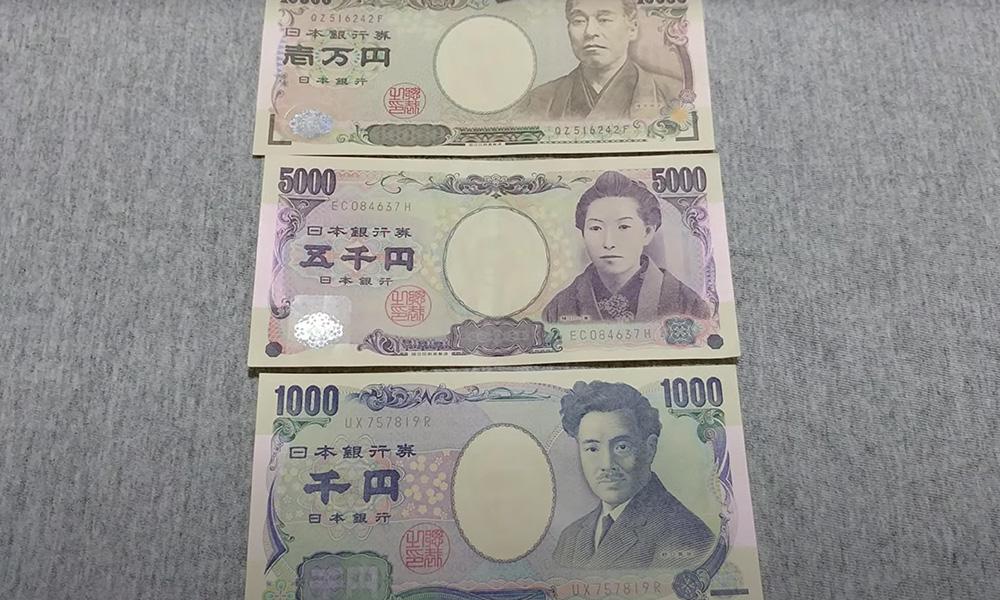
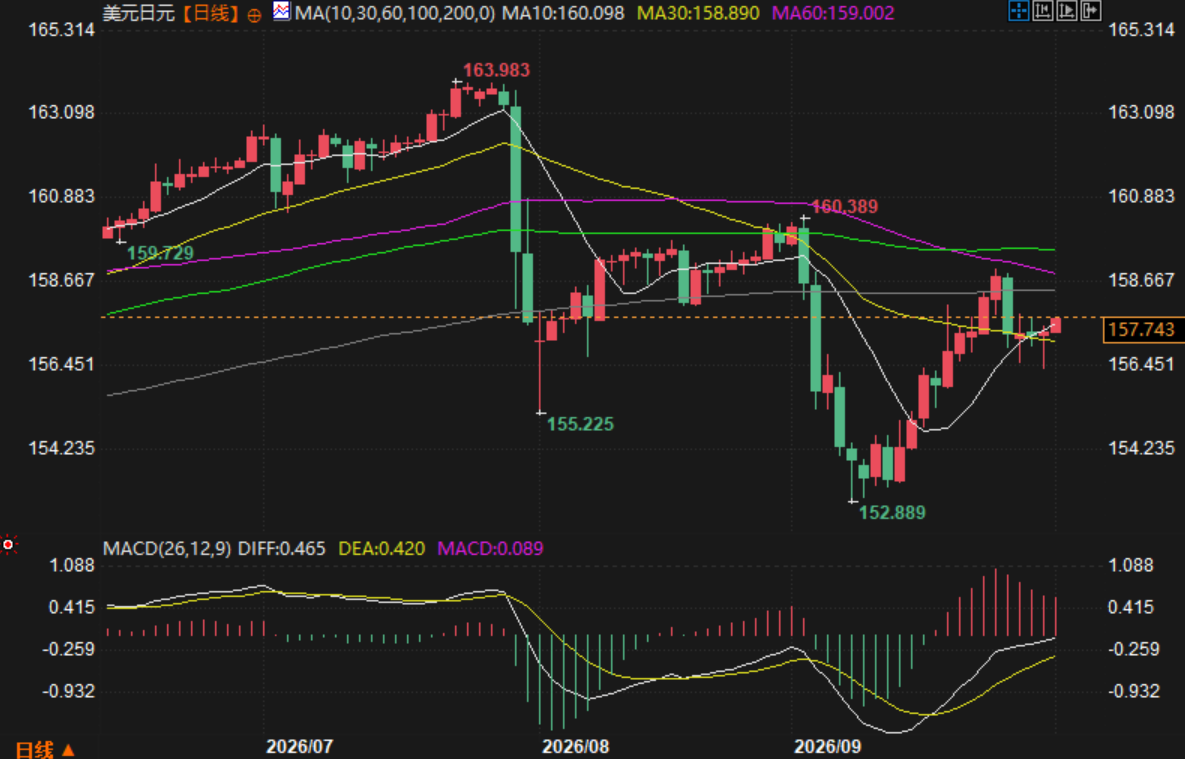 (USD/JPY daily chart, source: FX678) At 8:40 Beijing time, USD/JPY was trading at 157.86/87.
Policy shift: From pushing up inflation to stabilizing it around 2%
The committee members believed that monetary policy was undergoing a phase of transformation. One member explicitly pointed out that the central bank's task had shifted from "pushing up inflation" to "stabilizing inflation around 2%." The central bank should demonstrate its willingness to respond flexibly to overseas conditions and prices, while weighing the impact of exchange rate fluctuations. This statement signifies a shift in the policy framework's focus—previously, the Bank of Japan had long been committed to escaping deflation and pushing inflation upwards; now, the focus has shifted to preventing inflation from deviating excessively from the target. Governor Kazuo Ueda also emphasized at the post-meeting press conference that the situation had changed, with underlying inflation gradually approaching 2%, and the policy focus shifting to stabilization rather than simply pushing it up. If upside risks further emerge, policy needs to be adjusted promptly to avoid a forced and significant tightening later. This shift reflects the reality of Japan's economic transition from a deflationary era to a normalized inflationary environment, and also requires the market to reassess the pace and endpoint of interest rate normalization. The committee members generally agreed that flexibly responding to overseas shocks and exchange rate fluctuations is the core principle of policy operations in this new phase, helping to achieve price stability while minimizing the negative impact on the real economy.Interest rate hike path: Some committee members favor faster hikes, while the majority support further tightening.
On the path of interest rate hikes, committee members held differing opinions but were generally hawkish. Some members indicated that if prices show signs of upward deviation, the central bank may need to accelerate the pace of rate hikes. One member believed that the policy rate should approach its approximate target level relatively quickly to allow room for two-way adjustments. Another member pointed out that this rate hike was the first in three months, with a shorter interval than before, because the economy had proven more resilient. Most opinions supported this rate hike, citing reasons including the economy being largely on track, the situation in the Middle East, AI demand, and exchange rates as factors to watch, as well as still-accommodative financial conditions. However, two members favored keeping rates unchanged, arguing that overall CPI remained below 2% and the economy had not shown significant strength. Looking ahead, members believed further rate hikes were appropriate, but some argued against hasty action. This divergence shows that the policy committee is still weighing the sustainability of inflation against the resilience of the economy, and the pace of future rate hikes will be highly dependent on data developments; the market should be wary of the possibility of consecutive or larger adjustments.Economic assessment: Moderate recovery but with weaknesses.
On the economic front, the committee described it as a "moderate recovery with weaknesses," partly related to the situation in the Middle East, and expected moderate growth to continue, supported by government measures and global AI-related demand. One committee member attributed the weak domestic demand in the April-June GDP figures to technological factors, such as the processing of overseas patent sales and free school lunches. Another committee member stated that the breakdown of data showed a contraction in domestic demand, while positive external demand was merely due to reduced imports caused by supply constraints in the Middle East, therefore the economy could not be described as robust. Overall, the committee members acknowledged the recovery tone but emphasized the need to pay attention to the potential drag on the sustainability of growth from insufficient domestic demand and external uncertainties. Government fiscal support and AI-related investment were seen as important buffers to help offset the negative impacts of geopolitical shocks. This assessment provides flexibility for subsequent policy: if weaknesses persist, the pace of interest rate hikes may become more cautious; if resilience is further confirmed, the tightening pace is expected to accelerate. The market needs to closely monitor the divergent performance of domestic consumption, investment, and external demand.Inflation assessment: Underlying inflation is close to 2%, but upside risks remain high.
Regarding prices, the committee judged that underlying inflation was close to or largely at 2%, and projected it to reach a level consistent with the target between the second half of fiscal year 2026 and fiscal year 2027. Some committee members cautioned about the mixed indicators, with one noting that two core indicators had remained between 1.5% and 2.0%, partly due to government measures. Rising distribution costs are expected to help companies pass on these costs. Concerns about a severe impact from the Middle East conflict have not materialized, partly thanks to oil reserves and alternative supplies, but upside price risks remain high, and crude oil prices are likely to remain high. The committee members paid particular attention to crude oil and import prices, meaning that crude oil remains a key swing factor in Japan's inflation outlook—higher energy costs will exacerbate the upside price risks noted by the committee members.Neutral interest rate and government concerns
The committee members stated that the neutral interest rate could deviate upwards due to overseas developments and should be assessed after each rate hike, rather than assumed in advance. This assessment echoes recent comments by Federal Reserve official Kashkari—that the neutral interest rate might be higher than previously assumed, implying that the current policy constraints may be weaker than apparent. The government has also expressed concerns. The Ministry of Finance wants the central bank to carefully explain its intentions to the market, while the Cabinet Office has requested the central bank to review the cumulative effects of past rate hikes. This government request constitutes a check and balance, a variable that traders need to pay attention to.Summarize
The core signal from the Bank of Japan's September meeting summary is that the policy phase has shifted, with preventing inflation overshooting becoming an equally important task as pushing up prices. Some members were open to accelerating interest rate hikes, with one member believing that rates should approach the approximate target level relatively quickly, resulting in an overall hawkish tone. However, two members favored maintaining the current interest rate, and the government's requirement to review the cumulative effects of rate hikes provided some checks and balances. Crude oil and the yen were explicitly identified as key swing risks—higher energy costs would exacerbate upside price risks, while exchange rate fluctuations could affect the inflation path. The next policy meeting will be held on October 29-30, and the full minutes of the September meeting will be released on November 5. Until then, market pricing will revolve around inflation and wage data, the yen exchange rate, and crude oil price movements. (USD/JPY daily chart, source: FX678) At 8:40 Beijing time, USD/JPY was trading at 157.86/87.
- Risk Warning and Disclaimer
- The market involves risk, and trading may not be suitable for all investors. This article is for reference only and does not constitute personal investment advice, nor does it take into account certain users’ specific investment objectives, financial situation, or other needs. Any investment decisions made based on this information are at your own risk.