EUR/USD Analysis: The Euro is caught in a double whammy of French sovereign risk and soaring US Treasury yields.
2026-10-01 19:24:16
The euro has broken out of its trading range. Rising political risks in France have left the European Central Bank helpless. The US economy's ability to withstand high interest rates is strengthening the dollar. Driven by strong macroeconomic data, rising bond yields, and a rebound in oil prices, the dollar has reached an 18-month high.  The revised annualized GDP growth rate for the second quarter in the US was revised upward from 1.6% to 2.2%, indicating that the US economy is growing faster than Europe and has the capacity to withstand higher interest rates. Personal consumption expenditures (PCE) rose 0.9% month-on-month in August, exceeding market expectations; although the core price index remained at 3.0% year-on-year, the market quickly realized that current policy rates are still far above the 2% inflation target. Notably, despite yesterday's slightly weaker-than-expected core PCE data and the market lowering its expectation of a Fed rate hike in October to below 40%, US Treasury yields still rose against the trend. Boosted by the GDP data, the 10-year Treasury yield reached its highest point since 2002. Meanwhile, cooling risk sentiment in European markets triggered safe-haven inflows, further strengthening the safe-haven demand for the US dollar. Market attention has now turned to Friday's non-farm payroll report—if the employment data is strong, US Treasury yields may rise further, thus putting greater downward pressure on the euro against the dollar. High Oil Prices: A Complex Variable of Inflation and Tightening Expectations Goldman Sachs predicts that Middle Eastern oil exports (including those through grey market channels) have reached 23.3 million barrels per day, exceeding the 2025 forecast. The bank believes that the failure of Brent crude prices to fall is mainly due to a significant decline in global oil inventories and the continued rise in the risk of escalating conflict. If oil prices remain high, it will further exacerbate core inflationary pressures. The higher the likelihood of central banks adopting aggressive monetary tightening policies, the stronger the momentum for further dollar strengthening—this transmission chain is particularly clear in the current environment. Euro Breaks Trading Range: France's Dual Fiscal and Political Crisis The euro/dollar pair has broken out of its long-term trading range, falling below 1.13, its lowest level since May 2025, and reaching a 15-month low. Even better-than-expected Eurozone manufacturing PMI data failed to reverse the euro's decline. French fiscal risk is the core factor weighing on the euro. On Thursday, the yield on French 10-year OAT bonds surged to 4.9%, a new high since June 2002. The French government plans a €54 billion fiscal consolidation package, aiming to reduce the fiscal deficit to 5% of GDP by 2027. However, market confidence is severely lacking: against the backdrop of a global bond sell-off, the yield spread between French and German bonds has widened to 127-130 basis points, reaching its highest level since the European debt crisis; France's debt burden is expected to exceed 120% of GDP next year; and the market is concerned that France's budget deficit ratio may rise from 5.1% of GDP to 5.6% by 2026, rather than converging towards the target. The political deadlock has further exacerbated market panic. Given the French government's insistence on austerity measures, and the unwillingness of both right-wing and left-wing parties in parliament to cooperate, conflict between the executive and legislative branches is almost inevitable. Coupled with the political uncertainty ahead of the April elections next year, investors are fleeing French assets, leading to a continued sell-off of local bonds and putting significant pressure on the euro against the dollar. The European Central Bank's Dilemma The European Central Bank (ECB) is currently facing a near-unsolvable policy dilemma. On the one hand, inflationary pressures should prompt the central bank to raise interest rates; on the other hand, raising rates would directly push up bond yields in peripheral European economies, further exacerbating debt financing problems in countries like France. Christine Lagarde, former French Finance Minister, head of the International Monetary Fund during the European debt crisis, and long-time ECB President, is acutely aware of this danger—according to ECB Governing Council officials, there are currently no clear signs of a wage-price "second-order effect," providing the central bank with a reason to remain inactive. In this situation, rising inflation is actually detrimental to the euro: rising prices weaken the currency's purchasing power, while the central bank can only stand by for the time being. It may take several quarters for the euro's weakness to revitalize the regional economy by improving the competitiveness of European exports. A "Hedge" for Eurozone Fundamentals: Improved Manufacturing PMI It is worth noting that the aforementioned concerns have temporarily overshadowed the positive signals in the Eurozone's fundamentals. Driven by resilient demand and increased new orders, Eurozone manufacturing activity accelerated again in September, reaching its fastest growth rate in over four years. The manufacturing PMI rose for the third consecutive month, from 52.7 in August to 52.9 in September. However, this positive data failed to provide effective support for the euro, as it was caught between rising French sovereign risks and soaring US Treasury yields. Technical Analysis : The euro has now fallen to a 15-month low against the dollar, and the overall technical picture is bearish.
 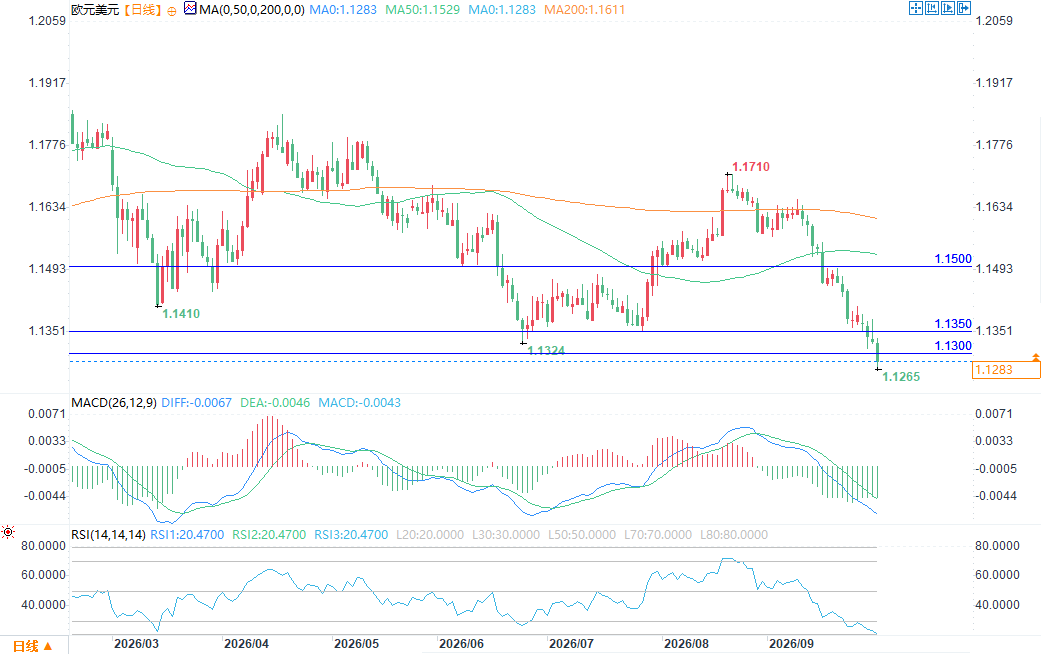 (EUR/USD Daily Chart Source: FX678) The exchange rate is trading below the downtrend line and below both the 50-day and 200-day exponential moving averages (EMAs). After breaking below the 1.1350 support zone, the price has retreated towards the 1.1300 level. The Relative Strength Index (RSI) is in deep oversold territory, suggesting a potential period of consolidation or a technical rebound. Key Levels: Bullish Resistance: A retest of the 1.1350 resistance zone is needed before targeting 1.1500 – this level coincides with both the 50-day EMA and a horizontal resistance level. Bearish Target: A break below 1.1300 would open up downside potential, targeting 1.1200, a level last seen in early 2025. Summary Strong US economic resilience and high oil prices provide solid support for the US dollar, while inflationary pressures, debt risks, and political instability in France continue to weigh on the euro. The euro has broken out of its long-term trading range, with the European Central Bank caught between fighting inflation and stabilizing debt, while the political deadlock ahead of the French election is unlikely to be resolved in the short term. Friday's US non-farm payroll report will be the next key catalyst—if the data confirms the strength of the US economy, the euro could fall further against the dollar to test the 1.1200 level.
The revised annualized GDP growth rate for the second quarter in the US was revised upward from 1.6% to 2.2%, indicating that the US economy is growing faster than Europe and has the capacity to withstand higher interest rates. Personal consumption expenditures (PCE) rose 0.9% month-on-month in August, exceeding market expectations; although the core price index remained at 3.0% year-on-year, the market quickly realized that current policy rates are still far above the 2% inflation target. Notably, despite yesterday's slightly weaker-than-expected core PCE data and the market lowering its expectation of a Fed rate hike in October to below 40%, US Treasury yields still rose against the trend. Boosted by the GDP data, the 10-year Treasury yield reached its highest point since 2002. Meanwhile, cooling risk sentiment in European markets triggered safe-haven inflows, further strengthening the safe-haven demand for the US dollar. Market attention has now turned to Friday's non-farm payroll report—if the employment data is strong, US Treasury yields may rise further, thus putting greater downward pressure on the euro against the dollar. High Oil Prices: A Complex Variable of Inflation and Tightening Expectations Goldman Sachs predicts that Middle Eastern oil exports (including those through grey market channels) have reached 23.3 million barrels per day, exceeding the 2025 forecast. The bank believes that the failure of Brent crude prices to fall is mainly due to a significant decline in global oil inventories and the continued rise in the risk of escalating conflict. If oil prices remain high, it will further exacerbate core inflationary pressures. The higher the likelihood of central banks adopting aggressive monetary tightening policies, the stronger the momentum for further dollar strengthening—this transmission chain is particularly clear in the current environment. Euro Breaks Trading Range: France's Dual Fiscal and Political Crisis The euro/dollar pair has broken out of its long-term trading range, falling below 1.13, its lowest level since May 2025, and reaching a 15-month low. Even better-than-expected Eurozone manufacturing PMI data failed to reverse the euro's decline. French fiscal risk is the core factor weighing on the euro. On Thursday, the yield on French 10-year OAT bonds surged to 4.9%, a new high since June 2002. The French government plans a €54 billion fiscal consolidation package, aiming to reduce the fiscal deficit to 5% of GDP by 2027. However, market confidence is severely lacking: against the backdrop of a global bond sell-off, the yield spread between French and German bonds has widened to 127-130 basis points, reaching its highest level since the European debt crisis; France's debt burden is expected to exceed 120% of GDP next year; and the market is concerned that France's budget deficit ratio may rise from 5.1% of GDP to 5.6% by 2026, rather than converging towards the target. The political deadlock has further exacerbated market panic. Given the French government's insistence on austerity measures, and the unwillingness of both right-wing and left-wing parties in parliament to cooperate, conflict between the executive and legislative branches is almost inevitable. Coupled with the political uncertainty ahead of the April elections next year, investors are fleeing French assets, leading to a continued sell-off of local bonds and putting significant pressure on the euro against the dollar. The European Central Bank's Dilemma The European Central Bank (ECB) is currently facing a near-unsolvable policy dilemma. On the one hand, inflationary pressures should prompt the central bank to raise interest rates; on the other hand, raising rates would directly push up bond yields in peripheral European economies, further exacerbating debt financing problems in countries like France. Christine Lagarde, former French Finance Minister, head of the International Monetary Fund during the European debt crisis, and long-time ECB President, is acutely aware of this danger—according to ECB Governing Council officials, there are currently no clear signs of a wage-price "second-order effect," providing the central bank with a reason to remain inactive. In this situation, rising inflation is actually detrimental to the euro: rising prices weaken the currency's purchasing power, while the central bank can only stand by for the time being. It may take several quarters for the euro's weakness to revitalize the regional economy by improving the competitiveness of European exports. A "Hedge" for Eurozone Fundamentals: Improved Manufacturing PMI It is worth noting that the aforementioned concerns have temporarily overshadowed the positive signals in the Eurozone's fundamentals. Driven by resilient demand and increased new orders, Eurozone manufacturing activity accelerated again in September, reaching its fastest growth rate in over four years. The manufacturing PMI rose for the third consecutive month, from 52.7 in August to 52.9 in September. However, this positive data failed to provide effective support for the euro, as it was caught between rising French sovereign risks and soaring US Treasury yields. Technical Analysis : The euro has now fallen to a 15-month low against the dollar, and the overall technical picture is bearish. (EUR/USD Daily Chart Source: FX678) The exchange rate is trading below the downtrend line and below both the 50-day and 200-day exponential moving averages (EMAs). After breaking below the 1.1350 support zone, the price has retreated towards the 1.1300 level. The Relative Strength Index (RSI) is in deep oversold territory, suggesting a potential period of consolidation or a technical rebound. Key Levels: Bullish Resistance: A retest of the 1.1350 resistance zone is needed before targeting 1.1500 – this level coincides with both the 50-day EMA and a horizontal resistance level. Bearish Target: A break below 1.1300 would open up downside potential, targeting 1.1200, a level last seen in early 2025. Summary Strong US economic resilience and high oil prices provide solid support for the US dollar, while inflationary pressures, debt risks, and political instability in France continue to weigh on the euro. The euro has broken out of its long-term trading range, with the European Central Bank caught between fighting inflation and stabilizing debt, while the political deadlock ahead of the French election is unlikely to be resolved in the short term. Friday's US non-farm payroll report will be the next key catalyst—if the data confirms the strength of the US economy, the euro could fall further against the dollar to test the 1.1200 level.
- Risk Warning and Disclaimer
- The market involves risk, and trading may not be suitable for all investors. This article is for reference only and does not constitute personal investment advice, nor does it take into account certain users’ specific investment objectives, financial situation, or other needs. Any investment decisions made based on this information are at your own risk.