Monetary policy transformation: from focusing on interest rates to focusing on market environment
2026-10-01 18:44:17
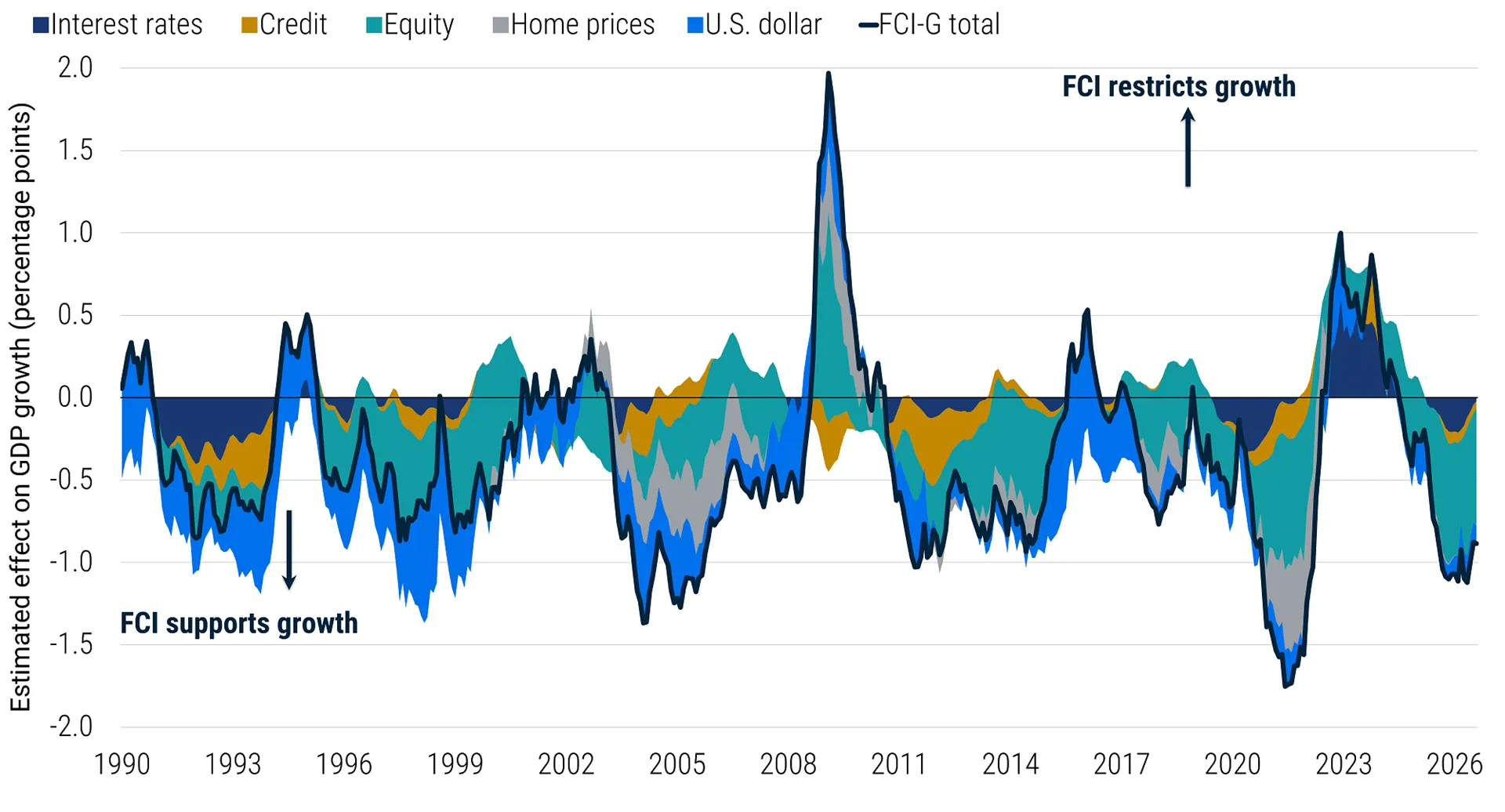
In recent months, major central banks have increasingly emphasized broad financial conditions when explaining their monetary policy stances. Federal Reserve Chairman Kevin Warsh characterized the Fed's September rate hike as "withdrawing some accommodative measures to better align financial and credit conditions with the Fed's policy objectives." European Central Bank President Christine Lagarde, in interpreting the ECB's September decision, cited "financial and monetary conditions" as a core assessment criterion. At the recent G20 summit, Bank of Japan Governor Kazuo Ueda directly linked the policy rate path to financial conditions, stating that the Bank of Japan would continue to raise rates as long as financial conditions remain accommodative. Reserve Bank of Australia Governor Michelle Bullock also stated this week that the RBA must ensure financial conditions tighten sufficiently to suppress inflation.  For investors, this shift in the central bank's focus raises several key questions: How should financial conditions be measured? Are current financial conditions stimulating or suppressing economic growth? What does this mean for subsequent monetary policy? Let's answer the last question first: The wealth effect and consumption boost from the stock market performance have resulted in financial conditions being more relaxed than ideal. However, since June, rising interest rates on US Treasury bonds, mortgages, and corporate bonds will offset the positive impact of the stock market on the economy. More importantly, the tightening of financial conditions needed to quickly bring inflation back to the target range is far less than that of 2022. How will monetary policy be transmitted to the market ? Over the past decade, the Federal Reserve has often compared short-term policy rates with the equilibrium neutral rate (r*, r-star) to determine its policy stance. The neutral rate represents the interest rate at which the economy fully realizes its potential output and inflation stabilizes at the Fed's 2% target level. However, the neutral rate cannot be directly observed, and its estimation results are highly uncertain, making it difficult to use as a real-time policy indicator. The short-term interest rates controlled by the Fed are only one aspect of financial conditions. The transmission logic of monetary policy is essentially how changes in short-term interest rates affect a whole set of asset prices. The Federal Reserve understood this transmission mechanism early on. After the pandemic, the wealth effect of stock and housing prices on consumption became a key focus of policy discussion. During the global financial crisis and the COVID-19 pandemic, credit spreads received significant attention, with policymakers focusing on the financial accelerator mechanism—a sharp drop in asset prices would further amplify downward economic pressure. Now, central banks are repeatedly emphasizing broad financial conditions, simply putting this logic explicitly on the table in monetary policy decisions. To aggregate the impact of various assets, researchers have developed the Financial Conditions Index (FCI): a weighted index combining interest rates and various asset prices, with weights representing the magnitude of each indicator's impact on the economy. But how should these weights be set? The Financial Conditions Growth Shock Index (FCI-G), developed by Federal Reserve economists, is one of the mainstream solutions. This index selects seven financial variables, assigning weights according to their impact on GDP growth. The seven indicators are: the federal funds rate, the 10-year Treasury yield, the 30-year fixed mortgage rate, the BBB-rated corporate bond yield, stock prices, housing prices, and the broad dollar index. Key distinction: The FCI-G measures the impact of changes in financial conditions on subsequent GDP growth, not whether financial conditions are absolutely loose or tight. A positive index indicates a drag on economic growth; a reading of +1 means that financial conditions are expected to drag down GDP growth by 1 percentage point in the coming year. A negative index indicates a positive impact on economic growth. The latest FCI-G reading for Q2 2026 is -0.9. This means that changes in financial conditions over the past few years, as of the end of Q2, are expected to boost US GDP growth by 0.9 percentage points in the coming year. This contrasts sharply with 2022–2023, when aggressive interest rate hikes tightened financial conditions, dragging down GDP by approximately 0.5–1 percentage point. Our breakdown of the FCI-G (Figure 1) shows that the US stock market was the primary driver of US economic growth over the past year. Figure 1: Federal Reserve FCI-G Index, Current Financial Conditions Supporting the Economy (Data as of Q2 2026)
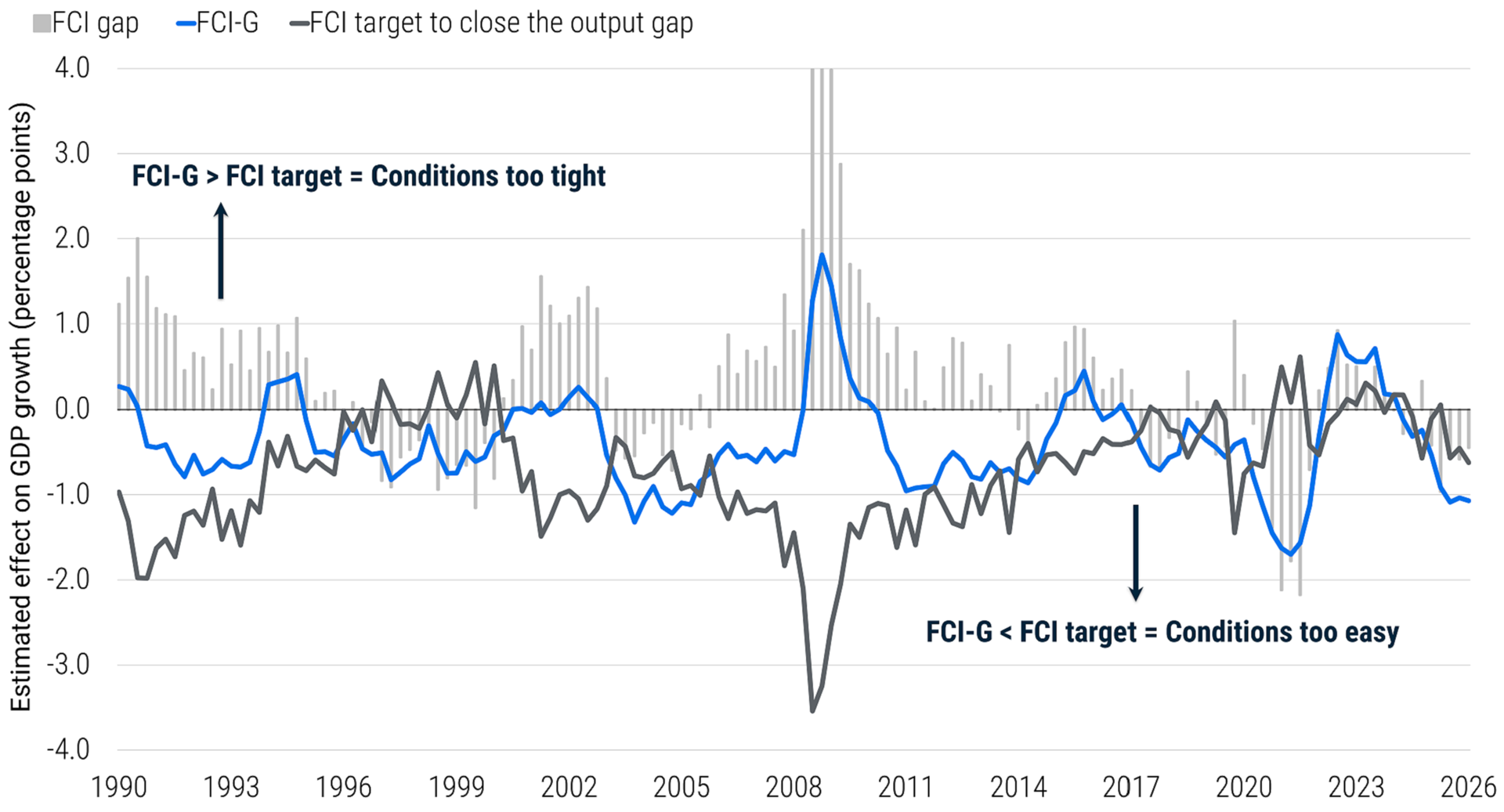
  Data Source: Federal Reserve, Bloomberg, Q2 2026 FCI Target: Theory and Reality Federal Reserve Chairman Warsh's September speech sent a signal: the Fed does not want the market to have already priced in interest rate hikes, but the central bank fails to implement them, passively creating looser financial conditions—which would reignite inflationary pressures. This leads to the core question: to what extent should financial conditions tighten/loosen to bring inflation back to the 2% target? The FCI-G alone cannot answer this question. The FCI-G only shows the impact of financial conditions on growth; it cannot tell us the ideal level of financial conditions when the economy is operating at its potential growth rate. To find this ideal level, a target value for financial conditions that dynamically changes with fundamentals is needed. The approach to constructing a target FCI is to calculate what asset price changes are needed to eliminate the output gap. Estimating the output gap itself is very difficult: the US labor market generally believes that full employment has been achieved; however, if investment and wealth effects are considered simultaneously, estimates show that current US total output is 1-1.5 percentage points higher than potential capacity. Substituting this output gap into the Phillips curve (where the output gap translates into inflationary pressure), the corresponding inflationary pressure is only about 0.1-0.3 percentage points, a relatively small magnitude. The economy's production capacity continues to expand, while adjustments in household consumption lag behind. Under normal circumstances, we need a certain degree of loose financial conditions to ensure that demand growth matches supply growth. Conversely, if a permanent supply shock occurs, financial conditions need to be tightened to balance supply and demand. Artificial intelligence is a new variable: on the one hand, AI brings an investment boom, representing a positive demand shock; on the other hand, it improves production efficiency, representing a positive supply shock, increasing the difficulty of policy judgment. Economists from MIT and Yale University recently proposed a method to estimate the target FCI needed to close the output gap. Applying this model, as of the end of the second quarter, actual financial conditions were slightly looser than the theoretical ideal level (Figure 2). Figure 2: Current FCI-G vs. Target FCI-G Required to Close the Output Gap (Data as of Q2 2026)
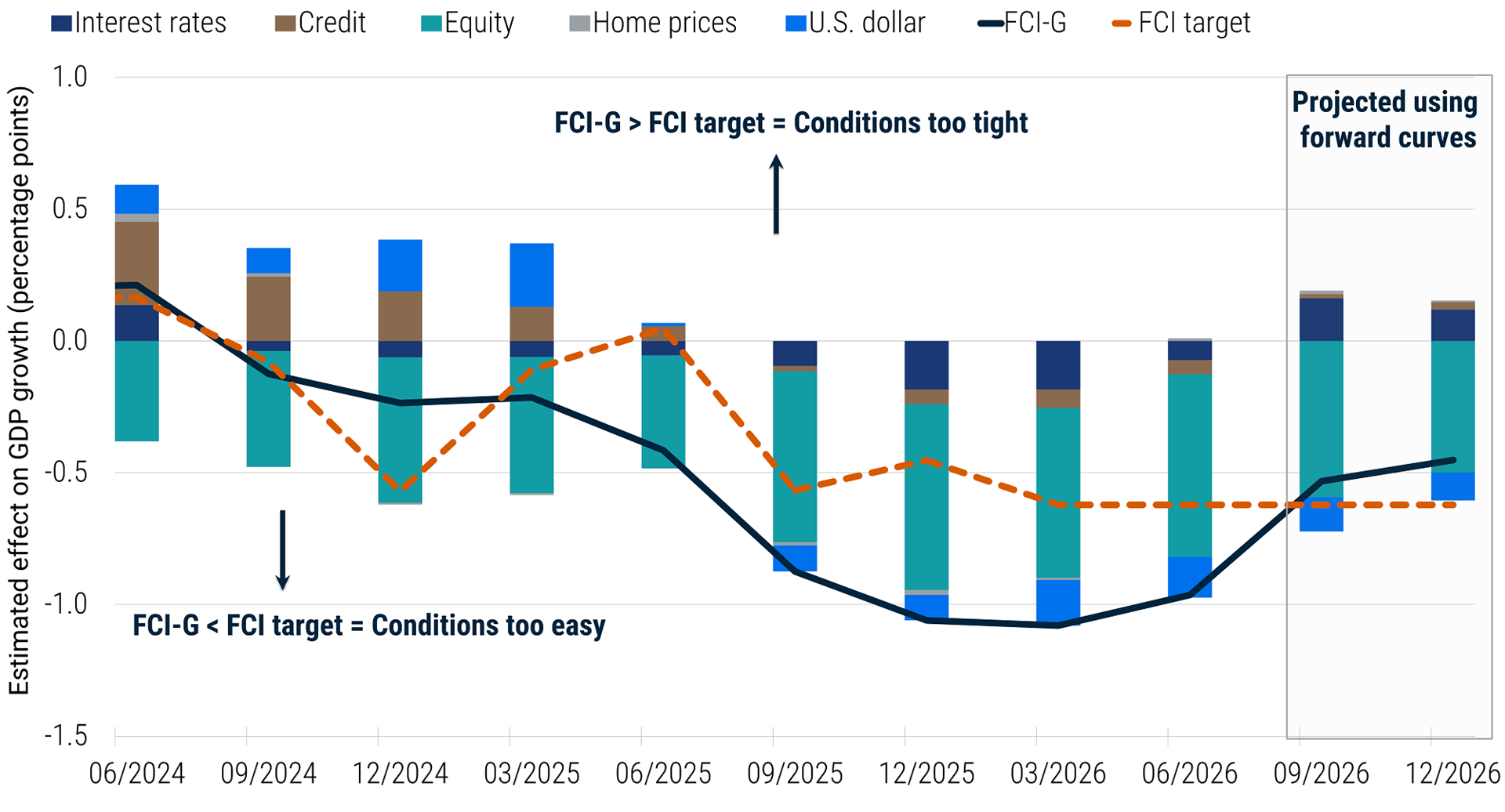
  Data source: Federal Reserve, Bloomberg, Q2 2026. The model, based on the Caballero, Caravello, and Simsek research framework, estimates that financial conditions eased by approximately 50 basis points at the end of Q2. This means the Federal Reserve needs to fine-tune its policy to offset the impact of previous easing. Of course, this adjustment can be achieved through changes in various asset price combinations, and the timeframe can vary. We use equivalent scenarios to illustrate the magnitude: tightening financial conditions by 50 basis points is equivalent to any of the following scenarios (or combinations): 10-year Treasury yield rises by 70 basis points (mortgage rates and corporate bond yields rise simultaneously); US stocks fall by 9% overall; the broad trade-weighted US dollar index rises by 4%. Important reminder: The above are not market predictions, but only the equivalent tightening force resulting from different asset changes. As of this writing, the 10-year Treasury yield has risen by approximately 80 basis points since June. In other words, the long-term interest rate market has already spontaneously completed most of the work of cooling the economy. If we substitute the latest market conditions into the FCI-G model, and assume that the market evolves according to the expected futures curve, the tightening effect of long-term interest rates has theoretically exceeded the gap that needs to be closed (Figure 3). Figure 3: FCI-G forecast based on the market's implied path.
  Data Source: Federal Reserve, Bloomberg, September 30, 2026. The model is based on the research framework of Caballero, Caravello, and Simsek. Looking deeper, financial conditions are influenced by many factors beyond the control of central banks. Geopolitical conflicts, recession fears, and unexpected fiscal policies can all rapidly alter investor risk appetite. Current optimistic expectations for AI growth and productivity increases support financial conditions, but these expectations can reverse at any time. Therefore, policy rates used to calibrate financial conditions today may not be applicable tomorrow. Currently, long-term interest rates bear most of the tightening burden; in the future, other assets such as stocks, credit spreads, and exchange rates may also share some of the adjustment pressure. Key Implications Our analysis suggests that this Fed rate hike is more accurately understood as a policy calibration than the beginning of a new round of sustained rate hikes. Slightly looser US financial conditions in the second quarter supported a slightly higher-than-potential economic output, which is the underlying logic behind the Fed's "withdrawal of some easing." However, the adjustment required in this round is significantly more moderate compared to 2022. Furthermore, the rise in 10-year US Treasury yields since June indicates that the market has already largely completed its own tightening. If the Federal Reserve increasingly focuses on broad financial conditions rather than closely monitoring the difference between the policy rate and the highly uncertain neutral rate r*, then the central bank will not need to repeatedly raise interest rates to tighten the environment. Higher long-term bond yields, a weaker stock market, wider credit spreads, and a stronger dollar can all serve to cool the economy instead of raising interest rates. Finally, from a financial conditions perspective, AI may reshape the Federal Reserve's policy framework. AI drives up investment demand and creates a wealth effect, requiring tighter financial conditions to curb inflation in the short term; in the long term, AI brings productivity gains, creating a positive supply dividend. At that time, even if financial conditions shift to looser, it will not easily generate inflationary pressure.
For investors, this shift in the central bank's focus raises several key questions: How should financial conditions be measured? Are current financial conditions stimulating or suppressing economic growth? What does this mean for subsequent monetary policy? Let's answer the last question first: The wealth effect and consumption boost from the stock market performance have resulted in financial conditions being more relaxed than ideal. However, since June, rising interest rates on US Treasury bonds, mortgages, and corporate bonds will offset the positive impact of the stock market on the economy. More importantly, the tightening of financial conditions needed to quickly bring inflation back to the target range is far less than that of 2022. How will monetary policy be transmitted to the market ? Over the past decade, the Federal Reserve has often compared short-term policy rates with the equilibrium neutral rate (r*, r-star) to determine its policy stance. The neutral rate represents the interest rate at which the economy fully realizes its potential output and inflation stabilizes at the Fed's 2% target level. However, the neutral rate cannot be directly observed, and its estimation results are highly uncertain, making it difficult to use as a real-time policy indicator. The short-term interest rates controlled by the Fed are only one aspect of financial conditions. The transmission logic of monetary policy is essentially how changes in short-term interest rates affect a whole set of asset prices. The Federal Reserve understood this transmission mechanism early on. After the pandemic, the wealth effect of stock and housing prices on consumption became a key focus of policy discussion. During the global financial crisis and the COVID-19 pandemic, credit spreads received significant attention, with policymakers focusing on the financial accelerator mechanism—a sharp drop in asset prices would further amplify downward economic pressure. Now, central banks are repeatedly emphasizing broad financial conditions, simply putting this logic explicitly on the table in monetary policy decisions. To aggregate the impact of various assets, researchers have developed the Financial Conditions Index (FCI): a weighted index combining interest rates and various asset prices, with weights representing the magnitude of each indicator's impact on the economy. But how should these weights be set? The Financial Conditions Growth Shock Index (FCI-G), developed by Federal Reserve economists, is one of the mainstream solutions. This index selects seven financial variables, assigning weights according to their impact on GDP growth. The seven indicators are: the federal funds rate, the 10-year Treasury yield, the 30-year fixed mortgage rate, the BBB-rated corporate bond yield, stock prices, housing prices, and the broad dollar index. Key distinction: The FCI-G measures the impact of changes in financial conditions on subsequent GDP growth, not whether financial conditions are absolutely loose or tight. A positive index indicates a drag on economic growth; a reading of +1 means that financial conditions are expected to drag down GDP growth by 1 percentage point in the coming year. A negative index indicates a positive impact on economic growth. The latest FCI-G reading for Q2 2026 is -0.9. This means that changes in financial conditions over the past few years, as of the end of Q2, are expected to boost US GDP growth by 0.9 percentage points in the coming year. This contrasts sharply with 2022–2023, when aggressive interest rate hikes tightened financial conditions, dragging down GDP by approximately 0.5–1 percentage point. Our breakdown of the FCI-G (Figure 1) shows that the US stock market was the primary driver of US economic growth over the past year. Figure 1: Federal Reserve FCI-G Index, Current Financial Conditions Supporting the Economy (Data as of Q2 2026) Data Source: Federal Reserve, Bloomberg, Q2 2026 FCI Target: Theory and Reality Federal Reserve Chairman Warsh's September speech sent a signal: the Fed does not want the market to have already priced in interest rate hikes, but the central bank fails to implement them, passively creating looser financial conditions—which would reignite inflationary pressures. This leads to the core question: to what extent should financial conditions tighten/loosen to bring inflation back to the 2% target? The FCI-G alone cannot answer this question. The FCI-G only shows the impact of financial conditions on growth; it cannot tell us the ideal level of financial conditions when the economy is operating at its potential growth rate. To find this ideal level, a target value for financial conditions that dynamically changes with fundamentals is needed. The approach to constructing a target FCI is to calculate what asset price changes are needed to eliminate the output gap. Estimating the output gap itself is very difficult: the US labor market generally believes that full employment has been achieved; however, if investment and wealth effects are considered simultaneously, estimates show that current US total output is 1-1.5 percentage points higher than potential capacity. Substituting this output gap into the Phillips curve (where the output gap translates into inflationary pressure), the corresponding inflationary pressure is only about 0.1-0.3 percentage points, a relatively small magnitude. The economy's production capacity continues to expand, while adjustments in household consumption lag behind. Under normal circumstances, we need a certain degree of loose financial conditions to ensure that demand growth matches supply growth. Conversely, if a permanent supply shock occurs, financial conditions need to be tightened to balance supply and demand. Artificial intelligence is a new variable: on the one hand, AI brings an investment boom, representing a positive demand shock; on the other hand, it improves production efficiency, representing a positive supply shock, increasing the difficulty of policy judgment. Economists from MIT and Yale University recently proposed a method to estimate the target FCI needed to close the output gap. Applying this model, as of the end of the second quarter, actual financial conditions were slightly looser than the theoretical ideal level (Figure 2). Figure 2: Current FCI-G vs. Target FCI-G Required to Close the Output Gap (Data as of Q2 2026) Data source: Federal Reserve, Bloomberg, Q2 2026. The model, based on the Caballero, Caravello, and Simsek research framework, estimates that financial conditions eased by approximately 50 basis points at the end of Q2. This means the Federal Reserve needs to fine-tune its policy to offset the impact of previous easing. Of course, this adjustment can be achieved through changes in various asset price combinations, and the timeframe can vary. We use equivalent scenarios to illustrate the magnitude: tightening financial conditions by 50 basis points is equivalent to any of the following scenarios (or combinations): 10-year Treasury yield rises by 70 basis points (mortgage rates and corporate bond yields rise simultaneously); US stocks fall by 9% overall; the broad trade-weighted US dollar index rises by 4%. Important reminder: The above are not market predictions, but only the equivalent tightening force resulting from different asset changes. As of this writing, the 10-year Treasury yield has risen by approximately 80 basis points since June. In other words, the long-term interest rate market has already spontaneously completed most of the work of cooling the economy. If we substitute the latest market conditions into the FCI-G model, and assume that the market evolves according to the expected futures curve, the tightening effect of long-term interest rates has theoretically exceeded the gap that needs to be closed (Figure 3). Figure 3: FCI-G forecast based on the market's implied path. Data Source: Federal Reserve, Bloomberg, September 30, 2026. The model is based on the research framework of Caballero, Caravello, and Simsek. Looking deeper, financial conditions are influenced by many factors beyond the control of central banks. Geopolitical conflicts, recession fears, and unexpected fiscal policies can all rapidly alter investor risk appetite. Current optimistic expectations for AI growth and productivity increases support financial conditions, but these expectations can reverse at any time. Therefore, policy rates used to calibrate financial conditions today may not be applicable tomorrow. Currently, long-term interest rates bear most of the tightening burden; in the future, other assets such as stocks, credit spreads, and exchange rates may also share some of the adjustment pressure. Key Implications Our analysis suggests that this Fed rate hike is more accurately understood as a policy calibration than the beginning of a new round of sustained rate hikes. Slightly looser US financial conditions in the second quarter supported a slightly higher-than-potential economic output, which is the underlying logic behind the Fed's "withdrawal of some easing." However, the adjustment required in this round is significantly more moderate compared to 2022. Furthermore, the rise in 10-year US Treasury yields since June indicates that the market has already largely completed its own tightening. If the Federal Reserve increasingly focuses on broad financial conditions rather than closely monitoring the difference between the policy rate and the highly uncertain neutral rate r*, then the central bank will not need to repeatedly raise interest rates to tighten the environment. Higher long-term bond yields, a weaker stock market, wider credit spreads, and a stronger dollar can all serve to cool the economy instead of raising interest rates. Finally, from a financial conditions perspective, AI may reshape the Federal Reserve's policy framework. AI drives up investment demand and creates a wealth effect, requiring tighter financial conditions to curb inflation in the short term; in the long term, AI brings productivity gains, creating a positive supply dividend. At that time, even if financial conditions shift to looser, it will not easily generate inflationary pressure.
- Risk Warning and Disclaimer
- The market involves risk, and trading may not be suitable for all investors. This article is for reference only and does not constitute personal investment advice, nor does it take into account certain users’ specific investment objectives, financial situation, or other needs. Any investment decisions made based on this information are at your own risk.