Gold Trading Alert: Gold Prices Stabilize and Rebound Amidst Plunging Bets on Fed Rate Hike; Is the Bull Market About to Resume? Market Awaits Non-Farm Payrolls Data
2026-10-02 07:52:18
On Thursday (October 1), spot gold rose slightly by 0.5%, closing at $4,177.27 per ounce, with December gold futures also rising in tandem. On the surface, this was a direct response to lower-than-expected US August inflation data—the market quickly lowered its bets on a Fed rate hike in October, plummeting from 69% a week earlier to 25%. However, this rebound is far from smooth. High US Treasury yields, a strengthening dollar, soaring oil prices, and the continued escalation of Middle East geopolitical risks have collectively created a complex battle between bulls and bears. Can gold truly stabilize with this rebound, or is it merely a respite during a downtrend? The market is awaiting guidance from the US September non-farm payroll report. On Friday (October 2) in early Asian trading, spot gold traded in a narrow range, currently hovering around $4,180 per ounce. 
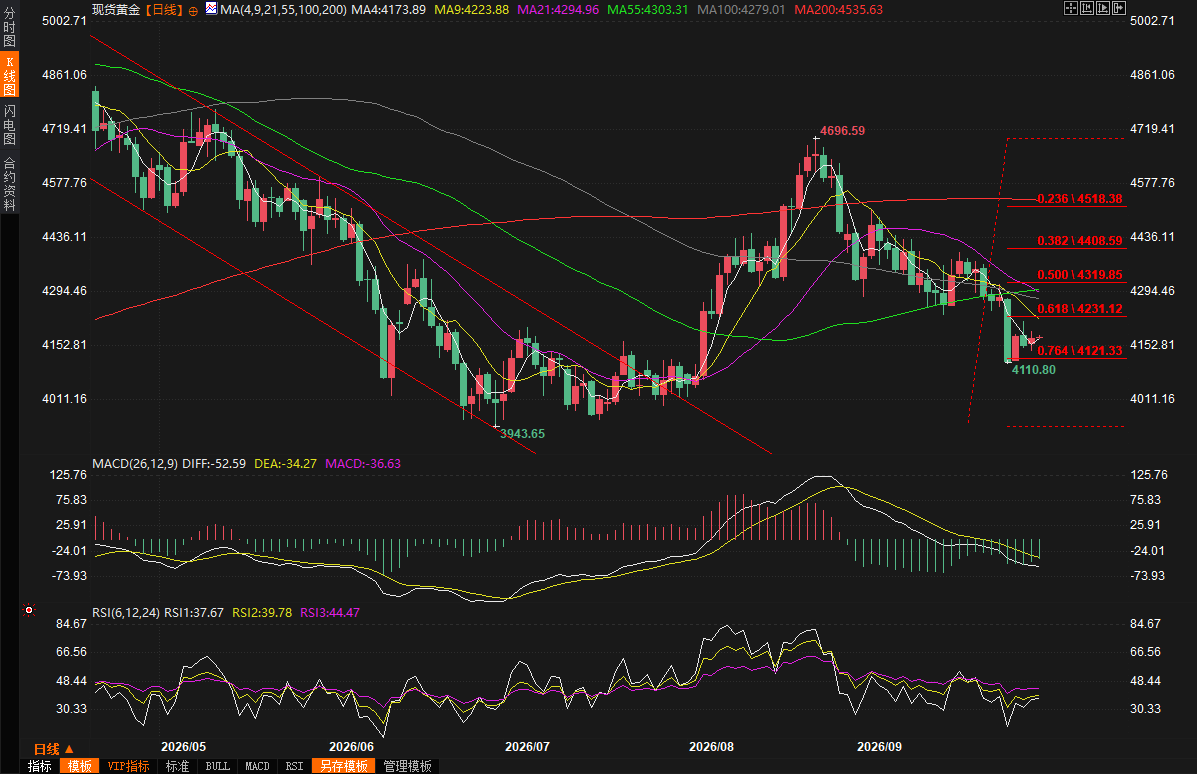 (Spot gold daily chart, source: FX678) At 07:50 Beijing time, spot gold is currently trading at $4181.45 per ounce.
Cooling inflation and dovish signals from the Federal Reserve: the direct drivers of the gold price rebound.
The core catalyst for this round of slight gold price increases stemmed from the further unfolding of unexpectedly weak US inflation data and dovish remarks from Federal Reserve officials. August inflation readings were lower than expected, and price pressures from the previous month were also revised downwards. This result directly shook market confidence in the Fed's aggressive rate hikes. Traders quickly adjusted their expectations, believing the probability of an October rate hike had significantly decreased. Meanwhile, public statements from top Fed officials further reinforced this shift. New York Fed President Williams explicitly stated that adjusting the current monetary policy stance "does not need to be rushed." Fed Vice Chairman Jefferson emphasized that any policy adjustments should be based on a careful review of data trends, changes in the outlook, and the balance of risks, noting that the market is "reassessing" the economic outlook. Minneapolis Fed President Kashkari, while open to a possible October rate hike, also acknowledged that current policy is not necessarily particularly restrictive. These voices collectively conveyed a clear signal: the Fed is more inclined to keep interest rates unchanged in October, postponing the next possible rate hike to December. For gold, lowered rate hike expectations mean a temporary reduction in the opportunity cost of holding non-interest-bearing assets, thus providing direct support. David Meger, head of metals trading at High Ridge Futures, pointed out that these reduced expectations of interest rate hikes have provided support for the precious metals market. HSBC also lowered its average gold price forecast to $4,490 per ounce in 2026 and $4,825 per ounce in 2027, judging that gold prices may face further pressure in the short term, but may be nearing a bottom. The bank also expects that once gold prices approach or fall below $4,000, central banks may resume gold purchases due to price attractiveness. These views have injected a touch of medium- to long-term optimism into the market.High yields and a strong dollar: invisible shackles restricting the upside potential of gold prices.
Despite inflation and policy expectations shifting in favor of gold, the sharp fluctuations in the bond market provided a strong hedge. The 10-year US Treasury yield touched its highest level in 24 years, even recording its largest quarterly increase since 1994. Although bond prices rebounded and yields fell on Thursday, the overall high-level trend remained fundamentally unchanged. High yields directly increase the opportunity cost of holding gold, while a strengthening dollar makes dollar-denominated gold more expensive for non-US investors. This turmoil in the bond market is not an isolated event. Strong economic data and inflation concerns had pushed yields to new highs, but professional investors believed that the sharp rise over the past six weeks had significantly improved the risk-reward profile of Treasury bonds, leading to a large-scale buying spree that reversed the selling pressure. The decline in the two-year Treasury yield was particularly pronounced, reflecting a rapid cooling of market expectations for a near-term Fed rate hike. However, this rebound was more a result of position adjustments and sentiment repair than a complete shift in fundamentals towards easing. Natixis portfolio strategists pointed out that yield movements had become somewhat decoupled from some fundamental factors, and overcrowded positions also created conditions for a pullback. For gold, as long as yields remain high, its upside potential will continue to be suppressed.Soaring oil prices and geopolitical risks: a dual variable of renewed inflation and risk aversion.
Meanwhile, the sharp fluctuations in the international oil market have brought new uncertainties to gold. Brent crude oil surged more than 4% on Thursday, breaking through the $100 per barrel mark. Direct triggers included the suspension of petroleum product exports by major Asian refineries and news that the US might send a third aircraft carrier and up to 10,000 troops to the Middle East. Trump's tough stance on Iran further exacerbated market tensions. Rising oil prices directly exacerbated inflation concerns. If energy prices continue to climb, they could offset the positive effects of recent inflation cooling, forcing the Federal Reserve to reassess its policy path. Meger warned that any factors that increase the likelihood of interest rate hikes, including a further sharp rise in energy prices or an escalation of the situation in the Middle East, would dampen sentiment in the gold market. At the same time, the US imposed a new round of sanctions on Iran's railway and automotive industries, further squeezing Tehran's land and sea economic lifelines. While these geopolitical actions have strengthened safe-haven demand, theoretically benefiting gold, if they ultimately translate into broader supply shocks and inflationary pressures, they could instead exert a negative drag on gold prices. Global currency markets also came under pressure. The US dollar index rose for the sixth consecutive quarter, and the euro fell to its lowest level since May 2025. French fiscal concerns and the European bond sell-off have further increased the attractiveness of the US dollar. In this environment, while gold's safe-haven appeal is somewhat evident, it cannot completely offset the dual pressures of a strong dollar and high opportunity costs.Non-farm payrolls report: A key test for short-term direction
Investors are currently focused on Friday's release of the US September non-farm payrolls report. Recent employment data has remained relatively stable, with declining initial jobless claims and fewer layoffs, indicating continued resilience in the labor market. This report will provide Federal Reserve officials with more information for their assessments. If the data continues to be strong, it could reinforce the narrative of economic resilience and increase concerns about sticky inflation, thus putting pressure on gold. Conversely, if there are clear signs of a slowdown, it could further solidify the market consensus of a December rate hike rather than an October one, providing additional support for gold prices. HSBC's assessment may offer a medium-term reference: gold prices may remain under pressure in the short term, but the possibility of them nearing a bottom is increasing. If central bank gold purchases resume when prices fall, it will constitute an important demand floor. Meanwhile, the evolution of oil prices and geopolitical risks, the ultimate direction of US Treasury yields, and the actual policy path of the Federal Reserve will all determine whether gold stabilizes and rebounds from its current level or continues to seek lower support. In summary, Thursday's rebound in gold prices was more of a technical reaction to a correction in short-term policy expectations than a confirmation of a trend reversal. Cooling inflation and dovish signals from the Federal Reserve have provided some breathing room, but high yields, a strong dollar, oil price pressures, and geopolitical uncertainty remain significant headwinds. The market is caught in a tug-of-war between multiple forces. Key data and events in the coming weeks, particularly the jobs report and developments in the Middle East, will determine whether gold is truly nearing its bottom or still needs to undergo further testing. (Spot gold daily chart, source: FX678) At 07:50 Beijing time, spot gold is currently trading at $4181.45 per ounce.
- Risk Warning and Disclaimer
- The market involves risk, and trading may not be suitable for all investors. This article is for reference only and does not constitute personal investment advice, nor does it take into account certain users’ specific investment objectives, financial situation, or other needs. Any investment decisions made based on this information are at your own risk.