Tokyo's core inflation rose more than expected to 2.7%, and the USD/JPY exchange rate fell back below the 158 level.
2026-10-02 10:38:18
Tokyo's September inflation data released on Friday slightly surprised the market: the core CPI, excluding fresh food, rose 2.7% year-on-year , higher than the market expectation of 2.4% and far exceeding the previous value of 1.8%, marking the fastest growth since November 2025; the overall CPI also rose to 2.7% year-on-year , compared to 1.9% previously; and the core indicator, which is more closely watched by the Bank of Japan and excludes food and energy, rose to 3.0% , compared to 2.0% previously—this data shows that the acceleration of inflation is not only from fuel and electricity, but that upward pressure on prices is spreading to a wider range. Normally, such data should provide significant support for the yen; however, the market reaction was quite restrained: the USD/JPY pair only briefly fell below 158.00 before stabilizing and rebounding, still recording gains for the week.  The strength of the inflation data had, in fact, already been partially "priced in" by the market. Prior to the Bank of Japan's interest rate hike on September 18th, speculators made net purchases of approximately 216,000 yen futures contracts (equivalent to about $17.3 billion) in the two weeks ending September 15th, setting a new record for two-week buying volume and pushing net long positions to a 14-month high of approximately 120,000 contracts . However, after the rate hike and the weakening yen, they reduced their holdings to approximately 72,000 contracts by the week ending September 22nd. In other words, the funds most likely to buy yen due to the inflation data had essentially already "got on board" before the data release, and the realization of the positive news became a window for some long positions to take profits. Currently, the remaining net long positions are still at a high level, around the 88th percentile of the past five years, and the risk of crowded positions has not yet been fully released. From a broader perspective, this round of accelerated inflation is more like a "predictable event" for the Bank of Japan than an "unexpected shock." August's national core CPI was only 1.7%, marking the eighth consecutive month below the 2% target, mainly suppressed by government utility subsidies. Tokyo data, often considered a leading indicator of national inflation, has seen the national core CPI reading 0.1 percentage points lower than Tokyo's for the past two months. National inflation data for September will be released on October 22nd , just before the Bank of Japan's (BOJ) interest rate meeting at the end of October, providing the latest information for policy decisions. Following the BOJ's two rate hikes in June and September 18th, pushing the policy rate to 1.25%, the market is closely assessing the timing and pace of its next move. Notably, Japan's total cash income in July increased by 4.7% year-on-year , the fastest growth since 1997, and faster than the jump in Tokyo inflation—wage growth outpacing price increases, precisely the virtuous cycle the BOJ hopes to achieve through continued rate hikes. Therefore, the strength of Tokyo inflation and wage support make the market's discussion about another BOJ rate hike at the end of October more plausible; however, the relative strength of the US dollar and interest rate differentials have temporarily overshadowed the positive impact on the yen. Looking ahead, investors are focusing on two key data points: the US September non-farm payrolls report released Friday evening , with market expectations of approximately 90,000 new jobs and a 3.2% year-on-year increase in average hourly earnings; and Japan's August wage data to be released next Tuesday evening . If the US employment data is significantly weaker, its downward pressure on the dollar may achieve the goal of "pushing up the yen," a task that Tokyo inflation failed to accomplish. Conversely, if the data remains resilient, the yen may still struggle to escape its dependence on interest rate differentials in the short term. Market sentiment is generally in a state of "crowded bulls awaiting a catalyst," with the battle between bulls and bears in the yen centered on the repricing of policy pace and interest rate differential expectations. From a technical perspective, on the daily chart, USD/JPY fell below 158.00 after the data release, a level that coincides with the 50-day moving average , forming the first resistance level. Thursday's high was slightly below 158.50 , representing the next resistance level. On the downside, the price found support at 157.50 during the data release period. Thursday's low was slightly higher than 157.00 , and the area around 156.50 forms a key support zone, converging the lows of September 28th and 30th. In terms of momentum, the daily stochastic oscillator RSI has risen to a high level of around 82 , indicating short-term overbought conditions and reduced risk of chasing highs. A pullback similar to that seen during data releases is possible at any time, but unless the trend structure is broken, the main theme remains upward oscillation. Looking at the 4-hour chart, the price has formed a high-level consolidation platform below 158.00, with short-term moving averages intertwined and the direction uncertain. A breakout of the 158.00-158.50 area with significant volume could lead to further upward movement; conversely, a break below 157.00 should raise concerns about a potential pullback to 156.50 or even lower.
 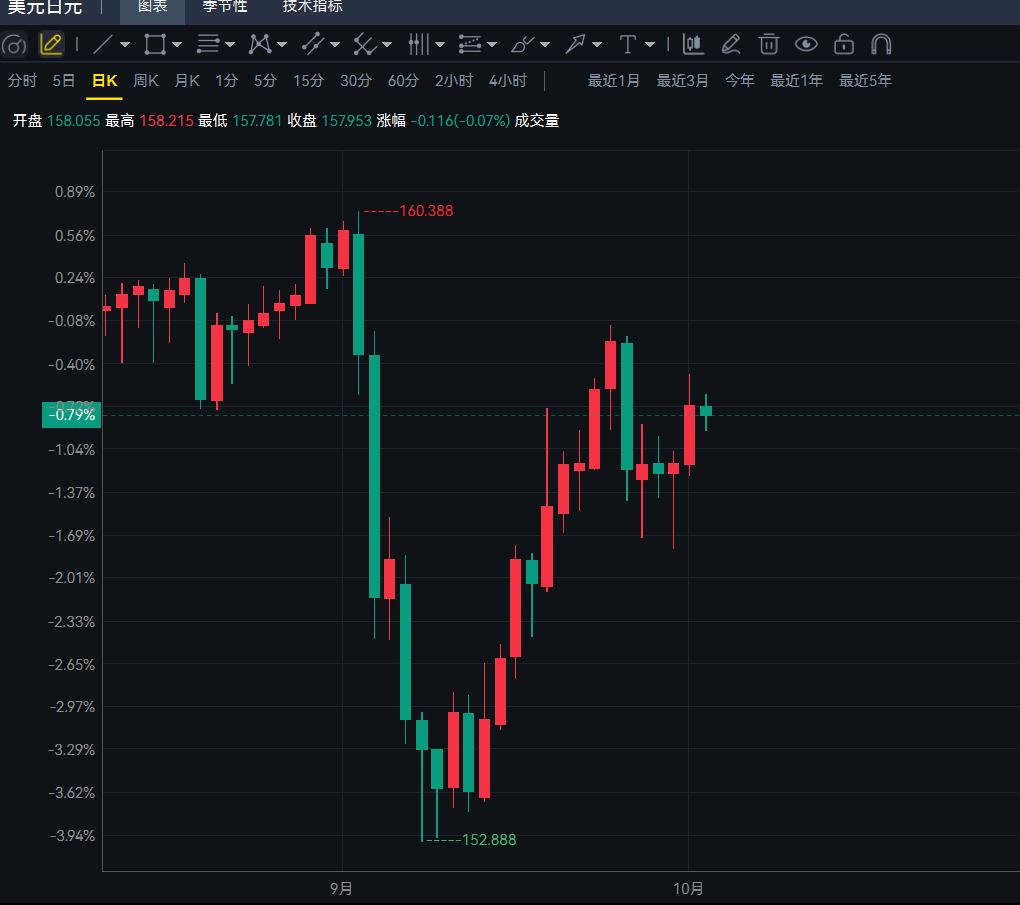 Editor's Summary : Overall, the strong inflation data in Tokyo failed to drive a sustained strengthening of the yen, essentially a classic example of "expectations leading the way": speculative positions had already reached record highs before the rate hike, coupled with the constraint of the USD/JPY interest rate differential remaining above 2.5 percentage points, leaving the yen lacking short-term catalysts. Looking ahead, whether the Bank of Japan will raise interest rates at its meeting at the end of October will depend on the combination of national inflation and wage data released on October 22; marginal changes in the US dollar—especially Friday's non-farm payrolls data—will also be key to determining the direction of USD/JPY. If US data weakens and Tokyo inflation remains strong, the yen may receive rare "two-way support," and USD/JPY could potentially fall below 157.00 and test 156.50; conversely, if US data is strong and the Bank of Japan holds rates steady, the exchange rate could challenge 158.50 or even 159.00 again. On the risk side, the high level of speculative net long positions and potential intervention statements from the Japanese and US authorities are the biggest uncertainties.
The strength of the inflation data had, in fact, already been partially "priced in" by the market. Prior to the Bank of Japan's interest rate hike on September 18th, speculators made net purchases of approximately 216,000 yen futures contracts (equivalent to about $17.3 billion) in the two weeks ending September 15th, setting a new record for two-week buying volume and pushing net long positions to a 14-month high of approximately 120,000 contracts . However, after the rate hike and the weakening yen, they reduced their holdings to approximately 72,000 contracts by the week ending September 22nd. In other words, the funds most likely to buy yen due to the inflation data had essentially already "got on board" before the data release, and the realization of the positive news became a window for some long positions to take profits. Currently, the remaining net long positions are still at a high level, around the 88th percentile of the past five years, and the risk of crowded positions has not yet been fully released. From a broader perspective, this round of accelerated inflation is more like a "predictable event" for the Bank of Japan than an "unexpected shock." August's national core CPI was only 1.7%, marking the eighth consecutive month below the 2% target, mainly suppressed by government utility subsidies. Tokyo data, often considered a leading indicator of national inflation, has seen the national core CPI reading 0.1 percentage points lower than Tokyo's for the past two months. National inflation data for September will be released on October 22nd , just before the Bank of Japan's (BOJ) interest rate meeting at the end of October, providing the latest information for policy decisions. Following the BOJ's two rate hikes in June and September 18th, pushing the policy rate to 1.25%, the market is closely assessing the timing and pace of its next move. Notably, Japan's total cash income in July increased by 4.7% year-on-year , the fastest growth since 1997, and faster than the jump in Tokyo inflation—wage growth outpacing price increases, precisely the virtuous cycle the BOJ hopes to achieve through continued rate hikes. Therefore, the strength of Tokyo inflation and wage support make the market's discussion about another BOJ rate hike at the end of October more plausible; however, the relative strength of the US dollar and interest rate differentials have temporarily overshadowed the positive impact on the yen. Looking ahead, investors are focusing on two key data points: the US September non-farm payrolls report released Friday evening , with market expectations of approximately 90,000 new jobs and a 3.2% year-on-year increase in average hourly earnings; and Japan's August wage data to be released next Tuesday evening . If the US employment data is significantly weaker, its downward pressure on the dollar may achieve the goal of "pushing up the yen," a task that Tokyo inflation failed to accomplish. Conversely, if the data remains resilient, the yen may still struggle to escape its dependence on interest rate differentials in the short term. Market sentiment is generally in a state of "crowded bulls awaiting a catalyst," with the battle between bulls and bears in the yen centered on the repricing of policy pace and interest rate differential expectations. From a technical perspective, on the daily chart, USD/JPY fell below 158.00 after the data release, a level that coincides with the 50-day moving average , forming the first resistance level. Thursday's high was slightly below 158.50 , representing the next resistance level. On the downside, the price found support at 157.50 during the data release period. Thursday's low was slightly higher than 157.00 , and the area around 156.50 forms a key support zone, converging the lows of September 28th and 30th. In terms of momentum, the daily stochastic oscillator RSI has risen to a high level of around 82 , indicating short-term overbought conditions and reduced risk of chasing highs. A pullback similar to that seen during data releases is possible at any time, but unless the trend structure is broken, the main theme remains upward oscillation. Looking at the 4-hour chart, the price has formed a high-level consolidation platform below 158.00, with short-term moving averages intertwined and the direction uncertain. A breakout of the 158.00-158.50 area with significant volume could lead to further upward movement; conversely, a break below 157.00 should raise concerns about a potential pullback to 156.50 or even lower. Editor's Summary : Overall, the strong inflation data in Tokyo failed to drive a sustained strengthening of the yen, essentially a classic example of "expectations leading the way": speculative positions had already reached record highs before the rate hike, coupled with the constraint of the USD/JPY interest rate differential remaining above 2.5 percentage points, leaving the yen lacking short-term catalysts. Looking ahead, whether the Bank of Japan will raise interest rates at its meeting at the end of October will depend on the combination of national inflation and wage data released on October 22; marginal changes in the US dollar—especially Friday's non-farm payrolls data—will also be key to determining the direction of USD/JPY. If US data weakens and Tokyo inflation remains strong, the yen may receive rare "two-way support," and USD/JPY could potentially fall below 157.00 and test 156.50; conversely, if US data is strong and the Bank of Japan holds rates steady, the exchange rate could challenge 158.50 or even 159.00 again. On the risk side, the high level of speculative net long positions and potential intervention statements from the Japanese and US authorities are the biggest uncertainties.
- Risk Warning and Disclaimer
- The market involves risk, and trading may not be suitable for all investors. This article is for reference only and does not constitute personal investment advice, nor does it take into account certain users’ specific investment objectives, financial situation, or other needs. Any investment decisions made based on this information are at your own risk.