Is the gold sell-off a buying opportunity or a trap? Institutions: Short-term rebound, long-term bearish.
2026-10-02 10:52:16
On Friday (October 2nd) during Asian trading hours, spot gold briefly touched a high of $4180 per ounce before falling back to $4134. It is currently trading around $4160 per ounce, a decline of nearly 0.4%. Gold investors suffered heavy losses in the latest round of selling, but one market strategist believes October may offer a respite. Carley Garner, co-founder of DeCarley Trading, stated in an interview that falling prices, technical support, and favorable seasonal trends have created attractive conditions for a short-term rebound in gold. 
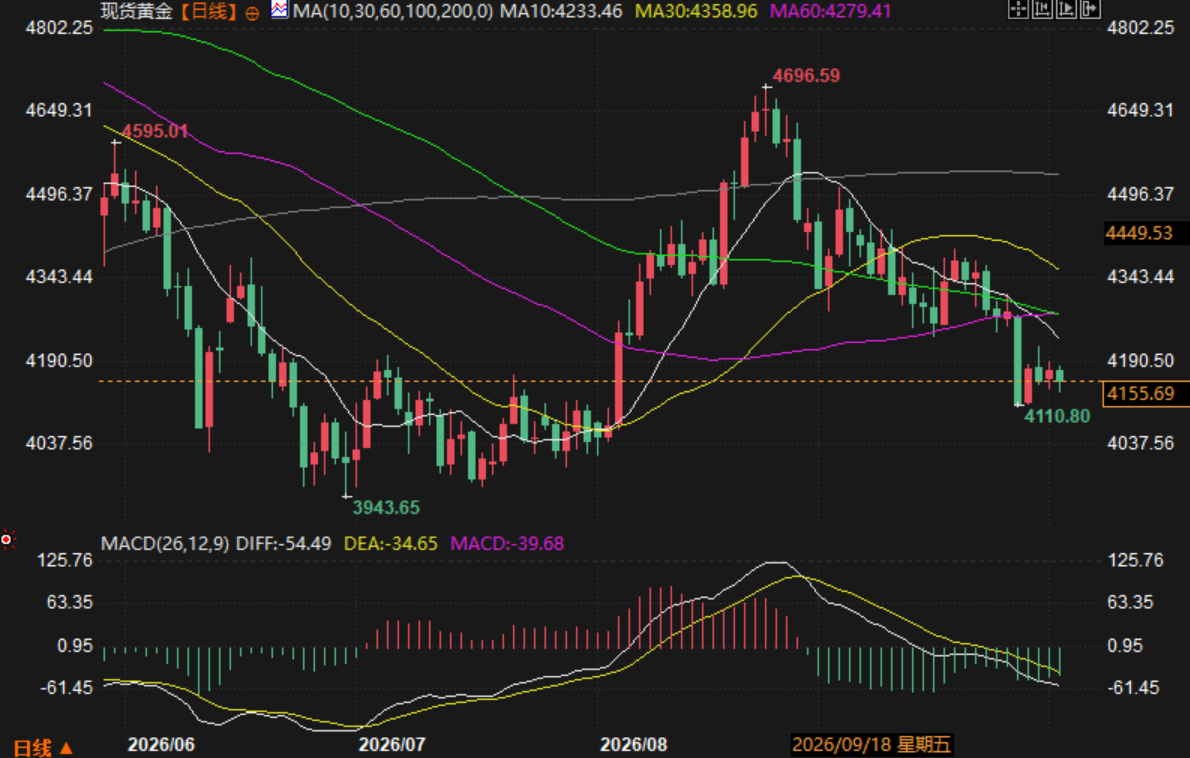 (Spot gold daily chart, source: EasyTrade) At 10:49 Beijing time, spot gold was trading at $4161.73 per ounce.
Seasonal trends and technical support converge, conditions are ripe for a short-term rebound.
Garner points out that gold typically benefits from positive seasonal factors at this time of year. According to the seasonal data she tracks, buying gold around September 29th and holding it until October 25th has resulted in gains in 12 of the past 15 years. Meanwhile, December gold futures successfully held a key daily trendline during the latest sharp decline. However, Garner makes it clear that she is looking for a rebound, not the start of a new long-term uptrend. She states bluntly, "Do I think gold will go to $5,000 or $5,500? No, I don't think so. But I think the next three or four hundred points could be up."Tactical trading strategy: Sell put options to profit from call spreads
Given the significant risk that a standard 100-ounce gold futures contract poses to small traders, Garner suggests considering mini gold futures, or even one-ounce gold futures, when gold prices are around $4,200 to limit overall risk exposure if direct exposure to gold prices is desired. Her latest recommendation is that her firm's primary tactical trading strategy is an options strategy designed to capitalize on potential rebounds. She adds that to mitigate risk, traders could consider buying options on mini gold contracts or even one-ounce contracts. This strategy involves selling a December $3,900 put option and using the premium to buy a $4,300/$4,450 call spread—that is, buying a $4,300 call option while simultaneously selling a $4,450 call option. Garner states, "We're buying the call spread with market money." However, this strategy faces significant downside risk should gold fall sharply below $3,900, which she describes as "unlimited."Support and Target: $4,000 is expected to hold, with a tactical target of $4,500.
Despite the risks, Garner expects support around $4,000 to hold. She stated that gold holding above the technical trendline, coupled with recent volatility around the October contract's initial notification period, suggests the market may have established at least a temporary bottom. On the upside, Garner said that in a best-case scenario, gold could rise towards the 200-day moving average around $4,650, but her more realistic tactical target is around $4,500. Stability in the US Treasury market could be a catalyst for gold's next move. Garner believes that after years of weakness, US Treasury prices may be approaching an "explosive bottom." While acknowledging that bond market volatility could become more extreme, she said any signs of stabilization in US Treasuries could provide room for a gold rally. "Once there are any signs of stabilization in US Treasuries, I think gold has a chance to bounce," she said. "The risk is that in this kind of explosive market, there are no limits to the chaos."The medium- to long-term outlook remains bearish: a rebound to $4,500-$4,600 will provide a shorting opportunity.
Despite the bullish short-term conditions, Garner emphasized that she hasn't abandoned her broader bearish view on gold. In fact, she stated that a rebound to $4,500 or $4,600 would provide her with a more attractive entry point for short positions. She said, "I'm not bullish at all. If gold reaches the $4,500 to $4,600 area, I'd rather short it there." Garner's long-term concern stems from the US dollar. She pointed out that the dollar tested a roughly 20-year trendline earlier this year, a trendline that has historically triggered significant rallies. She expects the dollar to eventually break out of its current slow recovery, thus putting new pressure on precious metals. She said, "I think this will ultimately be the coffin nail for metals—gold and silver."Medium-term risks for copper: Testing the 20-year trendline, with a potential pullback of 30% to 50%.
Garner shares a similar view on the medium-term downside risks for copper, with her outlook also heavily reliant on expectations of a stronger dollar. While copper has become one of the most favored commodities in AI and electrification trading, Garner says the metal is testing a significant long-term technical resistance level that has historically triggered substantial pullbacks. She explains that copper is testing a roughly 20-year trendline for the fifth time, with previous encounters leading to sharp declines. While she doesn't predict a repeat of some of the extreme historical drops, she says a 30% to 50% pullback is possible. Her bearish view on copper also aligns with her broader expectation that the dollar is poised for a larger rally. Garner says the market has largely ignored the dollar previously due to stalled rallies, but she expects this dynamic to change. "I think the dollar is going to start breaking something," she says, adding that financial markets haven't fully priced in the potential impact of a stronger dollar.Summarize
Garner's perspective offers a clear tactical and strategic framework: in the short term, seasonal trends, technical support, and volatility in the October contract have created conditions for a gold rebound, with a tactical target around $4,500 and a potential peak of $4,650. However, she explicitly defines this rebound as a "breathing-out" move, not a long-term trend reversal. In the medium to long term, she remains bearish on gold, believing that a rebound to the $4,500-$4,600 area would provide better shorting opportunities, based on the core logic that the US dollar may break through its long-term trend line and strengthen. This assessment also applies to copper—a potential 30% to 50% retracement after testing the 20-year trend line. For traders, the key point of contention lies in whether the short-term gold rebound is a tactical opportunity or a trend reversal, and Garner's answer is clearly the former. (Spot gold daily chart, source: EasyTrade) At 10:49 Beijing time, spot gold was trading at $4161.73 per ounce.
- Risk Warning and Disclaimer
- The market involves risk, and trading may not be suitable for all investors. This article is for reference only and does not constitute personal investment advice, nor does it take into account certain users’ specific investment objectives, financial situation, or other needs. Any investment decisions made based on this information are at your own risk.