US troop buildup and sanctions escalation send softer signals to Iran
2026-10-02 15:36:16
International oil prices surged and then retreated during the long holiday! The US military's large-scale troop buildup and expanded sanctions pressure Iran, potentially accelerating peace talks. On Friday (October 2nd) during the Asian and European sessions, although China was on holiday, international oil prices retreated slightly from their highs due to a confluence of factors: geopolitical stalemate, Iranian supply contraction, and structural restructuring of regional transportation. Yesterday's article highlighted the high probability of a rebound in international oil prices, but noted limited upside potential. Oil prices subsequently strengthened before declining this morning. On one hand, the US continues its blockade of Iran, increasing troop buildup and expanding sanctions, targeting Iranian railway and automotive companies, aiming to economically isolate Iran and force it to relinquish more interests and engage in peace talks with the US. On the other hand, the long-term US-Iran standoff and sporadic conflicts in multiple regions of the Middle East, even escalating marginally, have kept the market priced in geopolitical risk. However, pipeline replacements in the Gulf states and US escort operations also limit the potential for a one-sided surge in oil prices. 
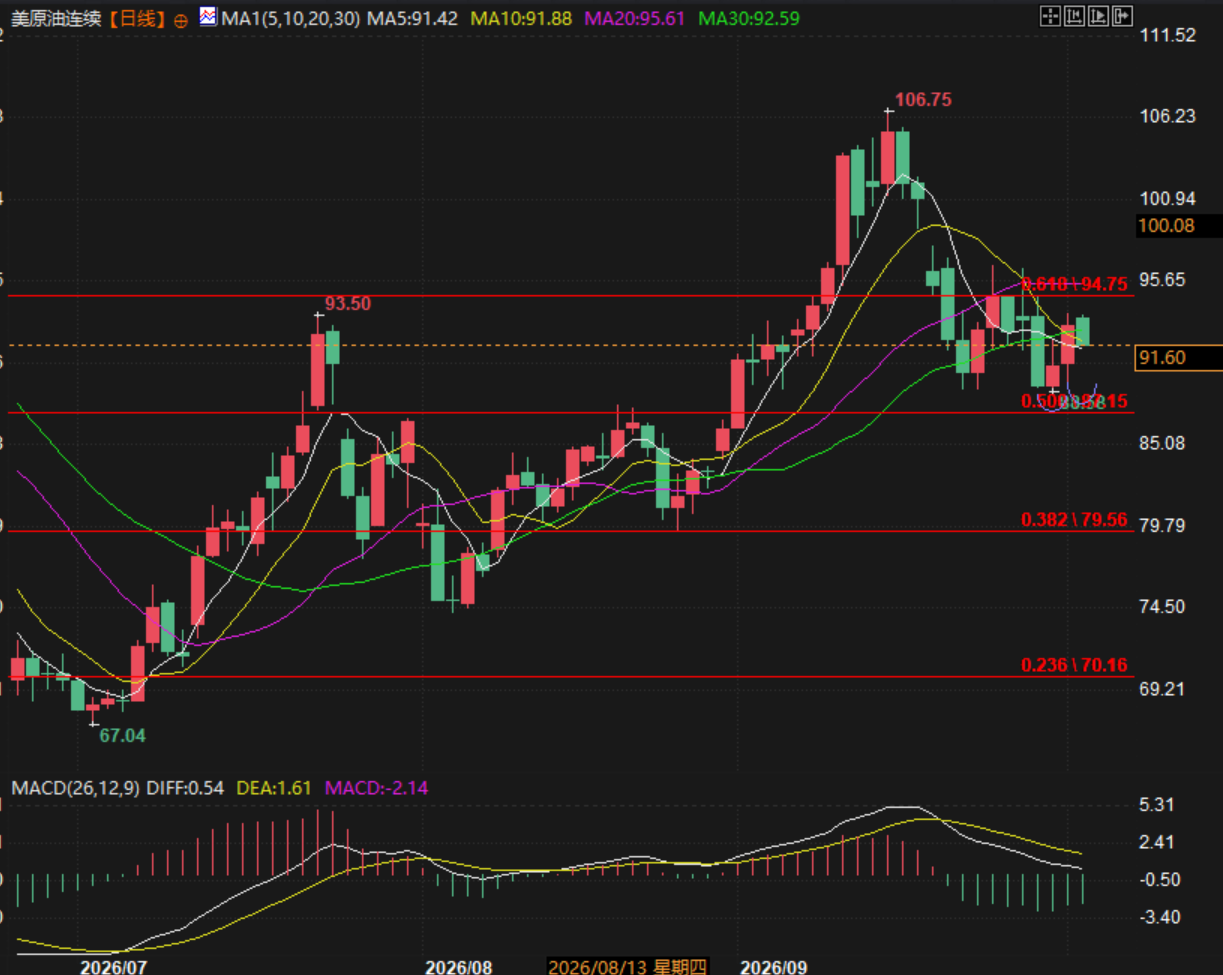 (WTI crude oil futures main contract daily chart, source: FX678) At 15:29 Beijing time, WTI crude oil futures main contract was trading at $91.21 per barrel.
Geopolitical Situation: US Troop Increase Forces Iran to Compromise
The current geopolitical situation in the Middle East is characterized by a marginal stabilization of conflict and a continued deepening of the power struggle. The probability of a large-scale direct confrontation between the US and Iran has significantly decreased, but the core framework of sanctions, military deployments, and diplomatic standoffs between the two sides remains unchanged. This stable power struggle continues to reshape the global oil supply and transportation system, directly dominating recent international oil price trends and the Middle East shipping landscape, becoming the core pricing logic of the oil trading market. Militarily, the US continues to strengthen its military presence in the Middle East. According to reports, the Pentagon is deploying a third aircraft carrier strike group and several Marine Corps ships to the Middle East, adding 9,000 to 10,000 troops. Three US carrier strike groups are about to be deployed in the region, solidifying the bottom line of regional military deterrence. At the same time, the US continues to increase its military reserves, finalizing a $24.4 billion five-year missile production contract to accelerate the replenishment of ammunition depleted by the Middle East conflict, providing support for long-term regional competition. Furthermore, the US Treasury Department announced new sanctions, targeting Iranian railway and automotive conglomerates in the latest round, aiming to economically isolate Iran. Diplomatic negotiations have reached a stalemate, and the market's anticipated window for US-Iran reconciliation has not opened. Iran had previously signaled a willingness to ease tensions, with Foreign Minister Araqchi privately proposing a "verification in exchange for sanctions easing" deal to Western diplomats during the UN General Assembly. Iran offered to allow inspectors to return to bombed nuclear facilities in exchange for easing US sanctions, and the Iranian president also publicly expressed goodwill towards negotiations. However, the official English account of the Islamic Republic News Agency (IRNA) subsequently issued a statement claiming that reports from other social media outlets about Iran submitting nuclear-related proposals to the US were "completely untrue." The US explicitly rejected Iran's latest ceasefire proposal, with Trump stating that Iran's terms "did not meet expectations," and rejecting any reconciliation options. He also indicated that the US might resume large-scale airstrikes against Iran after the November election, effectively closing the door to short-term easing. The game between the two sides has entered a protracted tug-of-war; geopolitical risks will not clear up quickly, and there is currently no momentum for further deterioration.Current status of the blockade: Iranian crude oil exports have nearly come to a standstill, and secondary sanctions continue to escalate.
Under the strong pressure of the US maritime blockade, the blockade on Iranian crude oil exports has become completely solidified, with crude oil exports essentially at a standstill, and the supply-side contraction effect continuing to materialize. According to tanker tracking data, since mid-August, Iran has not received any new crude oil loading orders; since mid-July, no crude oil tankers have broken through the US maritime blockade. The transportation of Iranian crude oil and liquefied petroleum gas to Asian and UAE markets has been completely disrupted, severely squeezing the lifeline of the oil economy. In addition to the maritime energy blockade, secondary US sanctions continue to impact Iran's cross-border circulation system. A new round of US sanctions has led Iraqi airport service providers to suspend all ground services to Iranian airlines due to concerns about potential collateral damage, resulting in the complete suspension of flights between Iran and four major Iraqi cities, including Baghdad and Najaf. Although the Iranian embassy in Iraq has repeatedly urged the Baghdad government to intervene to protect the air routes between the two countries from US sanctions, and Iraq has applied for an exemption from the US Treasury Department and proposed safeguards such as passenger screening, the US has only granted a limited exemption for one month, failing to completely lift the restrictions and indirectly hindering the flow of personnel and goods related to Iranian crude oil trade. At the same time, the United States is also pressuring the European Union to release its strategic diesel reserves, demanding that Germany, France, and other countries release 120 million barrels of diesel fuel within six months, further reducing Iran's bargaining power from the energy distribution side.Crude oil transportation: Shipping routes in Gulf oil-producing countries have resumed, leading to a structural restructuring of the shipping industry.
In stark contrast to the stagnation of Iranian exports, crude oil transportation from Gulf Arab oil-producing countries such as Saudi Arabia and the UAE has recovered rapidly, significantly reshaping the regional crude oil transportation landscape. The previously high market concern about a complete shutdown of the Strait of Hormuz has not materialized. With the support of US naval escorts, crude oil transportation from Gulf countries via the Strait of Hormuz has recovered to pre-war levels. To mitigate geopolitical risks associated with the shipping lanes and reduce reliance on the single Hormuz passage, the regional transportation structure continues to be optimized. Currently, approximately 40% of Gulf crude oil can be transported via land pipelines to ports in the UAE and Saudi Arabia for export, a significant increase from 17% before the war, effectively offsetting the transportation uncertainties caused by channel disruptions. However, localized shipping risks in the Strait of Hormuz have not been completely eliminated. The Persian Gulf Straits Authority of Iran confirmed that the three oil tankers recently attacked in the Strait of Hormuz were all UAE vessels, and these vessels had previously been listed as violators of the channel, indicating that targeted regional shipping risks still exist. Coupled with the Houthi rebels' continued cross-border attacks in Yemen, including multiple ballistic missile launches at Saudi Arabia, frequent airstrikes and explosions in the Yemeni capital Sana'a, and ongoing disruptions to energy shipping routes such as the Red Sea and the Bab el-Mandeb Strait, the Middle East's crude oil transportation system remains in a fragile state of equilibrium.Summary and Technical Analysis:
Overall, the short-term crude oil market will maintain a pattern of "geopolitical fluctuations, rigid supply contraction, and structural differentiation in transportation." In simpler terms, while short-term supply and demand issues are easing the upper limit of crude oil price increases, global strategic oil reserves are nearly depleted, making oil prices more sensitive to marginal changes in supply. The US has imposed transportation, financial, and oil transport blockades on Iran, along with escalating military measures, forcing Iran to consider renegotiation and even abandoning its nuclear interests. However, whether the Iranian Revolutionary Guard can reach a consensus with the peace faction, or whether this will escalate the conflict, remains uncertain, leading to a supply-demand imbalance and a downward trend in oil prices. In short, the US exerts pressure when oil prices rise, and Iran exerts pressure when prices fall, resulting in significant price volatility. The core focus of future crude oil trading will continue to be on the US sanctions situation, the progress of US-Iran negotiations, the stability of shipping in the Strait of Hormuz, and the pace of global strategic oil reserve releases. Technical Analysis: WTI crude oil futures have rebounded based on a double bottom pattern, but have been constrained by the downward pressure from the 5-20 day moving averages, and are currently still fluctuating widely between 87 and 95. (WTI crude oil futures main contract daily chart, source: FX678) At 15:29 Beijing time, WTI crude oil futures main contract was trading at $91.21 per barrel.
- Risk Warning and Disclaimer
- The market involves risk, and trading may not be suitable for all investors. This article is for reference only and does not constitute personal investment advice, nor does it take into account certain users’ specific investment objectives, financial situation, or other needs. Any investment decisions made based on this information are at your own risk.