The US dollar index fluctuated at high levels ahead of the non-farm payrolls report: Is the market really not focused on new job growth?
2026-10-02 15:44:18
Before the release of the US September non-farm payrolls report on October 2nd, the US dollar index was around 101.9, near a 17-month high; the 10-year US Treasury yield was around 5.24%, having previously touched a 24-year high of around 5.34%. Market focus has shifted from whether the Fed will continue tightening to whether it needs to pause in October after the September rate hike. Interest rate futures imply a lower probability of another rate hike in October, down to around 26%, from nearly 70% a week earlier. Against this backdrop, the non-farm payrolls report is more like a policy path calibration than simply a check on the health of the employment situation. 
 More informative is whether the variables become consistent after the data release. If the employment headline figures contradict wage, participation rate, and previous value revisions, the dollar index may initially reflect changes in interest rate expectations, followed by a repricing by long-term yields and cross-market risk appetite. The current common characteristic of both technical and fundamental factors is the market's high sensitivity to changes in policy path.
The core of non-farm payrolls is not just the number of new jobs.
The official US schedule indicates that the September jobs report is scheduled for release on October 2nd at 8:30 PM. The latest survey's mainstream expectation is for an increase of approximately 84,000 to 90,000 jobs, lower than August's 162,000; the unemployment rate is expected to remain at 4.1%, and average hourly earnings are projected to grow by about 3.2% year-over-year. Therefore, the focus should shift from "whether jobs have grown" to the quality of that growth: private sector contributions, labor force participation rate, average hours worked, wage growth, and revisions from the previous two months will all alter our understanding of labor supply and demand. While August saw 162,000 job gains, the market has already become wary of the seasonal factors at play, and focusing solely on the headline figure can easily overlook the noise from subsequent revisions.The labor market is forming a static equilibrium of "low layoffs and low hiring".
High-frequency data from the US presents a more complex picture. Private sector employment increased by 90,000 in September, higher than the revised 36,000 in August; initial jobless claims for the week ending September 26 were 197,000, with the four-week moving average remaining low at 200,000. Meanwhile, companies announced 43,281 job cuts in September, down 18% month-over-month and 20% year-over-year, but hiring plans totaled 90,787, down 23% year-over-year and the lowest for the same period since 2011. While companies haven't engaged in widespread layoffs, they have remained restrained in hiring new employees. This structure can suppress the unemployment rate, but it doesn't necessarily mean a continued acceleration in wages and consumption. Adjustments to AI-related jobs remain a structural variable. Layoff plans due to AI-related reasons total approximately 120,136 this year, accounting for about 21% of announced layoffs, but only about 9% in September alone. This indicates that employment changes are not driven by a single technological factor; industry differentiation and corporate cost constraints are equally important.The Federal Reserve faces a dual constraint: cooling inflation and high long-term interest rates coexist.
On September 16, the Federal Reserve raised its target range for the federal funds rate by 25 basis points to 3.75%-4.00%, marking its first rate hike in three years. The next meeting will be held on October 27-28. Recently released August personal consumption expenditures (PCE) price index data showed a year-on-year increase of 3.4%, with the core index at 3.0% year-on-year and a core month-on-month increase of only 0.2%. This marginal easing of inflation data has led to a reassessment of the necessity for a second rate hike in October. However, the cooling of short-term policy expectations has not automatically resulted in a corresponding decline in long-term yields. The 10-year Treasury yield remains above 5.2%, reflecting that long-term inflation compensation, bond supply, energy costs, and term premiums continue to influence valuations. The recent performance of the US dollar is not solely determined by the next Fed meeting; European fiscal risks, global bond volatility, and cross-market interest rate differentials also play a role in pricing. Therefore, the impact of non-farm payrolls on the US dollar index is more likely to be transmitted layer by layer through "wages and employment components, interest rate expectations, the bond curve, and dollar pricing," rather than a simple linear relationship between the figure and the exchange rate.US Dollar Index Technical Structure: Momentum Expansion
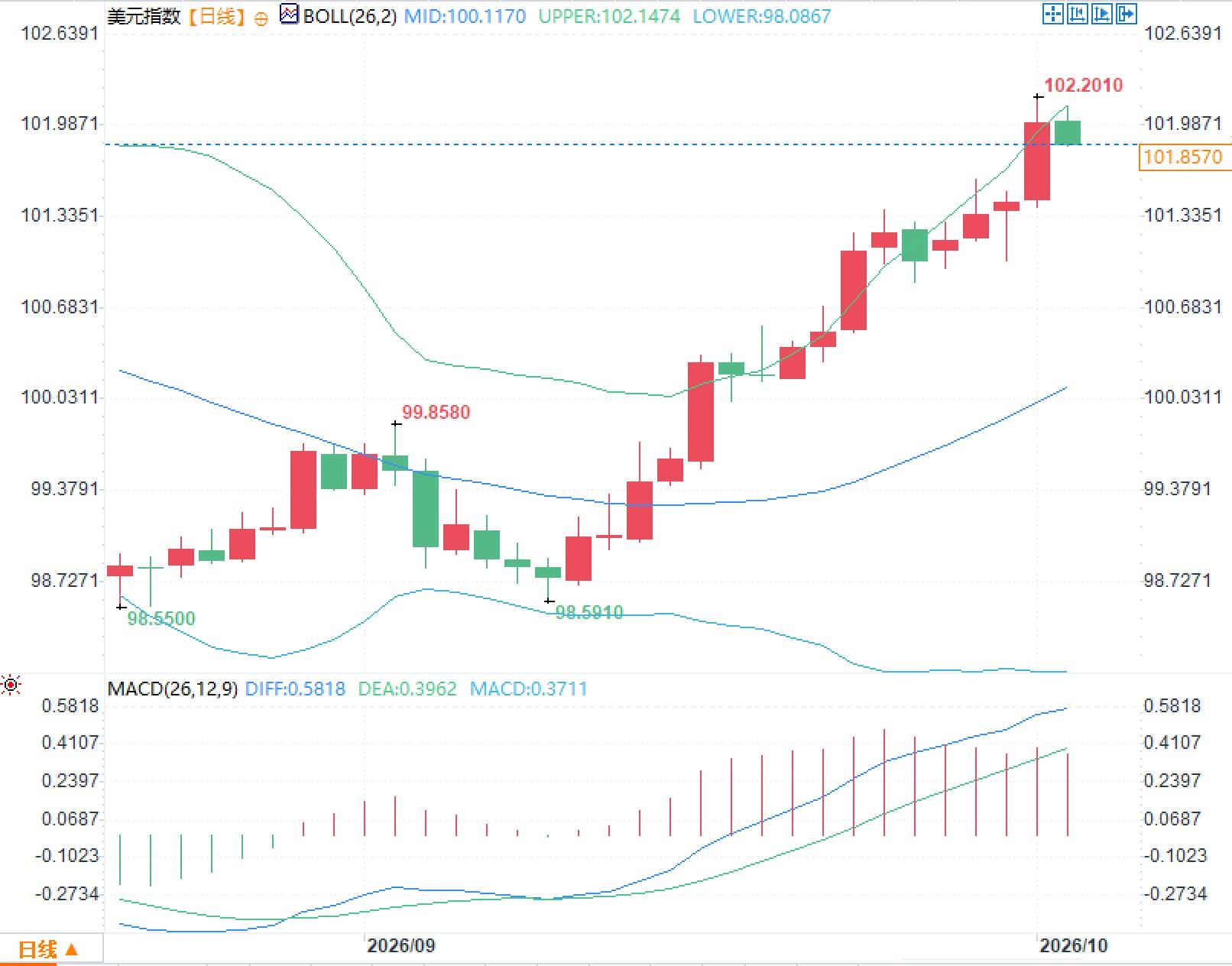
Observing the daily chart, the US dollar index is above the middle Bollinger Band and close to the upper band, with the Bollinger Bands widening, indicating an increase in recent volatility and trend momentum. The MACD fast line is above the slow line and above the zero axis, with the histogram remaining positive. When non-farm payrolls, wages, and unemployment rates are released simultaneously, daily fluctuations may cause a rapid recalculation of the Bollinger Band position, MACD histogram, and moving average slopes. More informative is whether the variables become consistent after the data release. If the employment headline figures contradict wage, participation rate, and previous value revisions, the dollar index may initially reflect changes in interest rate expectations, followed by a repricing by long-term yields and cross-market risk appetite. The current common characteristic of both technical and fundamental factors is the market's high sensitivity to changes in policy path.Frequently Asked Questions
Question 1: Why is this month's non-farm payrolls report more important to the US dollar index than usual? Answer: Because the Federal Reserve just completed a 25 basis point rate hike in September, and the October meeting is less than a month away. Market pricing for consecutive rate hikes has rapidly dropped from about 70% a week ago to about 26%. Non-farm payrolls, the unemployment rate, and wages will directly influence the market's judgment on whether the September rate hike needs to be continued. Therefore, it's more like a policy path calibration than just a check on the health of the employment situation. Question 2: If new job creation remains strong, why can't we only look at the total non-farm payrolls figure? Answer: The 162,000 increase in August is considered by some institutions to be largely influenced by seasonal adjustments, and employment data is often revised afterward. Currently, wage growth, labor force participation rate, unemployment rate, and previous value revisions are more informative, as they collectively determine whether labor supply and demand will continue to create sustained inflationary pressure.- Risk Warning and Disclaimer
- The market involves risk, and trading may not be suitable for all investors. This article is for reference only and does not constitute personal investment advice, nor does it take into account certain users’ specific investment objectives, financial situation, or other needs. Any investment decisions made based on this information are at your own risk.