Eurozone inflation surged to 3.8%, but the euro is embroiled in a triple pricing dilemma.
2026-10-02 18:30:17
On Friday, October 2nd, Eurozone inflation in September once again became a key variable in euro asset pricing. The latest preliminary figures show that headline inflation rose to 3.8% year-on-year, up from 3.2% in August, while core inflation rose to 2.5% from 2.4%. The euro is currently fluctuating around 1.124 against the US dollar, still in its lowest range since the end of September. 
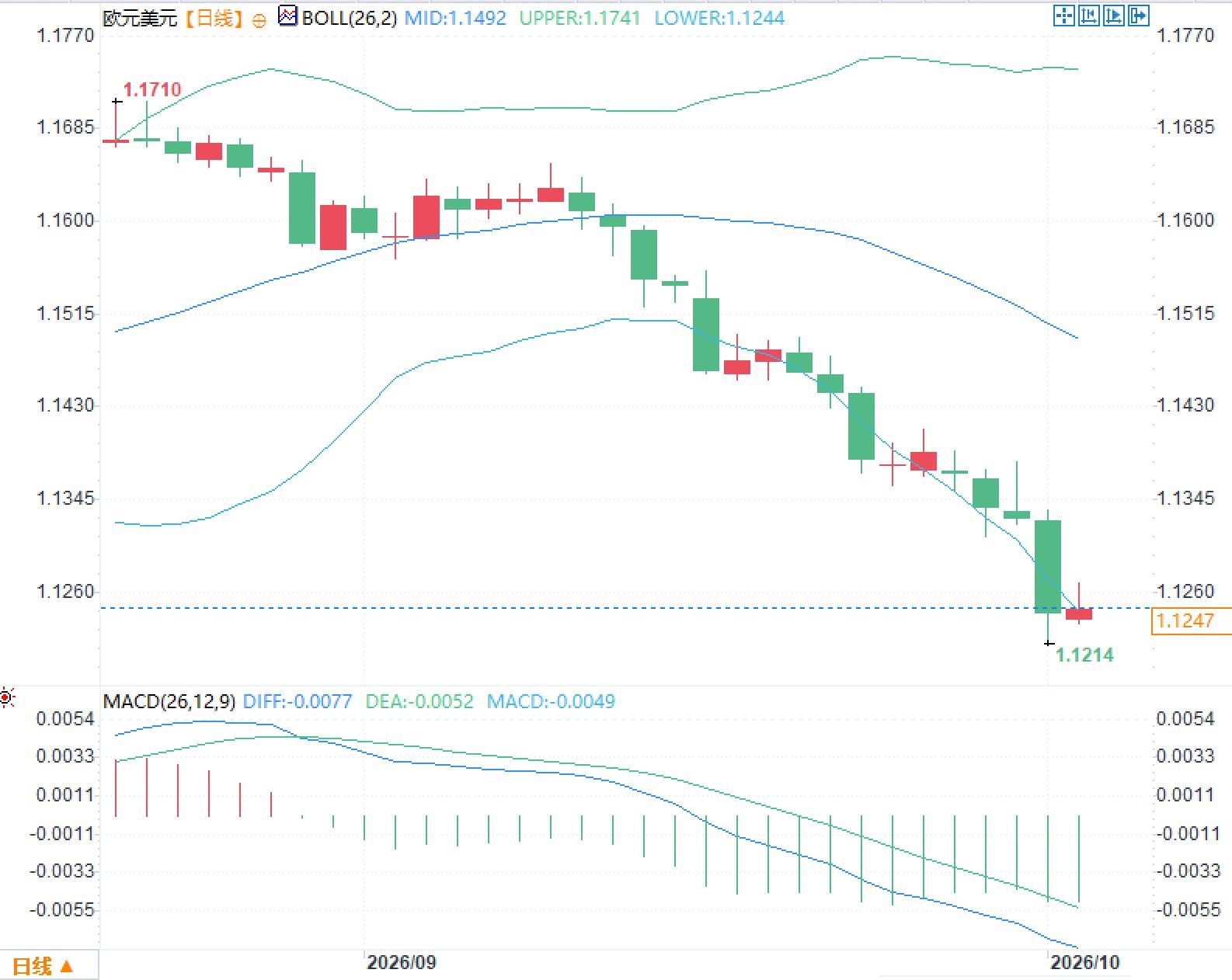 These indicators describe the strength, volatility, and momentum of an existing trend. During periods of intense activity, it's more informative to observe whether price volatility, term spreads, and momentum indicators change in tandem after inflation data is released. If these three indicators diverge, their market implications are often more complex than those of a single technical indicator.
Soaring Inflation: Energy Determines the Peak, Core Sectors Determine Sustainability
The most significant change in Europe in September was not the runaway core inflation, but rather the widening year-on-year increase in the energy component from 14.3% to 18.8%, directly pushing up overall inflation by 0.6 percentage points. Services inflation rose from 3.0% to 3.2%, and the food component also rebounded. The widening gap between overall and core inflation indicates that current price pressures still have a clear energy-driven character, but the renewed acceleration in service prices means that cost transmission has not stopped at the energy end. For the market, the 3.8% overall reading first affects the short-term inflation risk premium, while the 2.5% core reading determines the policymakers' sensitivity to the second-round effect. What really needs to be observed is not how high the overall inflation is in a single month, but whether energy costs can continue to be passed on to wages, service prices, and non-energy goods. If this transmission strengthens, the energy shock will gradually transform from a relative price change into broader inflation stickiness.ECB: After raising interest rates, the decision-making function will focus more on transmission.
The European Central Bank (ECB) raised three key interest rates by 25 basis points in September, bringing the deposit facility rate, main refinancing rate, and marginal lending rate to 2.50%, 2.65%, and 2.90%, respectively. The September baseline forecast projects headline inflation of 3.0%, 2.5%, and 2.1% for 2026, 2027, and 2028, respectively, with core inflation at 2.5%, 2.6%, and 2.3%. This implies that even as the direct impact of energy gradually weakens, underlying price pressures may still decline slowly. ECB Executive Board member Schnabel stated on September 30 that monetary policy "cannot wait until the indirect and second-round effects have truly emerged before acting." The policy implication is clear: the duration of the energy shock, the strength of cost pass-through by businesses, wage feedback, and long-term inflation expectations are now more important than a single headline inflation figure. At the same time, rising long-term yields will themselves tighten financing conditions, meaning monetary policy faces a combination of inflationary constraints and tightening financial conditions.Euro/Dollar: Inflationary interest rate differential logic offset by financial conditions
The euro is currently trading around 1.124 against the dollar, compared to around 1.133 on September 30th, indicating significantly increased short-term volatility. Looking solely at inflation, higher Eurozone readings would increase market focus on the ECB maintaining a restrictive policy stance; however, rising energy prices would simultaneously compress real income, impact terms of trade, and raise financing costs through increased bond yields. Therefore, the exchange rate cannot be explained solely by nominal interest rate expectations. On the other hand, the Federal Reserve raised its federal funds target range by 25 basis points to 3.75%-4.00% in September, and a significant gap remains between European and US policy rates. For the euro/dollar exchange rate, a more explanatory framework involves simultaneously deconstructing the European/US interest rate differential, the energy shock, and the risk premium, rather than directly mapping a 3.8% inflation figure to a single exchange rate conclusion.Technical Structure: Weakness Coexists with Volatility Expansion
The daily chart shows that the price continues to trade below the Bollinger Middle Band and close to the Lower Band, with the Bollinger Band width indicating a significant increase in price dispersion compared to the previous period. In the MACD, the DIF is -0.0077 and the DEA is -0.0052, both below the zero line, and the negative histogram remains expanding. The Bollinger Middle Band is also trending downwards, reflecting a continued downward shift in the price center of gravity over the past few weeks. These indicators describe the strength, volatility, and momentum of an existing trend. During periods of intense activity, it's more informative to observe whether price volatility, term spreads, and momentum indicators change in tandem after inflation data is released. If these three indicators diverge, their market implications are often more complex than those of a single technical indicator.Frequently Asked Questions
Question 1: Why did overall inflation rise to 3.8%, while core inflation was only 2.5%? Answer: Because the main increase in inflation this time came from energy. In September, energy prices rose 18.8% year-on-year, significantly higher than the service component. Core inflation excludes highly volatile items like energy, hence the significantly smaller increase. This is a key difference in determining whether the shock has spread to the broader price system. Question 2: Does higher-than-expected inflation necessarily mean a stronger euro? Answer: Not necessarily. Higher inflation will change the ECB's interest rate expectations, but energy costs will also compress real income, increase financing costs, and affect growth expectations. The exchange rate ultimately reflects the composite result of the interest rate differential between Europe and the US, financial conditions, and risk premiums.- Risk Warning and Disclaimer
- The market involves risk, and trading may not be suitable for all investors. This article is for reference only and does not constitute personal investment advice, nor does it take into account certain users’ specific investment objectives, financial situation, or other needs. Any investment decisions made based on this information are at your own risk.