The Triple Pull on the Pound Sterling Against the Dollar: Interest Rate Differentiation, Budget, and Energy – Which Factor is Pricing the Price?
2026-10-05 22:00:20
On Monday, October 5th, the pound was trading around 1.320 against the dollar, still in relatively low territory since the end of June. On September 16th, the Federal Reserve raised its target range for the federal funds rate by 25 basis points to 3.75%-4.00%, with the midpoint slightly higher than the Bank of England's policy rate of 3.75%. However, the US non-farm payrolls data released on October 2nd showed an increase of only 29,000 jobs in September, with the unemployment rate rising to 4.2%, indicating a divergence in the pricing logic of "continued resilience in US data." Meanwhile, with the UK budget due on October 28th, fiscal constraints, energy prices, and the policy response functions of the two central banks have become the three main drivers of the pound's repricing against the dollar. 
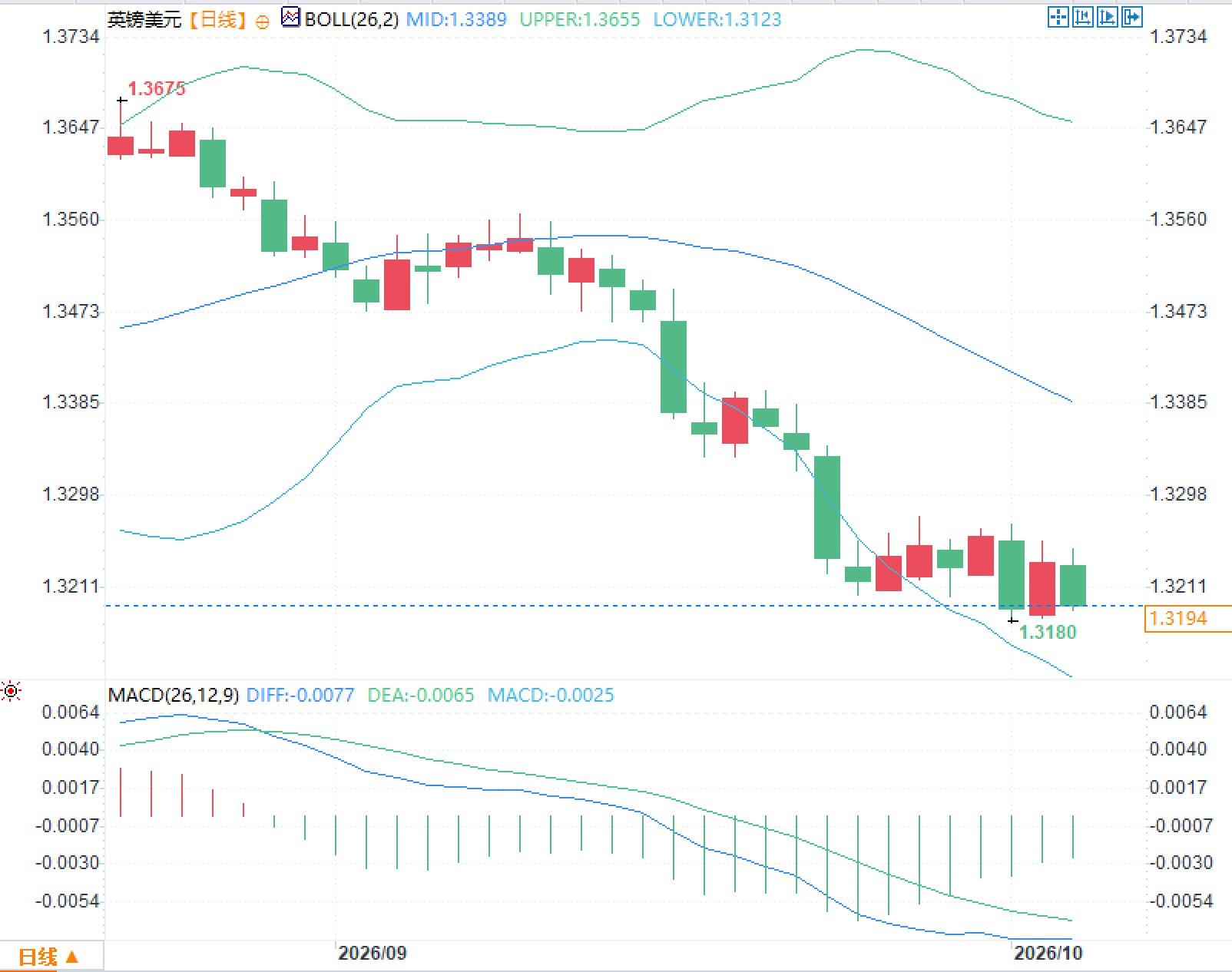 The MACD lines are below the zero line, and the histogram remains in negative territory, indicating that medium-term momentum has not yet fully recovered. However, the bodies of recent daily candlesticks have shortened significantly, with alternating bullish and bearish candlesticks, and the negative MACD histogram has not expanded substantially.
The logic behind the US dollar has changed: interest rate constraints are more important than employment data.
While some market views still hold that the Fed's policy is tightening, the notion of "overall superior US data" needs revision. US consumer prices rose 3.4% year-on-year in August, and the core personal consumption expenditures price index rose 3.0% year-on-year, indicating inflation is still significantly away from the 2% policy target. This is why the Fed chose to raise interest rates in September, rather than relying solely on the labor market to determine its policy stance. However, the employment side is providing the opposite signal. Non-farm payrolls increased by 29,000 in September, far below the revised 133,000 in August, and the unemployment rate rose to 4.2%. Following the release of the employment data, market pricing in a further rate hike in October decreased significantly. Therefore, the dollar's current interest rate advantage is closer to "maintaining higher interest rates under the constraint of high inflation" than to simultaneous improvement in various economic indicators. For the pound against the dollar, what truly matters is not just the current difference in policy rates, but the expected path of the next few policy meetings and how these expectations will be transmitted to short-term Treasury yields.The UK data is not entirely weak; the problem lies in the structure of growth and fiscal constraints.
The UK's fundamentals need to be analyzed in detail. Second-quarter real GDP grew by 0.5% quarter-on-quarter, a 0.1 percentage point upward revision from previous estimates, following a 0.6% increase in the first quarter; July's GDP grew by another 0.4%. Looking at the total figures alone, this is not typical recessionary data. The problem lies in the narrow breadth of growth. In the three months to July, service sector output grew by 0.6%, but production and construction both declined by 0.5%, indicating that economic expansion remains highly dependent on the service sector. Inflation further limits the Bank of England's policy flexibility. Consumer prices rose 3.1% year-on-year in August, above the 2% target. The Bank of England maintained interest rates at 3.75% in September and explicitly stated that energy price volatility could continue to push up inflation. This means that a weak growth structure does not automatically translate into room for easing; monetary policy needs to address both the risk of slowing demand and energy-imported inflation simultaneously. More noteworthy are fiscal conditions. Net borrowing by the UK public sector reached £18.3 billion in August, £3.5 billion higher than the official forecast for the same period. Therefore, the October 28th budget is not merely a tax and spending policy event; its core impact lies in the debt trajectory, fiscal credibility, the efficiency of public investment, and whether long-term growth expectations can form a consistent framework. If increased spending in the budget raises long-term financing costs, the growth effect may be partially offset by tighter financial conditions; only if fiscal risk premiums can be stabilized and private investment expectations improved can the market's pricing logic for UK assets undergo a more profound change.Technical structure indicates a continuation of the weak trend.
Observing the daily chart, after a continuous decline in September, the British pound against the US dollar is currently below the Bollinger middle band and close to the lower band. The Bollinger middle band continues to decline, and the bandwidth has widened significantly compared to the beginning of the month, indicating that the previous price adjustment was accompanied by increased volatility. The MACD lines are below the zero line, and the histogram remains in negative territory, indicating that medium-term momentum has not yet fully recovered. However, the bodies of recent daily candlesticks have shortened significantly, with alternating bullish and bearish candlesticks, and the negative MACD histogram has not expanded substantially.Frequently Asked Questions
Question 1: US employment data showed a significant slowdown in September, so why hasn't the pound sterling broken free of its previous weakness against the dollar? Answer: Because exchange rate pricing isn't solely determined by single-month employment data. US inflation remains above the policy target, and the Fed raised interest rates in September, meaning nominal interest rates continue to provide constraining support for the dollar. The slowdown in employment primarily reduces the necessity for further rapid tightening, but hasn't immediately eliminated existing interest rate differentials and inflation risk premiums. Question 2: Why will the UK budget on October 28th be a significant variable for the pound? Answer: The market isn't simply focused on how much spending will increase, but rather on whether fiscal rules, debt paths, financing costs, and productivity-enhancing measures are aligned. The budget will also affect the UK gilt term premium, growth expectations, and the Bank of England's future policy space.- Risk Warning and Disclaimer
- The market involves risk, and trading may not be suitable for all investors. This article is for reference only and does not constitute personal investment advice, nor does it take into account certain users’ specific investment objectives, financial situation, or other needs. Any investment decisions made based on this information are at your own risk.