One chart: The Baltic Dry Index has fallen sharply, and freight rates for large vessels have weakened significantly.
2026-10-05 22:46:18
Latest data shows that the Baltic Dry Index (BDI) closed at 3070 points on October 5, 2026, a new low since August 26, 2026, down 2.48% month-on-month, marking the largest drop in four days. Looking at the recent short-term charts, the BDI has seen positive growth 5 times, negative growth 6 times, and zero growth 0 times. Specifically, the Panamax Freight Index (BPI) closed at 2364 points, down 0.34% from the previous value; the Capesize Freight Index (BCI) closed at 4833 points, down 4.15%; and the Supramax Freight Index (BSI) closed at 1790 points, up 0.06%. For detailed charts of the latest 720-day and 10-year trends of the Baltic Dry Index and its three main sub-indices, please refer to the charts specially created by FX678. 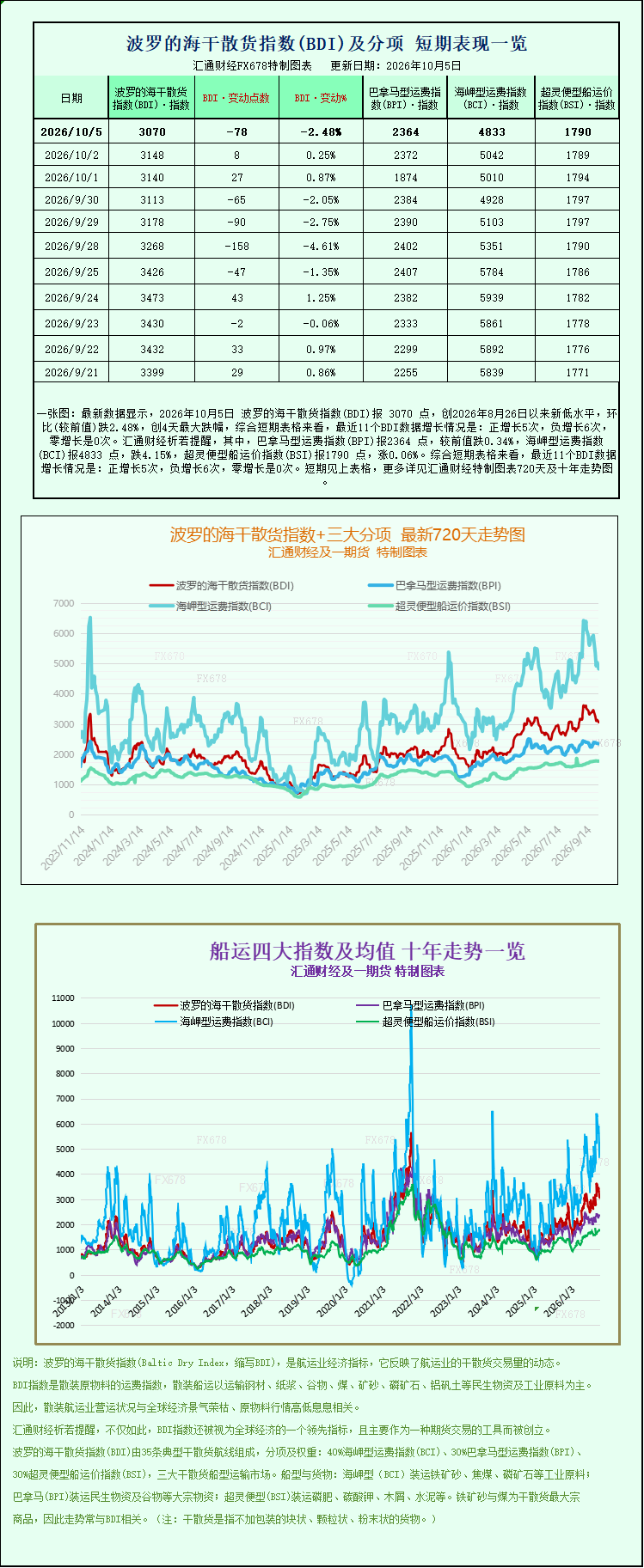 On October 5, 2026, the latest industry data showed a significant correction in the international dry bulk shipping market. The Baltic Dry Index (BDI) ended its two-day winning streak, declining slightly across the board. This decline was mainly due to a sharp drop in freight rates for Capesize and Panamax vessels, the two major types of large bulk carriers. Weak market demand and ample shipping capacity, among other factors, led to a temporary adjustment in the previously moderately recovering shipping market. Meanwhile, smaller vessels bucked the trend with slight increases, indicating a clear structural divergence in the market. Specifically, the Baltic Dry Index (BDI), which tracks freight rates for Capesize, Panamax, and Supramax bulk carriers, fell sharply by 78 points, a 2.5% drop, closing at 3070 points. This ended the short-term rebound and reflects a cooling in the overall global dry bulk shipping market. Looking at the performance of various ship type indices, the market differentiation is particularly evident. Large vessels carrying bulk industrial raw materials are under the most significant pressure on freight rates, while small and medium-sized vessels have maintained stable and resilient prices. As the ship type with the highest weighting in the dry bulk market, Capesize vessels have experienced the most significant decline in this round, becoming the core factor dragging down the overall market. Data shows that the Capesize vessel-specific index plummeted by 209 points in a single day, a drop of 4.2%, closing at 4833 points, the lowest point in nearly a month and a half since August 25th, with the decline far exceeding market expectations. In terms of actual operating revenue, the average daily earnings of 150,000-ton Capesize vessels mainly engaged in the transportation of ultra-large industrial bulk cargoes such as iron ore and coal have fallen sharply by $1898, with the latest daily earnings dropping to $40330, indicating a continued contraction in profit margins. Industry analysts point out that the core reason for the sharp weakening of Capesize vessel freight rates is the continued weakness in global iron ore end-user demand. Currently, steel mills worldwide are generally adopting a cautious production strategy. To mitigate the risks of raw material price fluctuations and control production costs, most mills have proactively reduced capacity and slowed down raw material restocking, resulting in a significant decrease in the volume of international iron ore imports. Simultaneously, the available capacity of Capesize vessels on major global shipping routes continues to rise, particularly in the core shipping regions of East Asia and the Atlantic. This supply-demand imbalance has directly led to a sharp decline in charter orders for large mining vessels, causing freight rates to fall rapidly, and the market benefits brought by the earlier peak season are gradually fading. The medium-sized Panamax vessel market also continued its weak trend, but the decline was relatively moderate. The Panamax index fell slightly by 8 points, or 0.3%, to close at 2364 points, indicating a relatively stable overall market. In terms of vessel operating revenue, Panamax vessels mainly engaged in the transportation of 60,000 to 70,000-ton coal, grain, and other bulk commodities saw an average daily revenue decrease of $76, ultimately closing at $21,273. Compared to the sharp drop in Capesize vessels, Panamax vessels saw a limited decline, mainly due to the rigid global demand for grain shipping, which to some extent offset the weak demand for energy and coal transportation, providing a floor for medium-sized vessel freight rates. In stark contrast to the overall weakness in large vessel types, Supramax vessels, which account for a smaller market share, bucked the trend with a slight increase, demonstrating strong market resilience. The Supramax vessel index rose slightly by 1 point, or 0.1%, closing at 1790 points, achieving the only positive growth. These smaller vessels mainly handle small-volume, multi-category general cargo and regional bulk cargo transportation, with more flexible route layouts. They are less affected by fluctuations in global demand for bulk industrial raw materials, while the stable release of regional short-haul shipping orders supports their freight rates to maintain a stable, slightly upward trend. Looking at recent market trends, this round of dry bulk index correction is a phase of market recovery. The consecutive rises in the index over the previous two trading days were mainly due to market speculation in anticipation of the traditional peak shipping season in the fourth quarter, representing a technical rebound rather than a substantial recovery in demand. As market transactions returned to fundamentals in early October, the reality of weaker-than-expected end-user demand and ample shipping capacity became apparent, naturally leading to a market correction. Regarding future market trends, industry institutions stated that the fourth quarter is traditionally the peak season for dry bulk shipping, and future market movements will heavily depend on the strength of end-user demand. If the pace of global infrastructure and manufacturing resumption accelerates, demand for seaborne industrial raw materials such as iron ore and thermal coal will recover, coupled with support from the concentrated arrival of grain at the end of the year, potentially stabilizing the index. Conversely, if end-user demand remains weak, freight rates for large vessels may continue to fluctuate weakly, and the overall market will maintain a structurally differentiated pattern. Furthermore, the pace of global vessel capacity deployment and changes in the geopolitical shipping environment will also be key variables affecting the dry bulk shipping market in the fourth quarter. This market adjustment also sends a clear signal to the shipping market: the dry bulk shipping market in 2026 has moved beyond a one-sided upward trend, with increasingly pronounced structural characteristics. Differentiation in market conditions for large and small vessels and uneven demand for different types of cargo will become the main norm in future market operations.
On October 5, 2026, the latest industry data showed a significant correction in the international dry bulk shipping market. The Baltic Dry Index (BDI) ended its two-day winning streak, declining slightly across the board. This decline was mainly due to a sharp drop in freight rates for Capesize and Panamax vessels, the two major types of large bulk carriers. Weak market demand and ample shipping capacity, among other factors, led to a temporary adjustment in the previously moderately recovering shipping market. Meanwhile, smaller vessels bucked the trend with slight increases, indicating a clear structural divergence in the market. Specifically, the Baltic Dry Index (BDI), which tracks freight rates for Capesize, Panamax, and Supramax bulk carriers, fell sharply by 78 points, a 2.5% drop, closing at 3070 points. This ended the short-term rebound and reflects a cooling in the overall global dry bulk shipping market. Looking at the performance of various ship type indices, the market differentiation is particularly evident. Large vessels carrying bulk industrial raw materials are under the most significant pressure on freight rates, while small and medium-sized vessels have maintained stable and resilient prices. As the ship type with the highest weighting in the dry bulk market, Capesize vessels have experienced the most significant decline in this round, becoming the core factor dragging down the overall market. Data shows that the Capesize vessel-specific index plummeted by 209 points in a single day, a drop of 4.2%, closing at 4833 points, the lowest point in nearly a month and a half since August 25th, with the decline far exceeding market expectations. In terms of actual operating revenue, the average daily earnings of 150,000-ton Capesize vessels mainly engaged in the transportation of ultra-large industrial bulk cargoes such as iron ore and coal have fallen sharply by $1898, with the latest daily earnings dropping to $40330, indicating a continued contraction in profit margins. Industry analysts point out that the core reason for the sharp weakening of Capesize vessel freight rates is the continued weakness in global iron ore end-user demand. Currently, steel mills worldwide are generally adopting a cautious production strategy. To mitigate the risks of raw material price fluctuations and control production costs, most mills have proactively reduced capacity and slowed down raw material restocking, resulting in a significant decrease in the volume of international iron ore imports. Simultaneously, the available capacity of Capesize vessels on major global shipping routes continues to rise, particularly in the core shipping regions of East Asia and the Atlantic. This supply-demand imbalance has directly led to a sharp decline in charter orders for large mining vessels, causing freight rates to fall rapidly, and the market benefits brought by the earlier peak season are gradually fading. The medium-sized Panamax vessel market also continued its weak trend, but the decline was relatively moderate. The Panamax index fell slightly by 8 points, or 0.3%, to close at 2364 points, indicating a relatively stable overall market. In terms of vessel operating revenue, Panamax vessels mainly engaged in the transportation of 60,000 to 70,000-ton coal, grain, and other bulk commodities saw an average daily revenue decrease of $76, ultimately closing at $21,273. Compared to the sharp drop in Capesize vessels, Panamax vessels saw a limited decline, mainly due to the rigid global demand for grain shipping, which to some extent offset the weak demand for energy and coal transportation, providing a floor for medium-sized vessel freight rates. In stark contrast to the overall weakness in large vessel types, Supramax vessels, which account for a smaller market share, bucked the trend with a slight increase, demonstrating strong market resilience. The Supramax vessel index rose slightly by 1 point, or 0.1%, closing at 1790 points, achieving the only positive growth. These smaller vessels mainly handle small-volume, multi-category general cargo and regional bulk cargo transportation, with more flexible route layouts. They are less affected by fluctuations in global demand for bulk industrial raw materials, while the stable release of regional short-haul shipping orders supports their freight rates to maintain a stable, slightly upward trend. Looking at recent market trends, this round of dry bulk index correction is a phase of market recovery. The consecutive rises in the index over the previous two trading days were mainly due to market speculation in anticipation of the traditional peak shipping season in the fourth quarter, representing a technical rebound rather than a substantial recovery in demand. As market transactions returned to fundamentals in early October, the reality of weaker-than-expected end-user demand and ample shipping capacity became apparent, naturally leading to a market correction. Regarding future market trends, industry institutions stated that the fourth quarter is traditionally the peak season for dry bulk shipping, and future market movements will heavily depend on the strength of end-user demand. If the pace of global infrastructure and manufacturing resumption accelerates, demand for seaborne industrial raw materials such as iron ore and thermal coal will recover, coupled with support from the concentrated arrival of grain at the end of the year, potentially stabilizing the index. Conversely, if end-user demand remains weak, freight rates for large vessels may continue to fluctuate weakly, and the overall market will maintain a structurally differentiated pattern. Furthermore, the pace of global vessel capacity deployment and changes in the geopolitical shipping environment will also be key variables affecting the dry bulk shipping market in the fourth quarter. This market adjustment also sends a clear signal to the shipping market: the dry bulk shipping market in 2026 has moved beyond a one-sided upward trend, with increasingly pronounced structural characteristics. Differentiation in market conditions for large and small vessels and uneven demand for different types of cargo will become the main norm in future market operations.
- Risk Warning and Disclaimer
- The market involves risk, and trading may not be suitable for all investors. This article is for reference only and does not constitute personal investment advice, nor does it take into account certain users’ specific investment objectives, financial situation, or other needs. Any investment decisions made based on this information are at your own risk.