What really changed after gold prices suddenly stabilized and oil prices fell below $100?
2026-10-06 19:30:17
On Tuesday, October 6th, spot gold was trading around $4160 per ounce, up about 0.5% on the day. Meanwhile, Brent crude oil fell to around $98.50 per barrel, returning below $100; the yield on the 30-year US Treasury note fell from a 2002 high of 5.702% the previous day to 5.626%. This makes the core contradiction for gold even clearer: the decline in energy prices has reduced the pressure of further inflationary acceleration, but long-term interest rates remain at historically high levels, and the opportunity cost of non-interest-bearing assets has not significantly disappeared. 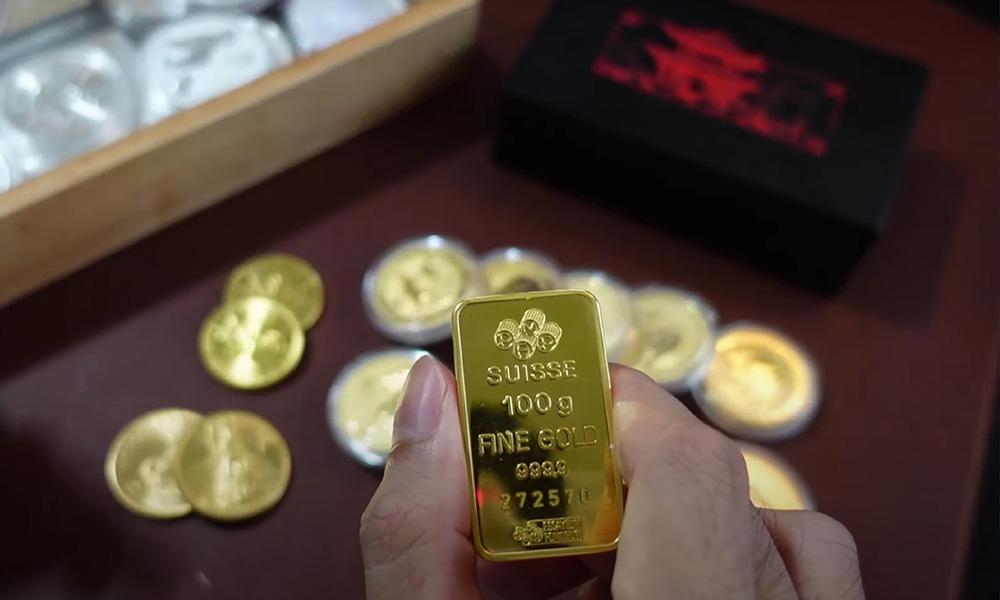
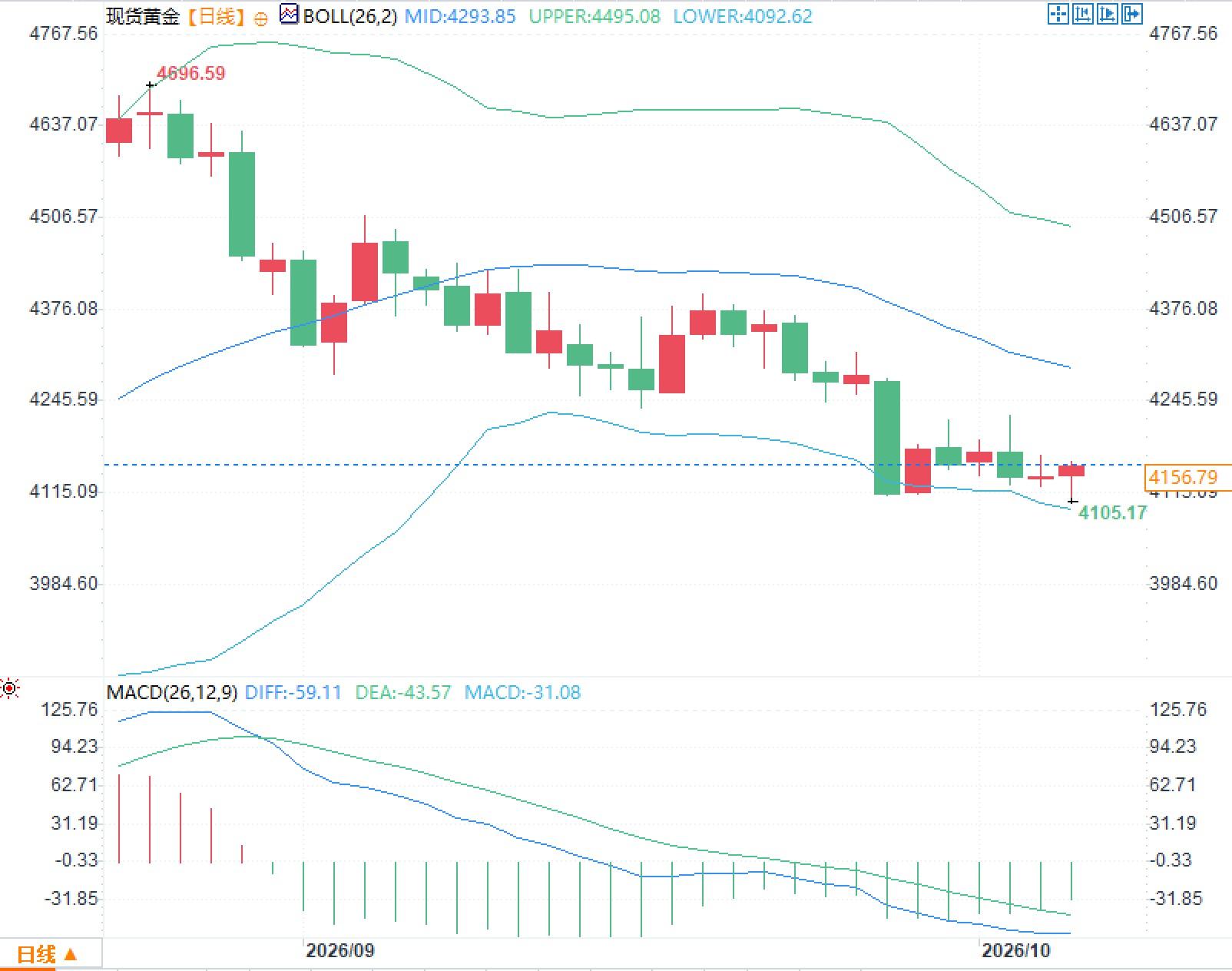 Regarding the MACD, the DIFF is -59.11, the DEA is -43.57, and the histogram is -31.08. Both lines are below the zero axis, and the DIFF is lower than the DEA, indicating that the previous negative momentum still exists. However, with the recent narrowing of price fluctuations, the effectiveness of relying solely on trend indicators will also decrease.
Why has the decline in oil prices become a key variable in the short-term pricing of gold?
Spot gold fell 6.6% in September, not because the traditional safe-haven logic suddenly failed, but because three variables—energy inflation, long-term yields, and the US dollar—simultaneously exerted downward pressure. After the rapid rise in oil prices, the market began to reassess inflation stickiness and how long the Federal Reserve needed to maintain a tighter policy, leading to a significant increase in bond yields. While gold has inflation-hedging properties, its holding costs rise when rising inflation directly translates into higher nominal and real interest rates. The change on October 6th was due to the resilience of Middle Eastern oil exports and the release of emergency inventories easing temporary supply concerns, causing Brent crude to fall below $100. The decline in energy prices primarily affects the inflation risk premium, and only secondarily affects gold itself. This explains why gold and bonds received some support on that day: the market was not simply increasing safe-haven allocations, but rather reducing the pricing of the previous extreme combination of inflation and interest rate hikes.Gold is truly dealing with real interest rates, not just the probability of a single interest rate hike.
The Federal Reserve raised its target range for the federal funds rate by 25 basis points to 3.75% to 4.00% at its September meeting, marking the first rate hike in three years. Currently, the market's pricing in another rate hike in October has fallen to about 20%, but the probability of further tightening in December remains close to 70%. This means that the constraints on gold have not been completely removed despite the decreased probability of an October rate hike; the market is merely redistributing policy risks from near-term points to longer-term horizons. More noteworthy is the US inflation itself. The overall personal consumption expenditure price index in August was 3.4% year-on-year, and the core index was 3.0% year-on-year, still significantly higher than the Fed's 2% target. Fed Vice Chairman Jefferson stated on October 1st that inflation is "too high and too long," and believes that there are still upside risks to inflation. Governor Barr also recently believes that further policy adjustments may still be necessary. Therefore, for gold, the determining factor for valuation pressure is not whether a particular meeting raises rates, but rather when real interest rates can stabilize and decline, and whether the term premium of long-term bonds can cool down.The key to the meeting minutes is not the conclusions, but the Federal Reserve's reaction function.
The minutes of the September meeting will be released on October 7th. What the market really needs to confirm is how policymakers weigh energy prices, cooling employment, and sticky inflation. The latest employment data was weaker than expected, accompanied by downward revisions to previous months' data, causing expectations of an October rate hike to decline rapidly. However, at the same time, long-term Treasury yields remain at multi-year highs, indicating that the bond market is concerned not only about short-term policy rates but also about long-term inflation, fiscal supply, and term premiums. Therefore, there is currently a clear term misalignment in gold pricing: short-term policy expectations have cooled, while long-term financing costs remain high. Focusing solely on the probability of a rate hike underestimates the macroeconomic constraints facing gold. More explanatory indicators are real yields, the shape of the yield curve, and the transmission of energy prices to inflation expectations, rather than a single meeting probability.The technical structure indicates weak momentum, but the volatility characteristics are changing.
Observing the daily chart, spot gold is still trading below the Bollinger Middle Band and close to the lower band. The Middle Band continues to slope downward, indicating that the previous downward shift in the price center has not yet been technically corrected. At the same time, the recent candlestick bodies have shortened significantly, and the upper and lower shadows have become more intertwined, showing that the intraday volatility after the rapid decline is shifting from unilateral expansion to convergence and repeated pricing. Regarding the MACD, the DIFF is -59.11, the DEA is -43.57, and the histogram is -31.08. Both lines are below the zero axis, and the DIFF is lower than the DEA, indicating that the previous negative momentum still exists. However, with the recent narrowing of price fluctuations, the effectiveness of relying solely on trend indicators will also decrease.Frequently Asked Questions
Question 1: Why does the drop in oil prices provide some buffer for spot gold? Answer: Currently, the main channel through which oil prices affect gold is not safe-haven demand, but rather inflation and interest rate expectations. Lower energy prices reduce market concerns about persistently rising inflation and lower the probability of further rapid monetary tightening, thus alleviating opportunity cost pressures on gold. However, this impact still depends on whether bond yields fall in tandem. Question 2: With the probability of a Fed rate hike in October falling to about 20%, does this mean that interest rate pressures on gold have disappeared? Answer: Not at all. Expectations of further tightening in December still exist, and long-term Treasury yields are at multi-year highs. Gold is more sensitive to real interest rates and holding costs than the single probability of a particular meeting.- Risk Warning and Disclaimer
- The market involves risk, and trading may not be suitable for all investors. This article is for reference only and does not constitute personal investment advice, nor does it take into account certain users’ specific investment objectives, financial situation, or other needs. Any investment decisions made based on this information are at your own risk.