Supply recovery in the Gulf suppressed geopolitical premiums, leading to a slight decline in international oil prices.
2026-10-06 20:36:17
International oil prices continued to decline on Tuesday (October 6). Despite ongoing geopolitical tensions in the Red Sea and the Persian Gulf, several crude oil export routes from Gulf oil-producing countries gradually resumed operation, providing positive news to the market from the supply side. Progress in the Yemeni government forces' counter-offensive at Mocha port, rapid repairs to Saudi Arabia's East-West oil pipeline, a rebound in Kuwaiti production, and Iraq's increased chartering of ships for oil transport all contributed to reducing the previously priced-in premium for supply disruptions. Analysts point out that the supply recovery is only marginal, and the risk of recurring regional conflicts remains high, providing strong support for the central oil price level. The core reason for this round of price declines is not the disappearance of geopolitical conflicts, but rather the market's gradual disproving of the extreme expectation of a "large-scale supply disruption of Middle Eastern crude oil," with some of the geopolitical risk premium previously priced into oil prices being digested. 
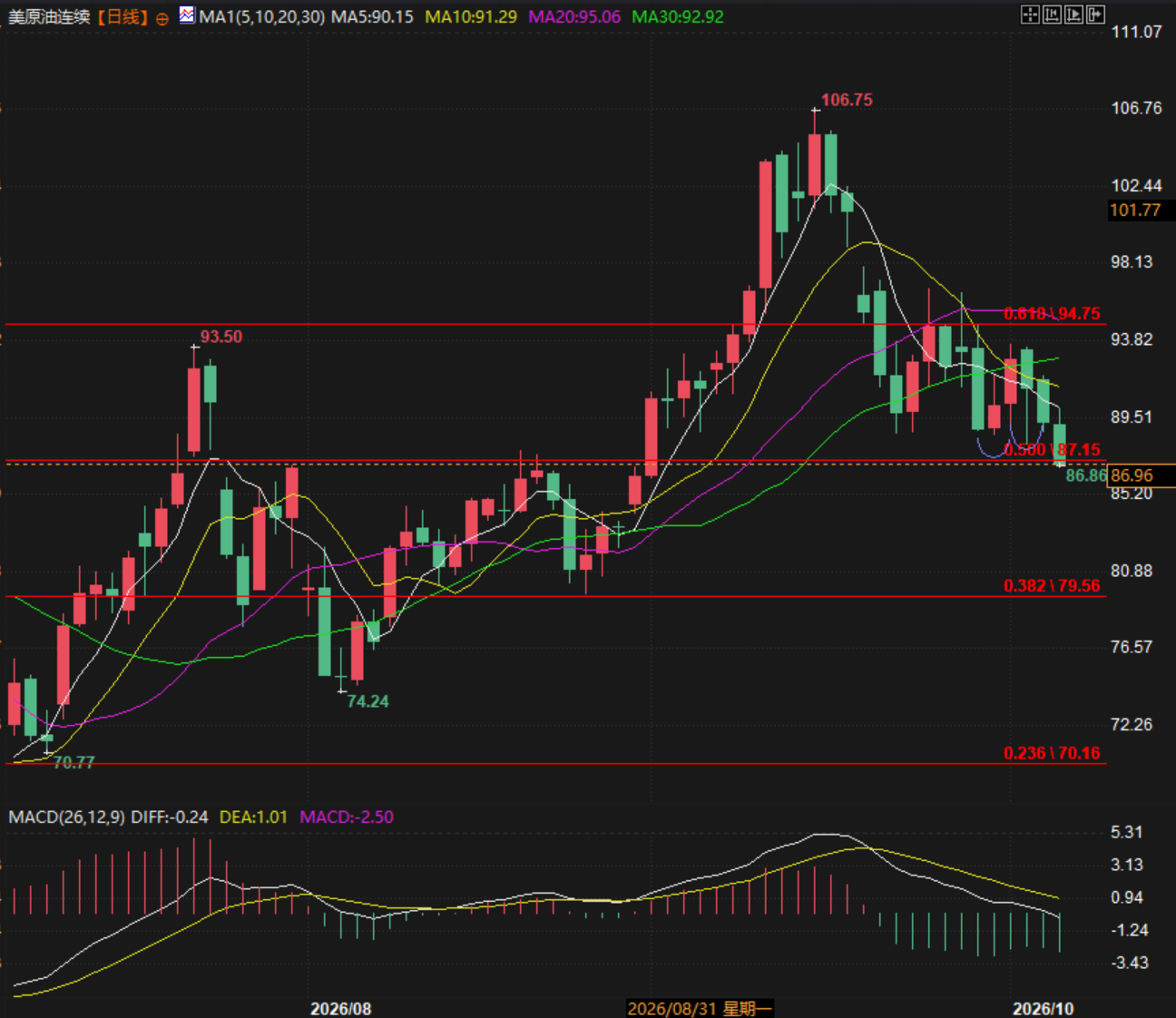 (WTI crude oil futures main contract daily chart, source: EasyForex) WTI crude oil futures main contract is currently trading at $87.14 per barrel.
Saudi Arabia's East-West oil pipeline is being rapidly repaired, and the Red Sea alternative export route is returning to high levels.
Saudi Energy Minister Abdulaziz bin Salman revealed at an event in Bahrain that the Saudi East-West oil pipeline is currently transporting 5.8 million barrels per day. This pipeline, traversing the Arabian Peninsula, was forced to shut down on September 10 after a drone attack from Iraq, raising concerns that Saudi Arabia's core export route bypassing the Strait of Hormuz would be paralyzed. However, Saudi Arabia restored production in just five to six days, and the current transport capacity is approaching 80% of the pipeline's total capacity of 7 million barrels per day, with approximately 4.5 million barrels per day of crude oil being transported directly to the Red Sea port of Yanbu for export. The East-West pipeline is Saudi Arabia's most important "alternative to the Strait of Hormuz." When Persian Gulf shipping is disrupted by geopolitical conflicts, this pipeline can directly transport crude oil from eastern oil fields to the Red Sea port of Yanbu, avoiding the shipping risks of the Strait of Hormuz. The rapid restoration of the pipeline's capacity directly alleviated market concerns about the disruption of Saudi crude oil exports, becoming a key supply variable suppressing oil prices.The border easing of the conflict in Yemen has reduced expectations of risks in the Red Sea shipping lanes.
Yemeni government forces launched a large-scale counter-offensive, claiming to have recaptured the strategic Red Sea port of Mocha from the Iranian-backed Houthi rebels. Located approximately 75 kilometers north of the Bab el-Mandeb Strait, Mocha is a key stronghold controlling the Red Sea oil shipping route. Previously, the Houthis seized Mocha in early September, raising market concerns that they would gain complete control of the Strait, directly threatening the passage of oil tankers in the Red Sea. Meanwhile, Saudi Arabia, Turkey, and Pakistan reached a consensus to deploy forces and launch deterrence operations against the Houthis. Although the Houthis denied the loss of Mocha, and attacks occurred on Monday night at the Jizan and Najran airports in Saudi Arabia, resulting in injuries, indicating the conflict is not over, the battlefield progress made by government forces along the Red Sea coast has reduced the market's extreme prediction of a complete blockade of the Bab el-Mandeb Strait, leading to a decline in tail risk pricing for Red Sea shipping.Production and shipping capacity in many Gulf countries are recovering simultaneously, and traffic in the Strait of Hormuz is picking up.
Besides the pipeline repairs in Saudi Arabia, crude oil supplies from other Gulf oil-producing countries are also steadily recovering. Kuwait stated that its crude oil production has recovered to 75% of pre-war levels before the Iran-Iraq War; Iraq is actively leasing more tankers to expand its crude oil exports via the Strait of Hormuz. The simultaneous restoration of production and shipping capacity by multiple countries has led to a continued rebound in Persian Gulf crude oil outflows. ING Energy's strategy team pointed out in its latest research report that signs of a recovery in Persian Gulf crude oil flows are increasing, and the market is reassessing the probability of Middle Eastern supply disruptions. However, the institution emphasized that this recovery is a marginal improvement, not a complete elimination of risk.A decline in risk premiums does not mean the crisis is over; oil prices have solid support on the downside.
The recent decline in oil prices is essentially a retracement of risk premiums, not a shift in fundamentals to a bear market. On one hand, while progress has been made in the battle for Mocha port and Saudi pipelines have resumed operation, the Houthi rebels still possess long-range strike capabilities. Attacks on Saudi civilian facilities demonstrate that regional conflicts remain unpredictable, and any new infrastructure attacks could quickly push up oil prices. On the other hand, the Strait of Hormuz, a crucial global oil shipping route, remains uncertain in terms of navigation safety. ING believes that market tensions will only subside significantly once substantial progress is made on a deal between the US and Iran, and the risk of further escalation remains a real concern.Easing energy inflation has put downward pressure on market interest rates and the US dollar index.
As previously discussed, US nominal interest rates are primarily influenced by the domestic economic situation, concerns about US debt, and the inflation risk premium. Currently, the first two are unlikely to change significantly in the short term. Consequently, falling oil prices have reduced the inflation risk premium, leading to a rapid decline in US Treasury yields. Interestingly, because the European economic fundamentals are highly sensitive to oil prices, falling oil prices also lead to a stronger euro. This has resulted in a simultaneous weakening of the US dollar and US Treasury yields due to rising oil prices. The conclusion is that this is a direct benefit to the euro, gold prices, and technology stocks.Summarize:
In the short term, the restoration of export routes from Gulf countries and the partial improvement in the situation in Yemen have jointly suppressed the previously excessive geopolitical panic premium, leading to a slight correction in oil prices. However, Middle Eastern geopolitical conflicts are highly unpredictable, and the vulnerability of supply recovery remains high, suggesting that oil prices will maintain a high-level fluctuation pattern. In terms of trading, the market will continue to focus on two main themes: first, the continued stable operation of Saudi Arabia's East-West pipeline and Yanbu Port; and second, whether new attacks targeting energy infrastructure will occur in Yemen and the Persian Gulf. Simultaneously, oil prices have a dual impact on the US dollar and US Treasury bonds; a drop in oil prices directly benefits dollar-denominated assets. (WTI crude oil futures main contract daily chart, source: EasyForex) WTI crude oil futures main contract is currently trading at $87.14 per barrel.
- Risk Warning and Disclaimer
- The market involves risk, and trading may not be suitable for all investors. This article is for reference only and does not constitute personal investment advice, nor does it take into account certain users’ specific investment objectives, financial situation, or other needs. Any investment decisions made based on this information are at your own risk.