With the spread between French and German bond yields still exceeding 100 basis points, why is the euro struggling to escape the pull of the bond market?
2026-10-07 15:34:27
On Wednesday, October 7th, the core contradiction in European asset pricing has shifted from a simple interest rate differential to a combination of factors: inflationary constraints, fiscal risk, and sovereign credit premium. The euro was last quoted at around 1.122 against the US dollar, having touched a 17-month low of around 1.1160 on October 5th. Meanwhile, the spread between French and German 10-year bond yields narrowed to 127.4 basis points on October 6th, but remained significantly higher than the 80-90 basis point level seen in early September. While pressure on the French bond market has eased somewhat, it is far from returning to its normal pricing range. 
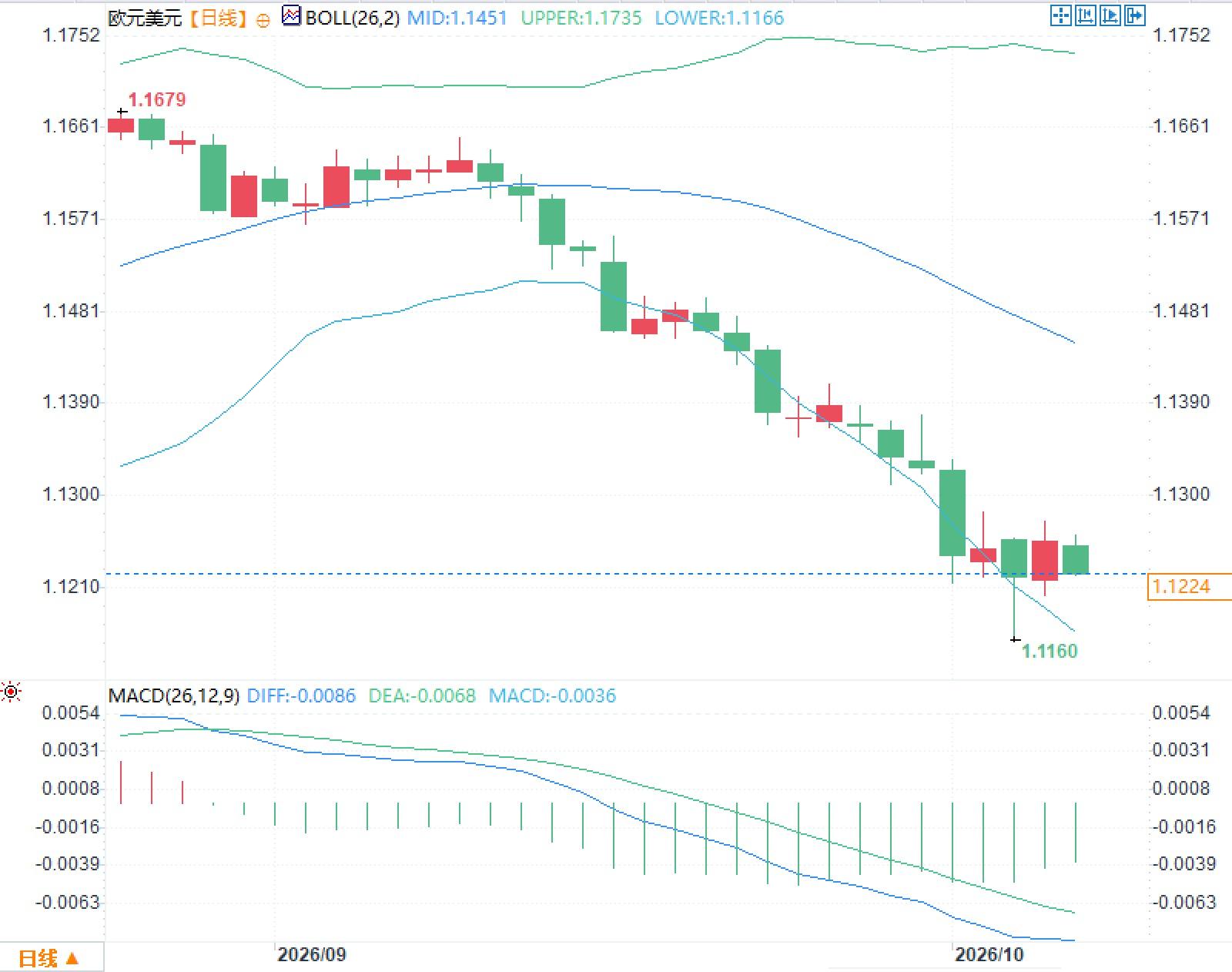 The MACD's DIFF is approximately -0.0086, and the DEA is approximately -0.0068, both lines below the zero line, indicating that the previously formed negative price momentum has not yet been fully digested by the medium-term moving average system. More importantly, the correlation between recent euro price movements and the yield spread between French and German government bonds has significantly strengthened. On October 6th, when French bond yields fell and the spread narrowed, the euro rose approximately 0.27% against the dollar; on October 7th, after the dollar index rose slightly to around 102.10, the euro came under pressure again. This shows that the exchange rate is currently influenced by three pricing factors simultaneously: European fiscal risk, European Central Bank policy constraints, and Federal Reserve interest rate expectations, rather than being dominated by a single economic data factor.
The French bond market truly prices fiscal credibility.
The key to recent volatility in French government bonds is not the change in daily yields, but rather the market's reassessment of fiscal constraints for the coming years. The French government plans to reduce its fiscal deficit as a percentage of GDP from 5.4% in 2026 to 5% in 2027. The problem is that this target requires both spending control and revenue adjustments, and whether the budget can successfully form a sustainable fiscal path directly impacts long-term financing costs. On October 2nd, the spread between French and German 10-year bond yields reached 146.9 basis points before falling back to 127.4 basis points. This narrowing spread indicates a slight reduction in the most concentrated risk premium, but it remains high compared to a month ago. This change is even more significant than the French bond yield itself, because France is a core large economy in the Eurozone. If its sovereign risk premium remains abnormally high for an extended period, the market will recalculate the overall risk compensation required for Euro assets. French central bank governor Emmanuel Moulin said on October 7 that the current situation is "serious," but the European Central Bank's responsibility is to achieve price stability, not to deal with the fiscal problems of member states, and the conditions for the European Central Bank to intervene in the French bond market are not present at this stage.Inflation is rebounding, and the European Central Bank's policy space is constrained.
As the French bond market comes under pressure, the European Central Bank (ECB) does not have unlimited room to buffer market volatility. The preliminary reading of the Eurozone's Harmonized Index of Consumer Prices (HICP) rose to 3.8% year-on-year in September, up from 3.2% in August; energy prices rose 18.8% year-on-year, service prices rose 3.2% year-on-year, and the figure excluding energy, food, alcohol, and tobacco was 2.5% year-on-year. This means that overall inflation remains significantly below the 2% medium-term target. In September, the ECB raised its deposit facility rate by 25 basis points to 2.50%, the main refinancing rate to 2.65%, and the marginal lending rate to 2.90%. While its policy framework retains transmission protection tools, the official definition emphasizes that these tools target disorderly market dynamics lacking fundamental support and seriously threatening the transmission of monetary policy, rather than being automatically activated when a member state's financing costs reach a specific level. Therefore, a unique constraint exists between French risks and ECB policy: excessively high government bond yields will suppress demand and tighten financial conditions, but high inflation limits the rapid easing of monetary conditions. European Central Bank Chief Economist Philip Lane recently pointed out that rising energy prices are creating inflationary pressures, while higher long-term yields, financing costs, and future fiscal contraction will suppress economic activity. Therefore, policies need to be assessed on a data-driven basis.The technical structure of the euro against the US dollar reflects that the risk premium has not yet been fully priced in.
From a daily chart perspective, the euro/dollar pair is trading below the Bollinger Middle Band after a period of decline. The Bollinger Middle Band is around 1.1451, and the Lower Band is around 1.1166. The exchange rate recently tested the area near the Lower Band. On October 6th, the exchange rate rebounded by approximately 0.27%, and on October 7th, it experienced another intraday pullback of approximately 0.3%. The MACD's DIFF is approximately -0.0086, and the DEA is approximately -0.0068, both lines below the zero line, indicating that the previously formed negative price momentum has not yet been fully digested by the medium-term moving average system. More importantly, the correlation between recent euro price movements and the yield spread between French and German government bonds has significantly strengthened. On October 6th, when French bond yields fell and the spread narrowed, the euro rose approximately 0.27% against the dollar; on October 7th, after the dollar index rose slightly to around 102.10, the euro came under pressure again. This shows that the exchange rate is currently influenced by three pricing factors simultaneously: European fiscal risk, European Central Bank policy constraints, and Federal Reserve interest rate expectations, rather than being dominated by a single economic data factor.Frequently Asked Questions
Question 1: The spread between French and German government bond yields has narrowed significantly. Does this mean the fiscal risk is over? Answer: This is not the case. Although the spread between French and German 10-year government bond yields has fallen from its early October high to approximately 127 basis points, it is still significantly higher than the level in early September. The market has only reduced some of the extreme risk premium. Whether the fiscal deficit target can be achieved and whether budget constraints can be sustained still determine medium- to long-term credit pricing. Question 2: Why didn't the ECB immediately intervene due to the volatility in the French bond market? Answer: The ECB's core mandate remains price stability. Currently, the preliminary inflation estimate for the Eurozone in September reached 3.8%. Transmission protection tools are aimed at disorderly market conditions that severely affect the transmission of monetary policy, not at directly reducing the financing costs of a member state due to fiscal problems.- Risk Warning and Disclaimer
- The market involves risk, and trading may not be suitable for all investors. This article is for reference only and does not constitute personal investment advice, nor does it take into account certain users’ specific investment objectives, financial situation, or other needs. Any investment decisions made based on this information are at your own risk.