Why has the yen's reaction to interest rate hike statements been limited? What is the market waiting for?
2026-10-07 16:42:18
On Wednesday, October 7th, the USD/JPY pair was fluctuating around 158. Currently, the core of exchange rate pricing is no longer just the static interest rate differential, but rather whether the Bank of Japan's policy normalization can continue to materialize, and how the Federal Reserve's subsequent policy path will reshape interest rate expectations at both ends. The Bank of Japan's latest policy rate has risen to 1.25%, while the Federal Reserve's target range for the federal funds rate is 3.75%-4.00%. The nominal policy rate differential remains wide, but the importance of marginal changes is clearly increasing. 
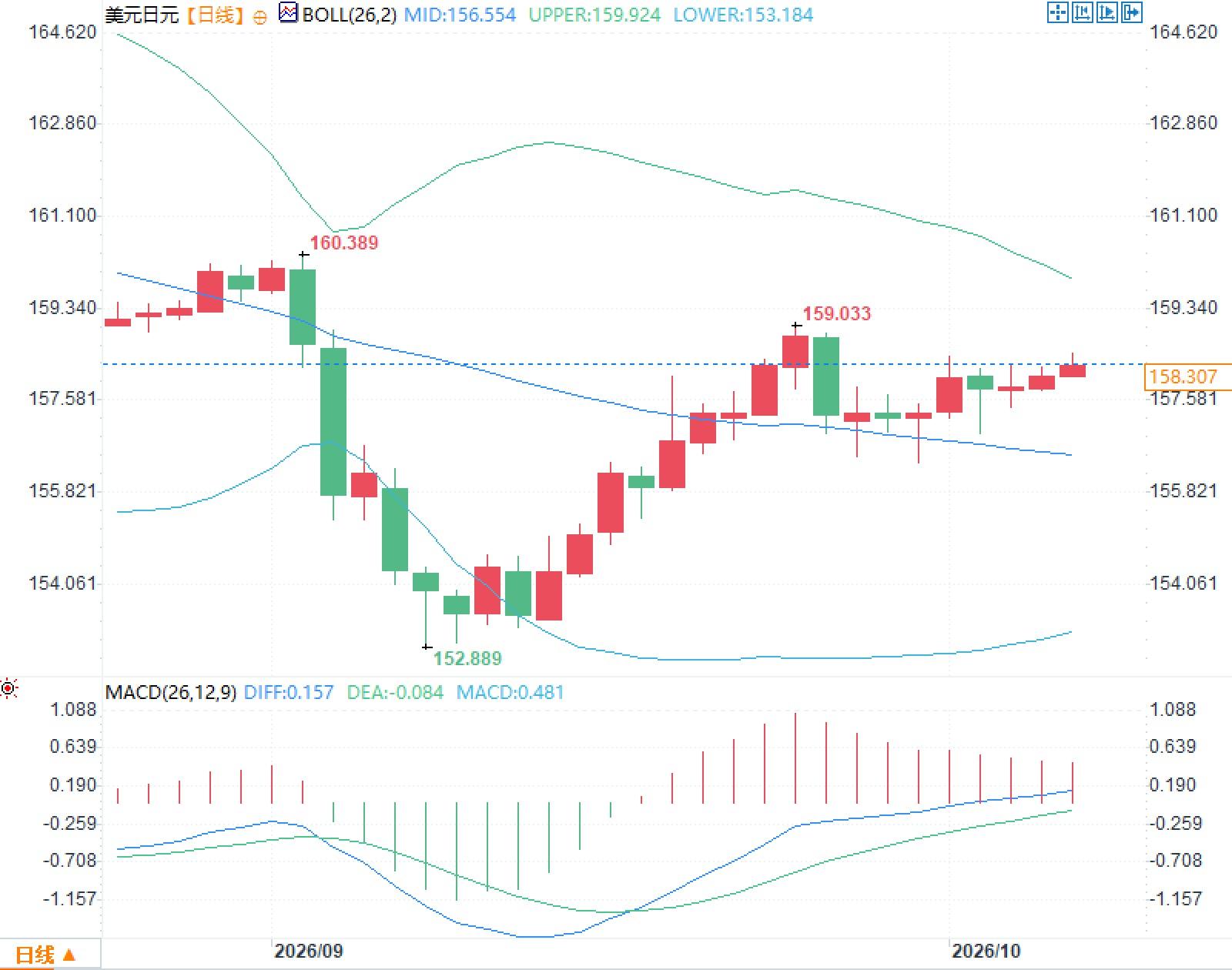 More informative is whether the indicators resonate with each other. For example, when price volatility contracts, if policy expectations and the yield curve change simultaneously, exchange rate sensitivity may increase significantly; conversely, if changes in policy expectations are not confirmed by bond yields and capital flow data, the explanatory power of technical indicators themselves will decrease.
Policy normalization has entered the verification stage, and the pricing logic of the yen has changed.
The Bank of Japan's current policy focus is gradually shifting from confirming whether inflation is sustainable to preventing potential inflation from deviating from the 2% target. On October 6th, Kazuo Ueda emphasized the increasing importance of stabilizing potential inflation at around 2%, noting that import costs, AI-related demand, and a weaker yen could all increase upward pressure on prices. The September meeting had already raised the policy rate to 1.25%, meaning that Japanese monetary policy is no longer simply exiting ultra-loose policies, but rather entering a phase of realigning interest rates with the inflation environment. The latest Japanese business survey further illustrates this policy shift. The business sentiment index for large manufacturers rose from 22 to 24 in September, while that for large non-manufacturing companies fell from 37 to 35, indicating both resilience in the manufacturing sector and pressure on the service sector. Businesses' average expectation for the USD/JPY exchange rate in fiscal year 2026 is 154.23, while the current market exchange rate deviates significantly from this assumption, increasing uncertainty regarding import costs, corporate budgets, and price transmission.Japanese bond yields rose, but the high yields also attracted allocation funds.
Another important constraint is emerging in the bond market. The average yield on 10-year Japanese government bonds auctioned on October 6th reached 3.101%, with competitive bidding totaling approximately 7.4 trillion yen and actual acceptance of approximately 1.97 trillion yen, resulting in a bid-to-cover ratio of approximately 3.76. Even after yields entered the 3% range, the demand for long-term capital allocation remains, indicating that rising bond yields do not necessarily evolve into sustained, disorderly selling pressure. This has a complex impact on the yen. On the one hand, higher domestic yields reduce the yield advantage of overseas assets relative to Japanese assets, helping to change the logic of long-term capital allocation; on the other hand, if bond auction demand remains stable, the pressure for a rapid rise in long-term yields may also be suppressed. Therefore, for the exchange rate, the key variable is not a single change in bond yields, but whether the Bank of Japan's policy rate, long-term real yields, and institutional asset allocation adjust in tandem. The Government Pension Investment Fund of Japan has also recently become a focus of market attention. Previously, the market discussed the possibility of it increasing its domestic asset allocation, but the latest information shows that the September meeting did not produce a clear signal of asset allocation adjustment. After related expectations cooled, some structural capital flow assumptions previously formed around the yen were repriced.The US dollar outlook offers no single answer, and technical indicators are in a transitional phase.
The US dollar also faces significant internal contradictions. The US Personal Consumption Expenditures (PCE) price index rose 3.4% year-on-year in August, while the core index rose 3.0%, indicating inflation remains above the Fed's long-term target. However, non-farm payrolls increased by only 29,000 in September, and the unemployment rate rose to 4.2%, showing weak employment data. Therefore, the Fed faces an environment of both sticky inflation and cooling employment, and relying solely on US interest rates to explain the USD/JPY exchange rate is no longer sufficient. Looking at the daily chart, the USD/JPY pair has entered a sideways consolidation phase after recovering from its September lows. The price is currently above the Bollinger Middle Band and below the Upper Band, with the Middle Band still slightly trending downwards. The MACD fast line has returned to near the zero line, while the slow line remains below the zero line, and the histogram is positive. More informative is whether the indicators resonate with each other. For example, when price volatility contracts, if policy expectations and the yield curve change simultaneously, exchange rate sensitivity may increase significantly; conversely, if changes in policy expectations are not confirmed by bond yields and capital flow data, the explanatory power of technical indicators themselves will decrease.Frequently Asked Questions
Question 1: The Bank of Japan has repeatedly pushed forward with policy normalization, so why hasn't the yen formed a stable one-sided trend? Answer: Exchange rates depend on relative interest rates, not a single interest rate. Although the Japanese policy rate has risen to 1.25%, there is still a significant gap between it and the Federal Reserve's policy range. Meanwhile, energy import costs, global capital allocation, and institutional hedging demand all affect the yen's performance. Therefore, policy normalization needs further verification through the yield curve and capital flows. Question 2: The 10-year Japanese government bond yield exceeds 3%, so why does bond demand remain strong? Answer: Rising yields mean increased maturity compensation for holding long-term bonds. The latest auction bid-to-cover ratio is approximately 3.76, indicating that some long-term institutions believe the current yield offers investment value. This reflects interest rate normalization and may also limit the short-term disorderly rise in long-term yields.- Risk Warning and Disclaimer
- The market involves risk, and trading may not be suitable for all investors. This article is for reference only and does not constitute personal investment advice, nor does it take into account certain users’ specific investment objectives, financial situation, or other needs. Any investment decisions made based on this information are at your own risk.